Podcast to Social Media Service: Transform Episodes Into
Discover how a podcast to social media service converts one episode into 30+ assets. Compare DIY, agency, and done-for-you costs to find the best fit for 2026.

A podcast to social media service turns each episode into a steady stream of ready-to-publish clips, posts, and graphics, so the show keeps working after release. The best services take one 45-minute recording and turn it into 20 to 30 assets, then package those assets into a monthly social cadence instead of a one-day launch spike.
Most podcast owners don't have a content problem. They have an execution problem. 73% of B2B marketers say recorded content is their primary source of high-quality leads, yet only 33% have a scalable system to repurpose those recordings into new assets (recorded content lead gen gap). That gap explains why strong episodes still disappear after publish day.
A podcast can be thoughtful, useful, and well produced. It can still underperform on social because nobody turned the conversation into native content for LinkedIn, YouTube Shorts, Instagram Reels, TikTok, X, and email. That work is slow. It also needs judgment. Social agencies often fill the gap by writing from scratch. That usually means they approximate the host's voice. Repurposing from the recording is different. The voice is already there.
Why Your Podcast Isn't Growing on Social Media
A lot of podcast owners assume growth stalls because the show isn't strong enough. That's usually the wrong diagnosis. The show may be fine. The system around it is weak.
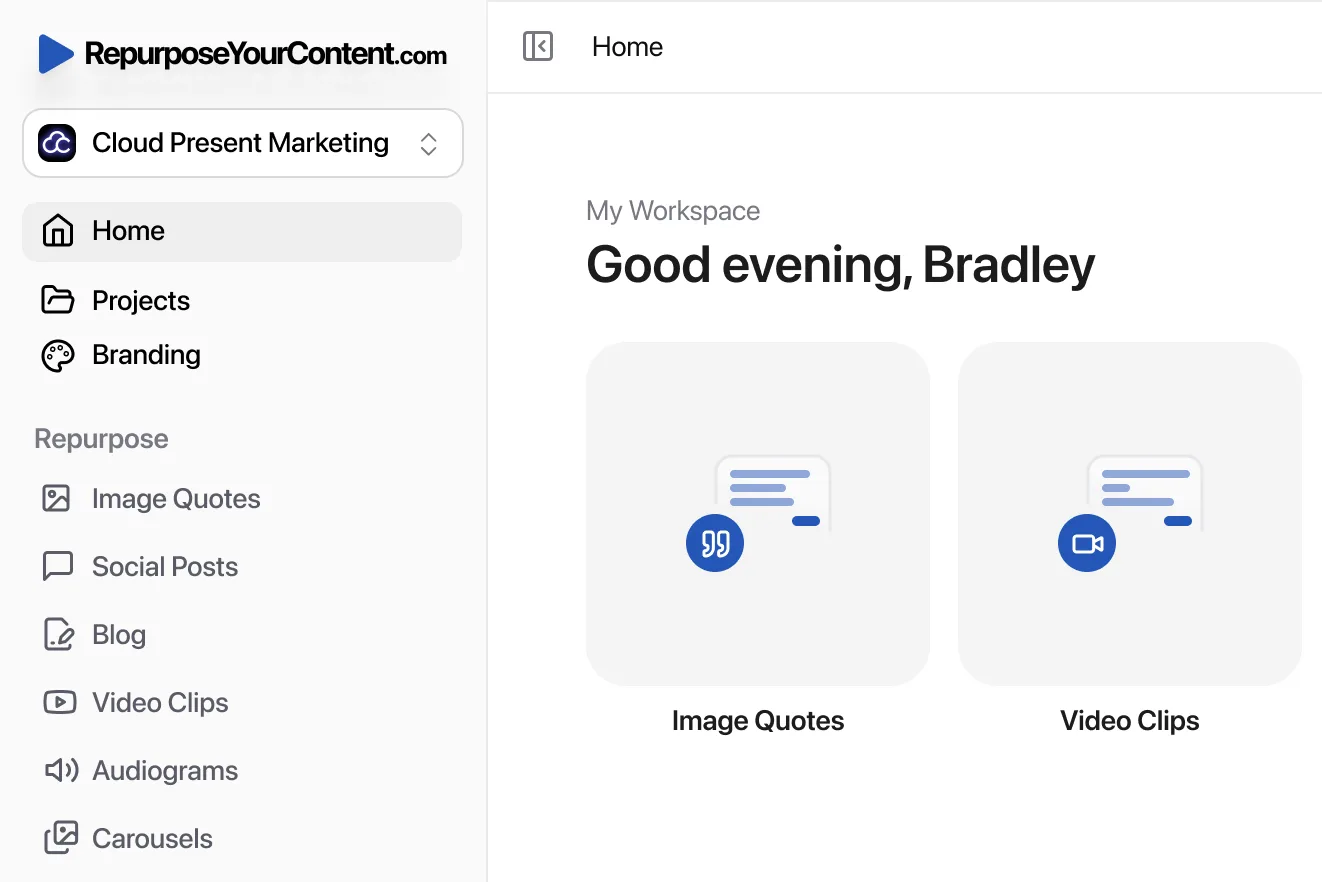
A podcast to social media service handles the social layer after recording. It takes the raw episode and turns it into a repeatable set of social assets that can keep your brand visible for the rest of the month. That means clips for reach, text posts for discussion, quote graphics for consistency, carousels for saves, and supporting copy that fits each channel.
The real bottleneck is distribution work
Publishing the full episode isn't promotion. It's distribution. Promotion starts after that.
For a podcast owner, the weekly reality looks like this:
- The episode goes live: audio hits Spotify, Apple Podcasts, or YouTube.
- A single clip gets posted: usually because that's all the team had time for.
- Then the feed goes quiet: no follow-up posts, no calendar, no platform-specific formatting.
That pattern kills momentum. Social growth comes from frequency and fit. One episode should feed the channel for weeks.
Practical rule: If the team still asks, "What should be posted this week?" the repurposing system isn't built yet.
The operational issue gets worse when the podcast is part of a B2B growth motion. The recording contains founder expertise, customer language, objections, stories, and point of view. Those are the ingredients for pipeline content. But if nobody extracts them, the value stays trapped in the full episode.
Podcasters trying to patch this with ad hoc promotion usually end up in a scramble after launch. A better approach is a fixed social engine around every episode. The show gets recorded once. The post-production system does the rest. For teams still stuck in launch-day thinking, this guide on how to promote a podcast episode after launch is a useful next step.
What a Good Podcast to Social Media Service Delivers
Only a small share of any podcast episode will ever be consumed in full. Growth usually comes from the shorter assets that carry the best moments into feeds where buyers already spend time.
A good podcast to social media service turns one recording into a repeatable lead generation system. The difference is operational. A traditional social agency usually interviews the client, studies brand guidelines, and writes posts that approximate the founder or host. A strong repurposing service starts with recorded source material, then extracts the actual language, stories, objections, and point of view already said on mic. That gap matters. One model creates social content. The other turns real expertise into demand capture.
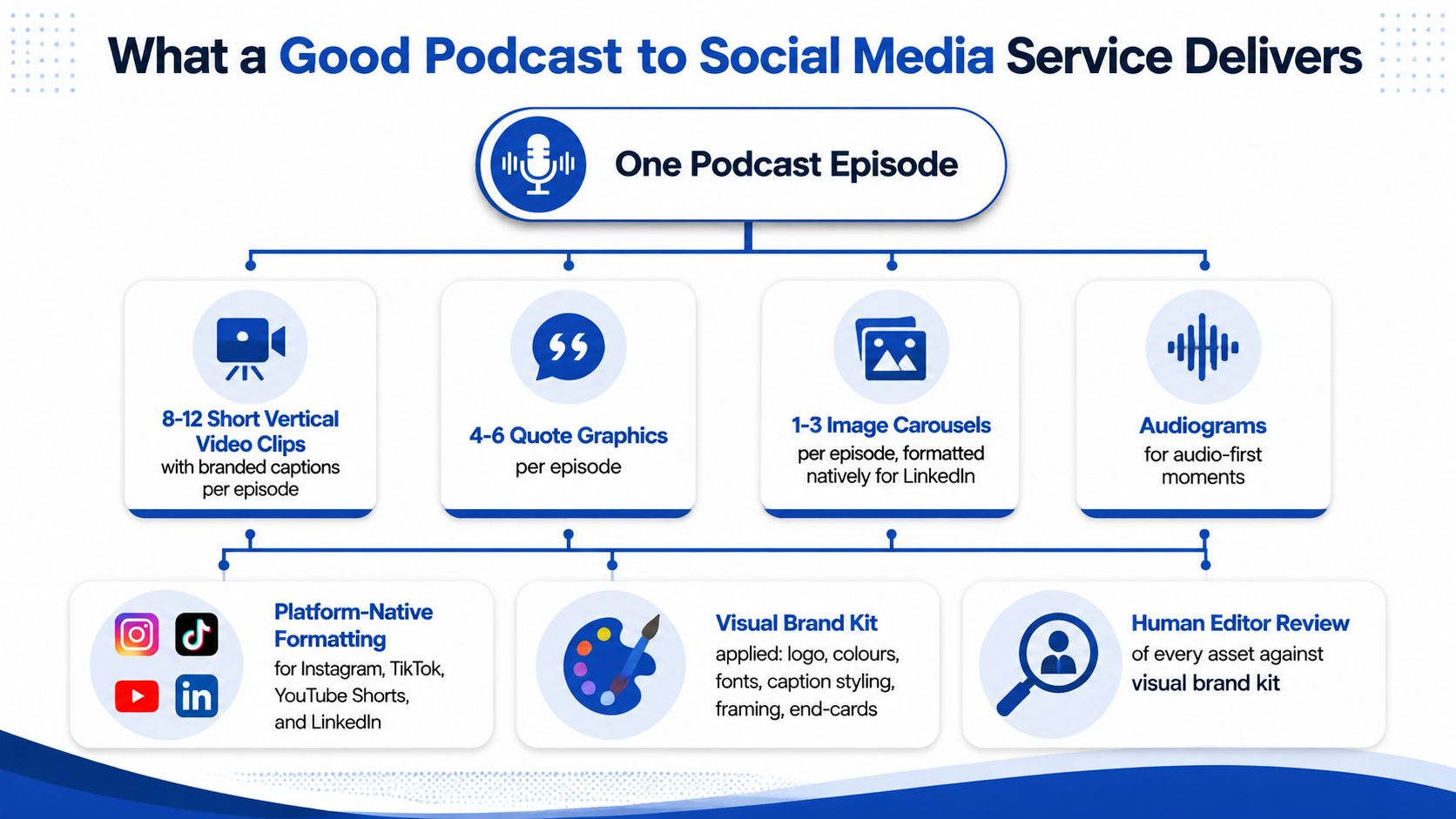
What one episode should produce
One episode should leave the team with enough finished assets to publish for weeks, not just a launch-day clip and a caption.
For a single episode, a strong service should typically deliver:
- 8 to 12 short vertical video clips with branded captions
- 6 to 8 LinkedIn posts written from the host's real talking points
- 4 to 6 quote graphics
- 1 to 3 image carousels
- Audiograms for audio-first moments
- One long-form blog article
That gives the team 20 to 30 publish-ready assets from one recording. The business value is straightforward. The recording already contains sales language. Good repurposing turns that language into content for awareness, consideration, and follow-up without asking the founder to brief a fresh campaign every week.
This also changes the quality of the message. Agencies often get close to the brand voice after a few rounds of edits, but "close" still costs time. Social posts built from the recording start with the host's exact phrasing, which usually means fewer revisions, faster approvals, and content that sounds like the person buyers will meet on a call.
Platform-native beats cross-posted
A service earns its fee by adapting the same source material to how each channel works.
| Destination | What a good service should send |
|---|---|
| Text posts, carousels, quote graphics, and native vertical video built for B2B attention spans | |
| Instagram Reels and TikTok | 9:16 vertical clips with burned-in captions and tighter pacing |
| YouTube Shorts | Clips trimmed for short-form discovery on a video-first podcast channel |
| X | Shorter exports and tighter framing around one idea |
| Newsletter-ready copy pulled from the episode's strongest angle |
Cross-posting the same asset everywhere saves production time and wastes distribution potential. LinkedIn rewards clarity and opinion. Shorts and Reels need a faster first three seconds. Email needs a usable takeaway and a reason to click. If a provider hands over one clip in five aspect ratios, the team still has a packaging problem.
For B2B companies, LinkedIn usually drives the highest-value conversations, but it should not be the only output. Buyers move across channels. A prospect might see a clip on YouTube, read a sharper argument on LinkedIn, then reply to an email version a week later. The service should support that path.
A founder's voice does not need to be recreated by a social team. The recording already contains it.
Teams that want the clip-first version of this model can start with done-for-you podcast video clips.
What the monthly cadence should feel like
The best service removes two expensive jobs from the client side. It removes weekly ideation and constant voice correction.
The team should not need to explain the brand from scratch every episode. The provider should build a usable operating rhythm. Record once. Review the selected assets. Publish on schedule.
That is the practical standard. If the output still requires the client to rewrite captions, choose topics, and decide what gets posted next Tuesday, the service is still selling production help, not a social engine.
The True Cost of Promoting Your Podcast
61% of B2B marketers say generating leads is their biggest challenge, according to HubSpot's State of Marketing. A podcast can help solve that. But only if the promotion process turns recorded expertise into content people see and trust.
The cost is rarely the editing software or the freelancer invoice. It is the salary time absorbed by marketers, founders, and coordinators who keep stopping to review footage, pull quotes, rewrite captions, fix formatting, and chase approvals. The expense shows up in hours first, then in delayed campaigns and missed follow-up.
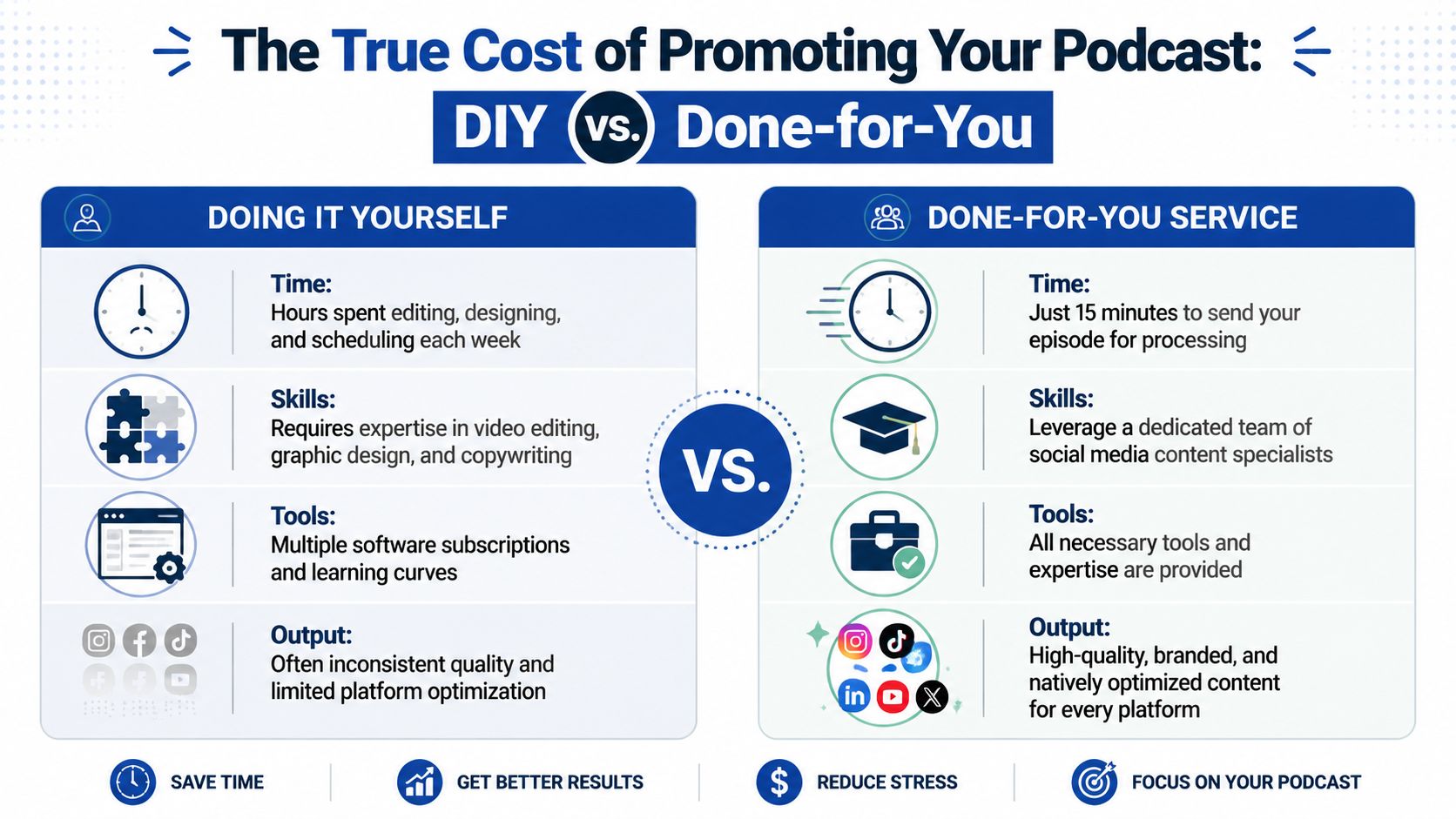
What DIY really includes
For one episode, the manual workload usually looks like this:
Review the full recording
Someone has to watch or listen closely enough to find the moments with a clear business point.Select and edit clips
Good clips need stronger openings, tighter pacing, captions, and framing that fits each platform.Write post copy and variations
LinkedIn needs a sharper argument. YouTube needs a title and description. Short-form video needs on-screen text that earns the next second of attention.Create supporting visuals
Quote graphics, carousels, thumbnails, and branded layouts still need a designer or a marketer with design time.Export, schedule, and quality check Teams catch broken captions, bad crops, formatting issues, and posts that do not sound like the host.
None of that work is hard to understand. It is hard to keep doing every week without draining expensive internal time.
I see the same failure pattern often. A company starts with good intentions, assigns podcast promotion to a marketer who already owns email, events, and reporting, then wonders why the show produces inconsistent social output and few attributed leads. The bottleneck is not effort. It is operating capacity.
Comparing the alternatives
The meaningful comparison is not agency versus freelancer. It is approximation versus extraction.
A traditional social agency often starts with a brief and a blank page. That model can work for general brand awareness, but it creates extra rounds of review because the team is trying to recreate how the host thinks, speaks, and argues. That review cycle is a real cost. It slows publishing and keeps senior people in the approval loop.
A repurposing service built from recorded content starts in a different place. The raw material already contains the phrasing, stories, objections, and points of view that make buyers trust the speaker. The job is not to invent a voice. It is to extract, package, and distribute the one that already exists.
| Option | Monthly benchmark | Trade-off |
|---|---|---|
| In-house social media manager | $4,000 to $6,000 per month | Stronger day-to-day control, but fixed salary cost stays high and one hire still may not cover editing, copy, design, and distribution well |
| Generalist VA | $800 to $1,500 per month | Lower spend, but usually needs close direction and often cannot carry video editing and message quality alone |
| Social media agency | $2,000 to $5,000 per month | Broader support, but the team often spends more time correcting voice because the content is being created from approximation |
| Repurposing service from recorded content | Starts at $999 per month | Lower management overhead and stronger voice fidelity because the output comes directly from the host's actual conversations |
That difference matters financially. If leadership still has to rewrite captions, approve angles, and explain what the founder would say, the cheaper line item is not the cheaper system.
The better buying question is simple: which option gets authentic buyer-facing content into market with the least internal drag? For teams comparing delivery models, the done-for-you repurposing pricing options are useful because they make that trade-off visible.
A Checklist for Choosing the Right Service
A fast turnaround only helps if the content sounds like the host buyers already trust. If the service has to guess at tone, point of view, and phrasing, the team gets more output but less credibility.
That is the core buying decision. A traditional social agency usually builds from briefs, brand documents, and a few examples. A podcast-first repurposing service should build from the recorded source itself. That operational difference shows up in quality, revision load, and internal time.
The risk is brand drift. Content can be polished, on-brand visually, and still miss the speaker's real voice. Research from the Content Marketing Institute has noted that human editing remains necessary to preserve quality and consistency in AI-assisted content workflows (Content Marketing Institute on human oversight in AI content).
Key evaluation points
Use these checks to separate a true extraction-and-repurposing service from a team that is still writing from approximation.
Voice calibration from real samples
The provider should train against the host's actual podcast episodes, interviews, and existing writing. Look for a clear method for capturing sentence rhythm, recurring viewpoints, phrase preferences, and words the brand avoids.One brand kit applied across every asset
Clips, graphics, carousels, audiograms, and written posts should all follow the same visual rules. If every format looks like it came from a different vendor, the service is creating management work, not reducing it.Human review before delivery
AI can draft and speed up clipping. An editor still needs to catch weak hooks, awkward captions, poor cuts, and claims that sound unlike the host.Platform-specific adaptation
LinkedIn posts, Shorts, and quote graphics should not be carbon copies. The underlying idea can stay the same, but the packaging should fit the channel and the buyer behavior on it.Format flexibility tied to business goals
Some teams need more founder-led LinkedIn posts because that channel drives meetings. Others care more about short-form video volume. The service should adjust the output mix without forcing a new process every month.
Questions worth asking on the call
Strong providers answer these with specifics, not sales language:
- How do you document the host's voice before the first batch?
- Who reviews each asset before it reaches the client?
- Can we change the clip, post, and carousel mix as channel priorities change?
- What does revision handling look like in practice?
- Do you stop at asset delivery, or do you also schedule and publish?
A vague answer usually means the team is relying on templates. A clear answer usually means they have an operating system.
Authentic content for social does not come from guessing what the founder might say. It comes from extracting what they already said, then refining it for distribution.
What to avoid
A few red flags usually show up early:
- Instant output with no editor involved
- Generic visual styling that ignores the brand kit
- The same asset reposted unchanged across every channel
- No clear process for capturing the host's voice
- A workflow that requires repeated explaining from the client
If you are comparing providers in this category, this breakdown of a podcast repurposing service for social content is a useful way to see how the model works before you get on a sales call.
The Done-for-You Workflow That Takes 15 Minutes
The best operational model is simple. The client sends one recording. The service sends back a complete social pack.
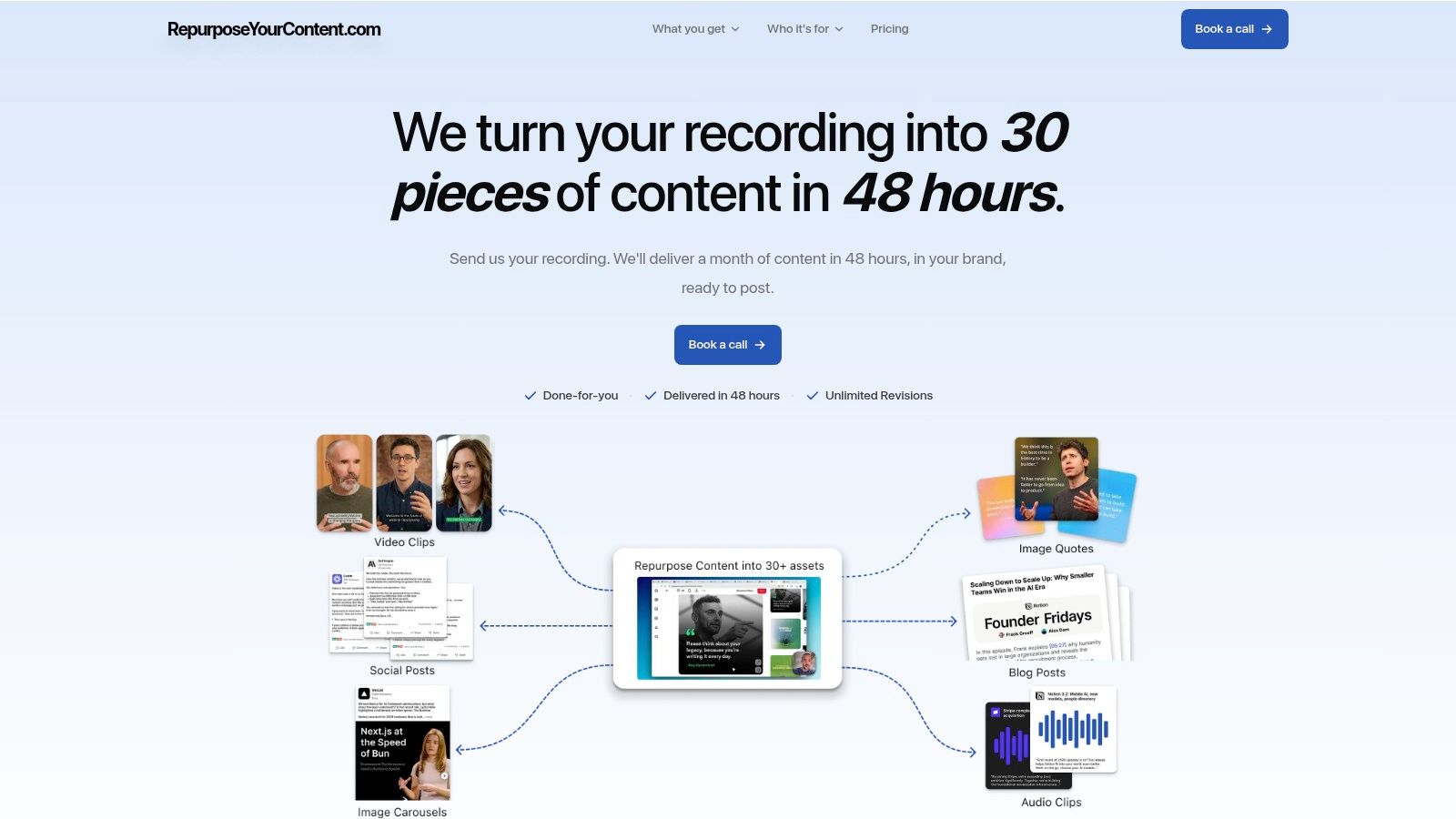
For podcast owners, that recording can be a podcast episode, interview, keynote, webinar, meeting, sales call, or livestream. The source doesn't matter nearly as much as the spoken expertise inside it.
A practical episode workflow
A clean done-for-you process, in practice:
Step 1
Send one recording from Zoom, YouTube, Vimeo, Riverside, or a raw file source.
Step 2
The service processes the episode against the client's voice profile and brand kit.
Step 3
Within 72 hours, the client receives a per-episode social pack containing 8 to 12 short vertical video clips with branded captions, 6 to 8 LinkedIn posts, 4 to 6 quote graphics, 1 to 3 image carousels, audiograms, and a long-form blog article.
Step 4
The client reviews and approves. Total client time is about 15 minutes per episode. Roughly five minutes to send the file and ten minutes to review and one-click approve.
Step 5
If anything misses, revisions are unlimited. If scheduling is included in the plan, the content doesn't just arrive formatted. It goes out on calendar.
That is very different from juggling a freelance video editor, a copywriter, a Canva designer, and a scheduler.
A visual walkthrough of that process appears in this video podcast repurposing workflow guide.
The workflow in action looks like this:
Why this model works
It removes decisions. That's the hidden cost in most content operations.
The podcast owner doesn't need to brief a monthly calendar from scratch. The episode becomes the calendar. The service extracts the strongest moments, spreads them across formats, and keeps the social layer aligned with the host's actual voice.
For a concrete example of how that output looks in practice, review the Shopify content examples.
Measuring Real Business ROI from Your Podcast Content
B2B teams that already record expert conversations are sitting on one of their best lead sources. LinkedIn's B2B content marketing research points to recordings as a primary source of quality leads for many marketers. The ROI question is not whether the podcast got attention on social. The ROI question is whether recorded expertise turned into qualified conversations, pipeline movement, and lower content production cost.
That distinction matters because agencies and internal teams often measure the wrong thing. They grade output quality by polish, posting cadence, and engagement rate. A podcast to social media service should be judged on something more commercial. Can it pull the authentic voice of the founder, executive, or subject matter expert out of recorded content and turn that voice into assets that start sales conversations?
That is the financial difference between approximation and extraction. A traditional social agency usually creates net-new posts by interpreting your brand voice from briefs, meetings, and previous copy. That takes more management time, and it often produces content that sounds close but not quite right. Repurposing recorded content starts with the source material, so the voice is already there. The service is not inventing authority. It is packaging authority you already captured and distributing it in a way sales and marketing can use.
What to measure instead
A tighter scorecard looks like this:
Inbound lead creation
Which clips, posts, or articles led to demo requests, direct replies, or booked meetings?Pipeline influence
Which assets were used in outbound sequences, shared by the sales team, or viewed by open opportunities?Sales cycle support
Which podcast-derived assets answered objections, reduced skepticism, or helped buyers reach a decision faster?Content efficiency
How many internal hours did the team avoid by repurposing one recording into multiple assets instead of creating each asset from scratch?Voice fidelity
Which approach produced content that sounds like the actual expert, not a social manager trying to imitate them?
Voice fidelity belongs on the ROI dashboard because authenticity affects response rate. Buyers can tell when a post came from a real point of view versus a generic brand calendar. One gets replies. The other gets light engagement and little else.
A simple tracking model
Use one episode as one campaign cluster.
Tag every asset to the source episode. Split performance by asset type, such as clips, text posts, carousels, and the article. Then map replies, form fills, booked meetings, and influenced opportunities back to that episode. A monthly review is sufficient for many. Keep the formats that create business conversations. Cut the ones that only produce shallow engagement.
This model also makes budget decisions cleaner. If one recorded episode generates multiple sales touchpoints and reduces production hours, the service is doing more than filling a content calendar. It is improving return on expertise already paid for through executive time, production time, and distribution spend.
For teams building a more disciplined reporting model, this guide to content marketing ROI measurement is a useful starting point.
Tags: