How to Repurpose Podcast Content Into 30 Assets
Learn how to repurpose podcast content into a month of on-brand assets. Get the exact workflow, time estimates, and a done-for-you alternative.

A podcast episode rarely fails because the recording lacks ideas. It fails because the recording gets published once, then disappears. How to repurpose podcast content is straightforward: transcribe the episode, identify its strongest ideas, and adapt them into clips, posts, graphics, carousels, an article, and email content.
Podcast clips now drive discovery at scale. The 2026 Podcast Atlas survey found that 89% of listeners watch podcast clips at least sometimes, while 72% watch them often or always. YouTube led clip engagement at 67%, followed by TikTok at 63%. Yet only roughly one-third of clip viewers reliably continue to the full episode or become regular listeners, according to the Podcast Atlas findings.
That gap matters. Repurposing isn't just a way to fill a social calendar. It connects discovery content to long-form listening, search, email, and future demand.
Why Most Podcasters Waste 90% of Their Content
Most podcast teams still treat the full episode as the finished product. They record, edit, publish, write a short description, and move on to the next conversation. That workflow gives one recording one opportunity to reach people.
The audience behaves differently. Repurposed podcast content in Reels, Shorts, and TikToks received 4.6 times more total impressions than full-length episodes alone, according to a 2026 video podcast growth study. The same study reported that 57% of social shares for video podcast content came from clips under 60 seconds, and 68% of video podcast viewers discover new shows through social clips.
Publishing only the episode means most potential entry points never exist. A prospect who won't start a long interview may still watch a focused clip. A buyer who ignores a video may save a carousel. A searcher may find an edited article months after the original release.
Practical rule: The episode is the source material. It isn't the content plan.
The recording has several jobs
A single 45-minute recording can support 20 to 30 ready-to-publish assets when the workflow starts with the transcript and a clear selection pass. The standard output can include discovery clips, LinkedIn posts, quote graphics, carousels, an SEO article, and a newsletter.
This approach also protects the production investment already made. The guest has appeared, the host has prepared, and the ideas have been captured. Repurposing turns that fixed effort into a distribution system rather than another isolated post.
Teams looking to save hours on social media should focus on repeatable production, not constant brainstorming. The format decision should happen once, at the system level. The episode's ideas should determine which moments populate each format.
That distinction prevents a common failure. If the team decides every week whether to create clips, quotes, or carousels, production depends on spare attention. Busy weeks then produce only the episode, and the backlog grows.
The 2026 content repurposing statistics reinforce the broader operational point. Distribution creates more opportunities for the same idea to reach people in different contexts, but only when the team completes the downstream work.
Your First Three Actions After Wrapping a Recording
The first minutes after recording determine whether the episode enters production or joins the “later” pile. That pile is where good episodes die.
A reliable workflow begins immediately. The first three actions are upload, transcribe, and select moments from the transcript. Every later asset depends on those marks.
Step 1 Upload before the file becomes forgotten
Send the podcast, interview, keynote, sales call, livestream, or meeting recording into the repurposing pipeline immediately. The upload itself may take 5 to 15 minutes, depending on file size and connection. Add the episode title, guest name, audience, brand kit, and any sensitive topics that require review.
The purpose isn't technical housekeeping. It removes the recording from the host's memory and places it into a defined production queue. Files left in local folders compete with meetings, client work, and the next recording.
Step 2 Create a timestamped transcript
Transcription should follow the upload. A transcript gives the team searchable text, speaker labels, and timestamps. It also becomes the source of truth for clip selection, article structure, captions, quotes, and newsletter copy.
Automated transcription can be fast, but accuracy still needs review. Names, product terms, acronyms, and technical language often require correction. Teams can use services such as Descript, Otter, or a transcription workflow built into their editing process. The practical guide to transcribing video automatically covers the production rationale behind this step.
Budget 15 to 30 minutes for transcript generation and a focused accuracy check. Longer or complex recordings may require more review, especially when several speakers overlap.

Step 3 Mark moments before opening the video editor
Read the transcript once for meaning, not polish. Mark the core thesis for the article, then identify 5 to 10 strong moments for clips. The workflow described by EpisodeKit recommends creating 1 to 2 hook variants per moment, writing platform-specific captions, extracting standalone quotes, staggering posts, and reviewing engagement for the next episode (podcast repurposing workflow).
Strong clip candidates usually have one of these qualities:
- A sharp opinion: The speaker challenges a familiar assumption.
- A complete idea: The clip makes sense without the full episode.
- A useful tension: The opening creates a reason to keep watching.
- A specific lesson: The viewer can apply the insight.
- A clean ending: The moment finishes naturally or points toward the full conversation.
Mark in and out points on text instead of scrubbing through video. This transcript-first approach can save substantial time because the editor can batch-cut selected moments in one session. Allow 30 to 60 minutes for selection and hook notes on a typical episode.
The key principle is simple:
Select ideas first. Edit media second.
The Standard Asset Set You Produce Every Episode
A content system works because the output is predictable. The team shouldn't decide from scratch each week whether an episode deserves clips, posts, or a carousel. It should produce the full standard set, then let the episode determine which ideas fill each slot.
The standard set includes:
- 8 to 12 clips for discovery across YouTube Shorts, TikTok, Instagram Reels, and other suitable channels.
- 6 to 8 social posts for feed presence, especially on LinkedIn.
- 4 to 6 quote graphics built from concise, attributable statements.
- 1 to 3 carousels for frameworks, processes, comparisons, or grouped lessons.
- 1 SEO article structured around a clear audience question or search intent.
- 1 newsletter that gives subscribers a useful reason to read and continue to the episode.
This set creates consistency without forcing identical content. A founder interview may produce clips about decision-making, hiring, and mistakes. A technical episode may produce a framework carousel, definition posts, and quote graphics explaining a complex concept. A customer conversation may support proof-oriented clips, objection-handling posts, and an article answering a buyer question.

Match each format to a job
Clips should earn attention quickly. Use a strong opening, readable captions, clean framing, and enough context for a new viewer. YouTube and TikTok lead clip engagement, so discovery edits should be adapted to those environments rather than copied identically everywhere.
Posts should make the idea useful without requiring a click. A LinkedIn post can begin with the problem, explain the lesson, and end with a question. Quote graphics need fewer words and stronger visual hierarchy. They shouldn't become screenshots of entire paragraphs.
Carousels work best when the episode contains sequence or structure. A “three mistakes” discussion can become a swipeable breakdown. A complex guest answer can become a step-by-step framework. Teams can review practical methods to create carousels from podcast clips, but the editorial selection still matters more than the template.
The SEO article shouldn't be a raw transcript. Edit the conversation into a useful page with a direct answer, descriptive headings, examples from the episode, relevant links, and a clear next step. Transcripts support accessibility and source material, but edited pages better match search intent.
A focused guide to podcast clips for social media can support platform planning, but the operating rule remains consistent: produce the full set every episode.
The Real Time Cost of DIY Repurposing
DIY repurposing looks cheap when the team counts only software fees. The larger expense is skilled attention. Someone must listen, identify moments, edit video, correct captions, write copy, design graphics, prepare the article, and schedule every asset.
Manual editing benchmarks show the scale. Basic podcast editing usually takes 2 to 4 hours per hour of recorded audio, while complex editing with tight cuts, sound design, and multi-track mixing can take 4 to 8 or more hours per episode (podcast editing time estimates). Another benchmark places manual interview editing between 4 and 14 hours, depending on complexity, while beginner editing can take 6 to 16 hours per episode (manual podcast editing benchmarks).
A 60-minute interview can take 4.8 to 8 hours to edit manually. That benchmark includes 10 to 15 minutes for setup, 50 to 80 minutes for filler-word removal, and 15 to 30 minutes for noise reduction. Manual editing generally costs $200 to $600 per episode, according to manual versus automatic podcast editing estimates.
DIY Repurposing Time Budget Per Episode
| Task | Time Estimate | Skill Required |
|---|---|---|
| Transcription and accuracy review | 15 to 30 minutes | Audio review and terminology checking |
| Transcript moment selection | 30 to 60 minutes | Editorial judgment and audience knowledge |
| Clip cutting and caption styling | 90 to 150 minutes | Video editing, pacing, captions |
| Caption and social copywriting | 45 to 75 minutes | Platform-native writing |
| Quote graphics and carousels | 45 to 90 minutes | Design, hierarchy, brand consistency |
| SEO article drafting and editing | 60 to 120 minutes | Search intent, editing, on-page structure |
| Newsletter writing | 20 to 40 minutes | Email strategy and conversion copy |
| Scheduling and quality control | 20 to 45 minutes | Publishing, links, formatting, review |
The optimized version can still reach 4 to 6 hours per episode, even with templates and a transcript-first workflow. A broader repurposing model recommends a roughly 2 to 3 hour weekly workflow per episode, including a transcript, 5 to 7 highlighted moments, a blog post, 3 to 5 LinkedIn posts, a 6 to 10 tweet thread, 2 to 3 audiograms or vertical clips, and 2 to 3 quote cards (weekly repurposing workflow).
Those estimates describe production time, not opportunity cost. The founder edits instead of selling. The marketer designs instead of building campaigns. The subject-matter expert reviews captions instead of serving customers.
The hidden cost isn't cutting the first clip. It's repeating every small task for every episode.
The Done-for-You Alternative
Time-poor teams don't need another production queue. They need the recording to move from capture to distribution without becoming the host's next unfinished project.
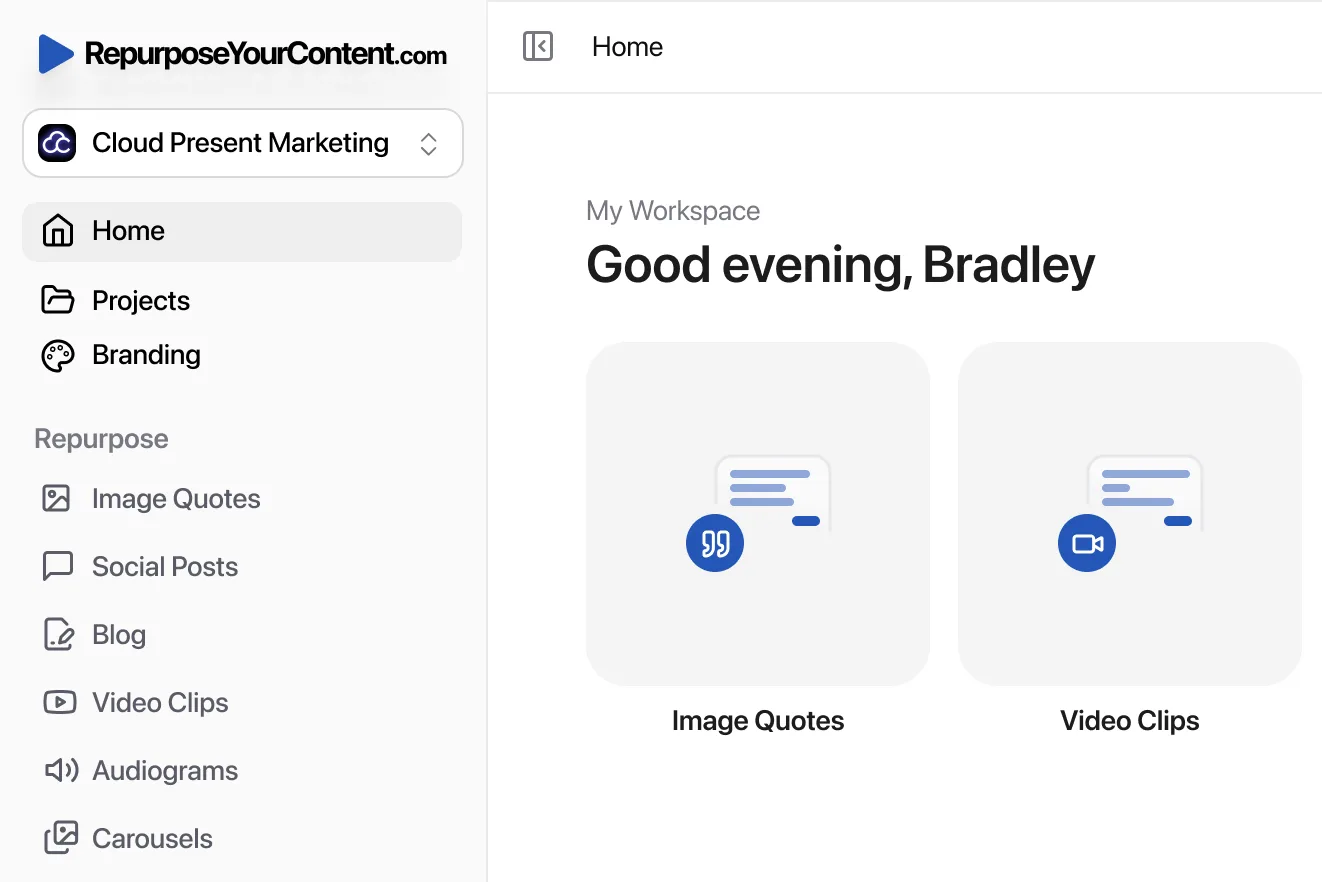
RepurposeYourContent is one done-for-you option. Clients send one recording, such as a podcast, webinar, keynote, interview, or meeting recording. The service returns 20 to 30 ready-to-publish assets in 72 hours, including video clips, LinkedIn posts, quote graphics, carousels, audiograms, and a blog post.
The deliverables are adapted to the client's brand voice and visual identity. The package includes unlimited revisions, so the team can correct positioning, terminology, tone, or design details without rebuilding the workflow internally.
What the client actually does
The client sends the source recording and relevant brand information. The total client time is about 15 minutes. The production team handles transcription, moment selection, editing, copywriting, design, article development, and delivery.
A 45-minute recording becomes 30 assets under the stated service model. Pricing starts from $14 per finished asset, and the 72-hour turnaround is guaranteed, or the client doesn't pay.
That trade-off makes sense when the internal alternative costs several hours per episode. DIY provides maximum control, but it also requires editing skill, copy judgment, design consistency, and reliable scheduling. A done-for-you workflow costs money, but it gives the internal team back the time those tasks consume.
The service can support recordings beyond podcasts. Keynotes, sales calls, interviews, livestreams, courses, panels, and internal meetings can all contain reusable insights. The source format changes, but the production logic stays stable: extract the ideas, adapt them to each channel, and package them for publication.
Teams evaluating automation can also review content repurposing automation tips, especially when deciding which tasks should remain internal and which should move to a specialist.
The done-for-you podcast content workflow is most useful for teams that already record consistently but struggle to publish consistently. It removes the weekly format debate and replaces it with a repeatable delivery process.
How to Measure Success for Each Repurposed Asset
A repurposed asset succeeds only when its job is clear. A clip should create discovery and prompt a next action. An SEO article should earn relevant search traffic and support conversion. Assigning one score to every format hides where the workflow is working.

Clips measure discovery and movement
Track reach, average watch time, completion behavior, profile visits, and follower conversion. The strongest signal is movement beyond the clip, such as opening the episode, joining the email list, or following the show.
Use separate tracking links where platforms support them. Connect each clip to its episode through a pinned comment, description link, playlist, or follow-up post. Podcast Atlas survey results indicate that clips can attract substantial viewing while producing much less full-episode listening or repeat listenership. The connection between short-form and long-form content therefore needs deliberate measurement.
Posts and carousels have different outcomes
Judge social posts by engagement quality and profile visits. Comments from the intended audience carry more value than empty reactions. For carousels, track saves and shares because they show practical usefulness and distribution beyond the initial audience.
A post with modest reach can outperform a widely viewed post if it sends qualified people to the profile. Use a consistent campaign label for links, then record the format, topic, hook, and call to action. Those fields make it possible to compare creative decisions rather than treating every result as an isolated win or loss.
Articles and newsletters require patience
For an SEO article, monitor search impressions, clicks, click-through rate, engaged sessions, and conversions over time. Search performance often develops gradually, so monthly comparisons provide a better view than launch-day results. Link the article to the relevant episode, related articles, and a clear next action.
Newsletter reporting should cover opens, clicks, replies, unsubscribes, and episode visits. The email needs to provide a useful summary or added perspective. A simple episode announcement gives subscribers little reason to continue.
Use this content marketing ROI measurement framework to connect asset activity with business outcomes, including the actions that happen after the initial view or click.
Roll the results up monthly
Create one row per asset in a spreadsheet or reporting dashboard. Record the episode, format, platform, publication date, topic, hook, reach, engagement, clicks, follower change, and available conversions.
Ask one question each month:
Did this episode reach more people than the audio alone would have?
The answer keeps reporting focused on distribution and business movement instead of vanity metrics. Review which ideas generated discovery, which formats created meaningful engagement, and which calls to action moved people toward long-form listening or business conversations.
Book a call with RepurposeYourContent or request a sample delivery to see how one podcast, interview, keynote, or meeting recording can become 20 to 30 finished assets without adding hours to the team's week.
Tags: