How to Outsource Podcast Editing Without Losing Your Voice
Learn how to outsource podcast editing the right way. Covers cost, vetting, workflows, QA, and how repurposing multiplies one recording into 30 assets.

A 30-minute podcast episode can consume 2 to 4 hours of editing and post-production time, while a weekly 45-minute interview show can take 5.5 to 6.5 hours overall once planning, scheduling, publishing, and promotion are included, according to the 2026 podcast time audit. To outsource podcast editing, a team should hand off the technical production work, define quality standards in writing, and decide how the finished recording will reach new audiences.
That last point matters. Editing makes a podcast publishable. Distribution makes it discoverable. A clean episode alone won't create the content engine most B2B teams need.
Why Outsource Podcast Editing in the First Place
DIY editing looks manageable until it becomes a weekly obligation. Manual podcast editing commonly takes 2 to 4 hours for every finished hour of recorded audio, while polished edits can require 4 to 6 hours or even 6 to 10 hours per finished hour, according to Podcast Rewind's editing time estimates. A separate production guide reports that one-hour episodes often need about 2 hours of editing, with some creators spending 3 to 5 hours on the same work, as documented by The Podcast Host.

For a founder or B2B marketer, those hours compete with guest outreach, sales enablement, customer research, and distribution. The editing fee is only one part of the cost. Delays also push back publishing and reduce the time available to turn each conversation into useful marketing assets.
Outsourcing is a workflow decision
A reliable editor removes repetitive work from the weekly production calendar. The scope can include noise reduction, gain balancing, removing awkward starts, repairing damaged sections, cutting filler, placing sponsor reads, and preparing the final mix.
Set the boundary before hiring:
- Editing only: The provider makes the episode sound clean and consistent.
- Production support: The provider also handles show notes, transcripts, publishing files, and related deliverables.
- Repurposing: The provider turns the recording into clips, posts, graphics, carousels, and articles.
These services address different operational needs. An editor protects the listening experience, while a repurposing team extends one recording across the channels where prospective customers may encounter it. The return on outsourcing comes from that broader system, not from receiving a polished audio file alone.
Practical rule: Outsource editing when the work delays publishing or takes time from higher-value responsibilities. Do not choose a provider solely because the hourly rate is lower.
The podcast production services market reflects this shift. A 2025 market report estimated the global podcast production services market at $5.8 billion in 2025, with editing services representing 19.3% of that market, or about $1.12 billion. Outsourced editing is a mature commercial category, not an unusual arrangement for creators.
Separate production hygiene from growth work. Hand off the edit, then build a repeatable process that turns the finished recording into distributed content.
Choosing the Right Outsourcing Model
Three outsourcing models cover most podcast teams: a solo freelancer, a specialist agency, and a productized service. None is automatically right. The decision depends on episode volume, required support, turnaround expectations, and how much vendor management the client can absorb.

Solo freelancer
A freelancer usually offers the most direct relationship and the simplest pricing. This model works well for a small show with a stable format, clean recordings, and one decision-maker.
The risk is capacity. If the editor gets sick, takes on new clients, or misses a deadline, the show may stall. A freelancer may also handle audio well but lack experience with video, captions, show notes, or social content.
Specialist agency
An agency provides broader production coverage and backup capacity. It can assign separate specialists for audio, video, design, writing, and publishing.
That breadth usually requires more coordination and a larger recurring commitment. Agencies suit teams that want production management, not just a finished WAV file. Buyers should ask who owns the relationship, who covers absences, and whether revisions go through a producer or directly to the editor.
Teams also need to distinguish podcast outsourcing from wider agency operations. For agencies building a broader delivery stack, a resource on scaling an agency with white label SEO can help clarify which services should remain internal and which can be fulfilled externally.
Productized service
A productized service uses fixed scope, defined deliverables, and predictable pricing. It suits B2B teams that value repeatability more than bespoke creative direction.
The trade-off is flexibility. A fixed package may not fit a complex narrative show, unusual sound design, or extensive producer involvement. It works best when the recording format and expected outputs remain consistent.
Use this decision rule:
- Choose a freelancer for straightforward editing and close collaboration.
- Choose an agency for multi-format production and higher operational coverage.
- Choose a productized service when predictable output matters more than custom production.
Before selecting a provider, teams should review this guide on how to choose a podcast production company. The right partner should match the show's operating model, not just its audio requirements.
A short comparison video can also help teams assess the difference between editing support and broader production capacity.
The Handoff Workflow That Prevents Revisions
Most revision problems start before the editor opens a project. The client sends scattered files, unclear notes, and no agreed definition of “done.” The editor then makes reasonable assumptions, and the client rejects work based on standards that were never documented.
A reliable handoff uses one folder per episode. The folder name should include the show name, episode number, guest, and recording date. Raw audio should sit apart from music beds, sponsor reads, artwork, and reference files.

Use a five-stage production flow
Ingest and file-integrity check: The editor confirms that every file opens, tracks are present, and the supplied audio matches the brief.
Raw cleanup: The editor reduces noise, balances gain, repairs obvious problems, and prepares the material for creative decisions.
Editorial pass: The editor removes filler, tangents, repeated points, awkward starts, and sections marked for deletion.
Brand integration: The editor adds the approved intro, outro, sponsor reads, music, and recurring segments.
Mix, master, and QC: The final mix is prepared, then reviewed separately for errors before client sign-off.
This QA-gated process prevents creative editing from happening on a damaged or incomplete source file. Providers documenting similar workflows also recommend consolidating client notes into one review round, which reduces version drift and missed fixes, as described by PodMuse's podcast editing workflow.
Build the brief once
A one-page brief should answer the questions an editor would otherwise guess:
- Sound standard: State the preferred loudness target and music levels.
- Editorial policy: Explain whether filler words, pauses, repeated phrases, and tangents should remain.
- Brand elements: Supply current intro, outro, sponsor, and segment files.
- Accuracy rules: List guest names, company names, product terms, acronyms, and industry jargon.
- Review process: Name the approver and require one consolidated round of notes.
Step 1 is recording the episode. Step 2 is consolidating every production file. Step 3 is uploading the folder with the brief and timestamped notes. This simple sequence gives the provider a complete production context.
Teams exploring broader production systems can also review guidance on AI-driven video editing efficiency, especially when the show includes video clips and social deliverables.
A useful handoff isn't elaborate. It is complete, repeatable, and specific enough that the editor doesn't need to interpret basic preferences every week. A dedicated creator content repurposing workflow can then extend the same structure beyond the audio edit.
What Editing Costs and What Adds Up
Podcast editing prices depend on whether “editing” means audio cleanup or a complete post-production operation. Basic outsourced work commonly runs $50 to $150 per finished hour of audio, while light-edit interview shows in the UK commonly cost $60 to $200 per episode, according to The Podcast Consultant's outsourcing cost guide.
For a 45-minute episode, light editing can cost about £75 to £120. Adding video editing raises the outsource cost to roughly £150 to £350 per episode. Full-service packages commonly start around $1,000 per month and can reach $3,000 or more per month, depending on scope, as outlined in Awkward Sage's 2026 pricing guide, which also notes that rush turnaround can add 25% to 50%.
| Provider Type | Typical Cost | Turnaround | What's Included |
|---|---|---|---|
| Basic outsourced editing | $50 to $150 per finished hour | Standard or agreed schedule | Cleanup, leveling, basic assembly |
| Light UK interview editing | $60 to $200 per episode | Standard schedule | Light audio editing for interview shows |
| Light editing for a 45-minute episode | £75 to £120 | Standard schedule | Basic episode post-production |
| Audio plus video editing | £150 to £350 per episode | Standard or accelerated schedule | Audio edit plus video production |
| Full-service package | $1,000 to $3,000 or more per month | Recurring cadence | Wider production and content support |
Basic edits may be advertised at $25 to $75 per episode. Higher-quality production commonly runs $75 to $200 per episode or more, with 24 to 48-hour work carrying a surcharge, as reported by Podvenues. Treat these figures as starting points, not the full production budget.
Price the complete deliverable list
The invoice grows through the deliverables around the edit. Show notes, transcripts, chapter markers, audiograms, video clips, captions, thumbnails, publishing support, and revisions all require time and coordination.
Podcast editing commonly requires 3 to 6 hours of editor time per finished hour of content. A 30 to 45-minute recording can expand into 6 to 11 hours of post-production once editing, show notes, clips, and distribution are included.
The cheapest editor becomes expensive when the client must manage every missing deliverable.
The distribution layer determines the return. Teams comparing the full economics should review how much content repurposing costs. Compare the complete cost of getting an episode edited, approved, distributed, and converted into useful content, not one editor's fee against another's. Audio cleanup ships a file. A properly scoped package turns that recording into assets that can support discovery and continued promotion.
QA Checklist and Feedback Loop for Consistent Sound
Consistency doesn't come from hiring the most talented editor. It comes from documenting the sound signature and checking it every episode.
A standing QA sheet should stay attached to the production folder. It should cover loudness targets measured in LUFS, intro and outro handling, filler-word policy, music levels, sponsor-read placement, and the treatment of guest names and acronyms.
Test the details before signing
Portfolio samples show what an editor can do. They don't show how carefully the editor handles a specific show. A paid test edit using real episode audio provides stronger evidence.
The detail test is simple. Include one hard-to-spell guest name, one acronym, and one abrupt topic change in the test file. Then inspect the captions and notes.
- Name accuracy: Check whether the guest's name is spelled correctly.
- Acronym handling: Check whether the acronym was verified or copied carelessly.
- Transition judgment: Check whether the abrupt topic change was cut, bridged, or left intentionally.
Careless caption errors are the fastest reason to reject a candidate. If an editor misses obvious accuracy signals in a paid test, better equipment won't fix the underlying attention problem.
The contract should protect quality too. The revision clause should require unlimited revisions until approval, in writing. Revision caps shift quality risk onto the client because the provider can stop after the agreed rounds, even when the episode still misses the brief.
Full client ownership of deliverables and source files is the second essential clause. The client should retain the raw recordings, project files, edited masters, music assets, captions, and related outputs.
Give timestamped feedback
“Make it warmer” creates debate. “At 12:14, reduce the music under the guest's answer” creates an action.
Use one review document per episode. Each note should include a timestamp, the problem, and the requested change. Consolidated feedback prevents multiple versions from circulating and gives the editor a clear approval target.
After two or three calibration episodes, a capable editor should match the show's sound signature without repeated reminders. That calibration depends on structured notes, not a stream of informal messages.
Teams needing a reference for audio quality can compare production requirements against audio enhancement tools for webinars in 2026. The same principles apply to podcast recordings, interviews, keynotes, and sales calls.
Editing Alone Does Not Grow the Show
A polished episode protects the brand. It doesn't automatically attract listeners, create demand, or put the host's ideas in front of buyers.
The common failure is operational. One recording becomes one podcast episode. The episode appears in the feed, then the team moves to the next recording. The best ideas remain buried inside a file that most prospects will never hear.
Repurposing is the growth layer
Content repurposing turns the edited recording into distribution across LinkedIn, YouTube, email, and the company blog. A single conversation can produce short clips, written posts, quote graphics, carousels, audiograms, and a search-focused article.
94% of content marketers repurpose content for different channels, and repurposing can save 60% to 80% of content creation time, according to SeriesX Marketing's content statistics. B2B teams still struggle to execute that process consistently. 48% of marketers say insufficient content repurposing is one of their biggest scaling challenges, according to Content Marketing Institute research.
Editing is a hygiene decision. Repurposing is a distribution decision.
The buyer's question should change from “What does podcast editing cost?” to “What is this recording worth after it reaches every relevant channel?” That framing exposes why a low editing fee can still produce weak returns if the episode remains confined to a podcast feed.
A useful production workflow separates the layers:
- Record: Capture the conversation, interview, keynote, livestream, course lesson, or sales call.
- Edit: Clean the source and create the approved master.
- Repurpose: Extract the strongest ideas into platform-specific assets.
- Distribute: Publish the assets using a clear schedule and call to action.
- Measure: Review which topics generate useful conversations and qualified interest.
Podcast editing makes the source usable. Repurposing makes the source work harder.
The Done-for-You Alternative and How to Start
Some teams do not need separate contractors for editing, clipping, design, and copywriting. They need one production partner that takes a long-form recording and returns content ready for publication. That choice shifts the work from audio cleanup to distribution.
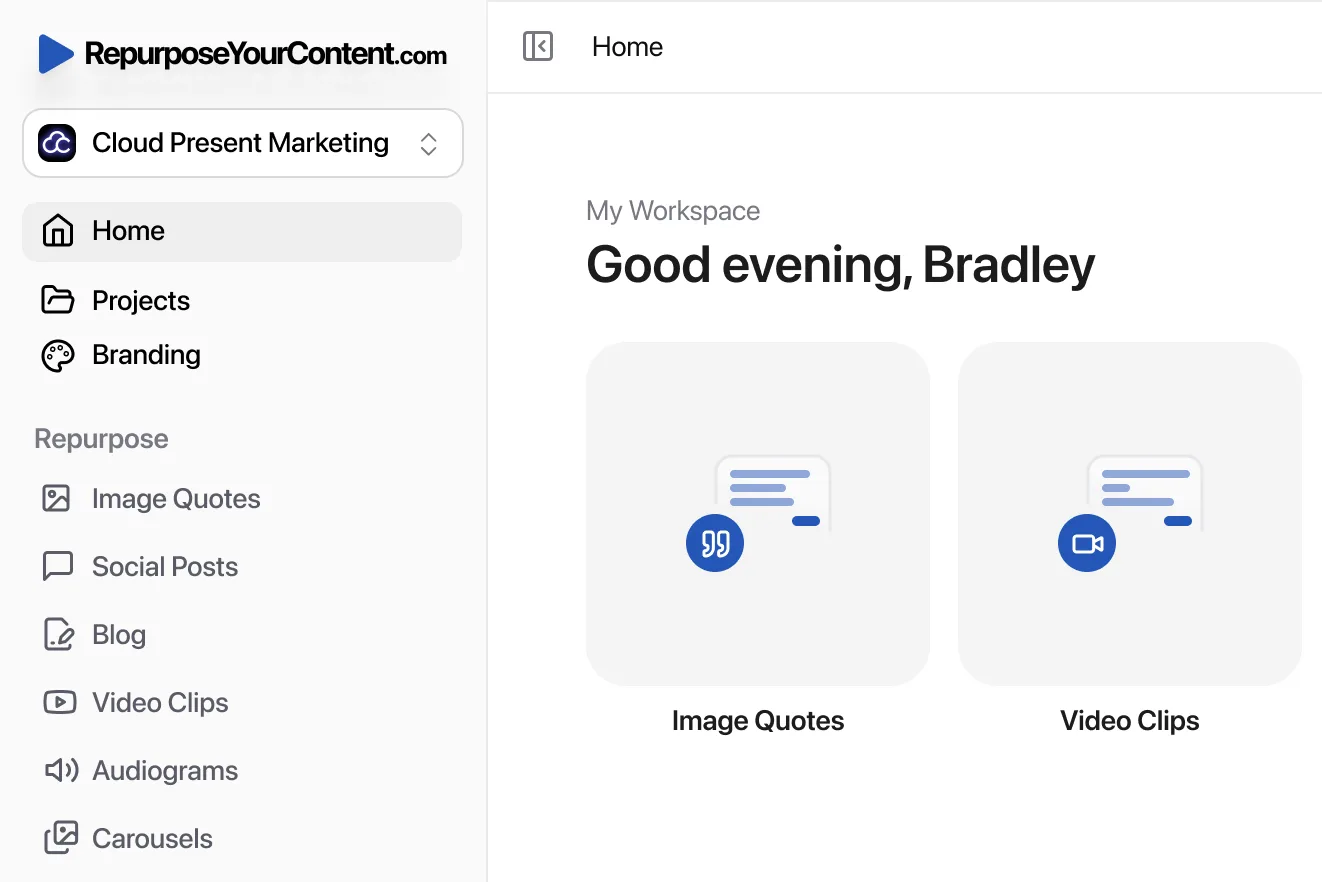
RepurposeYourContent is a done-for-you service for podcasts, interviews, keynotes, sales calls, livestreams, courses, meetings, and other long-form sources. Clients send one recording and spend about 15 minutes on the handoff. The service returns 20 to 30 ready-to-publish assets within 48 hours, including video clips, LinkedIn posts, quote graphics, carousels, audiograms, and a blog post.

What the delivery includes
A typical pack contains 8 to 12 short-form video or audio clips, 6 to 8 social posts with visuals, 4 to 6 quote graphics, 1 to 3 image carousels, and an SEO-ready blog post. The team follows the client's brand voice, applies the supplied brand kit, and provides a posting playbook.
The service includes unlimited revisions and a 72-hour turnaround guarantee. If that turnaround is missed, the client does not pay. Plans run from $999 per month for one recording to $2,499 per month for a full weekly content engine. Depending on the plan and output volume, pricing can reach $14 per finished asset.
A single 45-minute recording can become 30 assets. That changes the buying decision. An editor delivers one finished audio file, while a done-for-you team builds the content and distribution layer around the recording.
Review this guide to done-for-you podcast content before choosing a provider. Then request a sample built from an actual recording. The sample should reflect the client's voice, topics, audience, and publishing needs.
Book a call with RepurposeYourContent or request a sample from a podcast, interview, keynote, sales call, or livestream. Send one recording, review the finished pack, and judge whether the workflow gives the team enough time to publish consistently.
Tags: