Pillar Content Strategy That Turns One Recording Into 30
Learn pillar content strategy step by step. Build topic clusters, plan editorial, measure KPIs and turn one recording into 30 assets.
A pillar content strategy is a hub-and-spoke system where one page covers a broad topic and links to multiple cluster pages targeting long-tail questions. A single pillar page can rank for roughly 1,000 related keywords on average, giving one well-built asset more search reach than an isolated article (Pillar Content Strategy Stats for 2026).
That same structure can start with a recording. One 45-minute podcast, interview, keynote, sales call, or livestream can become the source for 20 to 30 ready-to-publish assets. The recording supplies the expertise. The pillar page organizes it. Cluster assets distribute it across search, LinkedIn, YouTube, email, and other channels.
Most B2B teams already create valuable long-form material. Their problem is extraction. A founder gives one strong interview, publishes the episode, and moves on. A marketing team posts a keynote recording once, then watches its reach disappear. A podcaster produces thoughtful conversations but never turns the best ideas into searchable articles or repeatable social content.
A pillar content strategy prevents that waste by treating each recording as a source system, not a finished post. The approach combines SEO architecture with editorial distribution, so one substantial idea keeps working after publication.
Why Most Great Recordings Get Posted Once and Forgotten
A 45-minute recording can produce 20 to 30 ready-to-publish assets, yet many B2B teams publish only the full episode and one announcement. The work then becomes hard to find, difficult to reuse, and disconnected from the rest of the site.
Recording one episode takes preparation, scheduling, guest coordination, production, and promotion. Publishing it once captures only a fraction of that effort. A founder may give a strong interview, a marketing team may post a keynote, or a podcast host may lead a useful conversation. Without a clear reuse plan, the best ideas disappear after the original release.
The mistake is treating a source asset as a distribution plan. A podcast episode, keynote, sales call, or livestream supplies the raw material. It does not automatically become a pillar. Someone must extract the main argument, shape supporting answers, connect related pages, and adapt the material for each channel.
A recording works like a source system. One session can feed a central article, narrower cluster pieces, video clips, LinkedIn posts, email sections, quote graphics, carousels, and audiograms. The recording provides the expertise. The content system gives that expertise repeated entry points.
Why isolated publishing fails
Standalone articles can answer individual questions, but they often lack a clear relationship with related material. Readers reach a dead end. Search engines see separate pages instead of a connected subject. Your sales team also loses useful paths from educational content to relevant commercial pages.
A practical rule keeps the system focused:
Publish one central answer, then build specific paths into the questions surrounding it.
Pillar content gives those paths a deliberate shape. The broad page establishes the main answer. Supporting pages address narrower questions. Social posts, clips, email sections, and graphics bring people back to the same subject through different channels.
Pillar pages commonly fall within the 3,000 to 6,000-word range, while cluster pages target narrower keywords, according to pillar content strategy research and benchmarks. Treat that range as a planning guide, not a quota. Stop when the page has covered its subject properly.
The operating model is simple: start with one recording and build a connected portfolio. One 45-minute session may require several hours to transcribe, edit, outline, write, design, schedule, and distribute. A done-for-you content service can handle those production steps when your team cannot spare the time.
The goal is not more content for its own sake. It is a repeatable route from recorded expertise to discovery, trust, and a sales conversation.
What a Pillar Content Strategy Really Is
A pillar system has three parts. The pillar page covers the broad parent topic. Cluster pages explore specific subtopics. Internal links connect the pages so readers and search engines can follow the relationship.
Think of a library. The pillar is the main reference guide at the entrance. It explains the subject and points visitors toward specialist shelves. Each cluster page is one of those shelves, focused on a narrower question. Internal links are the catalogue system that helps visitors move between the guide and the detailed material.
A pillar page gives the topic a centre. Cluster pages give it depth. Internal links make the relationship visible.
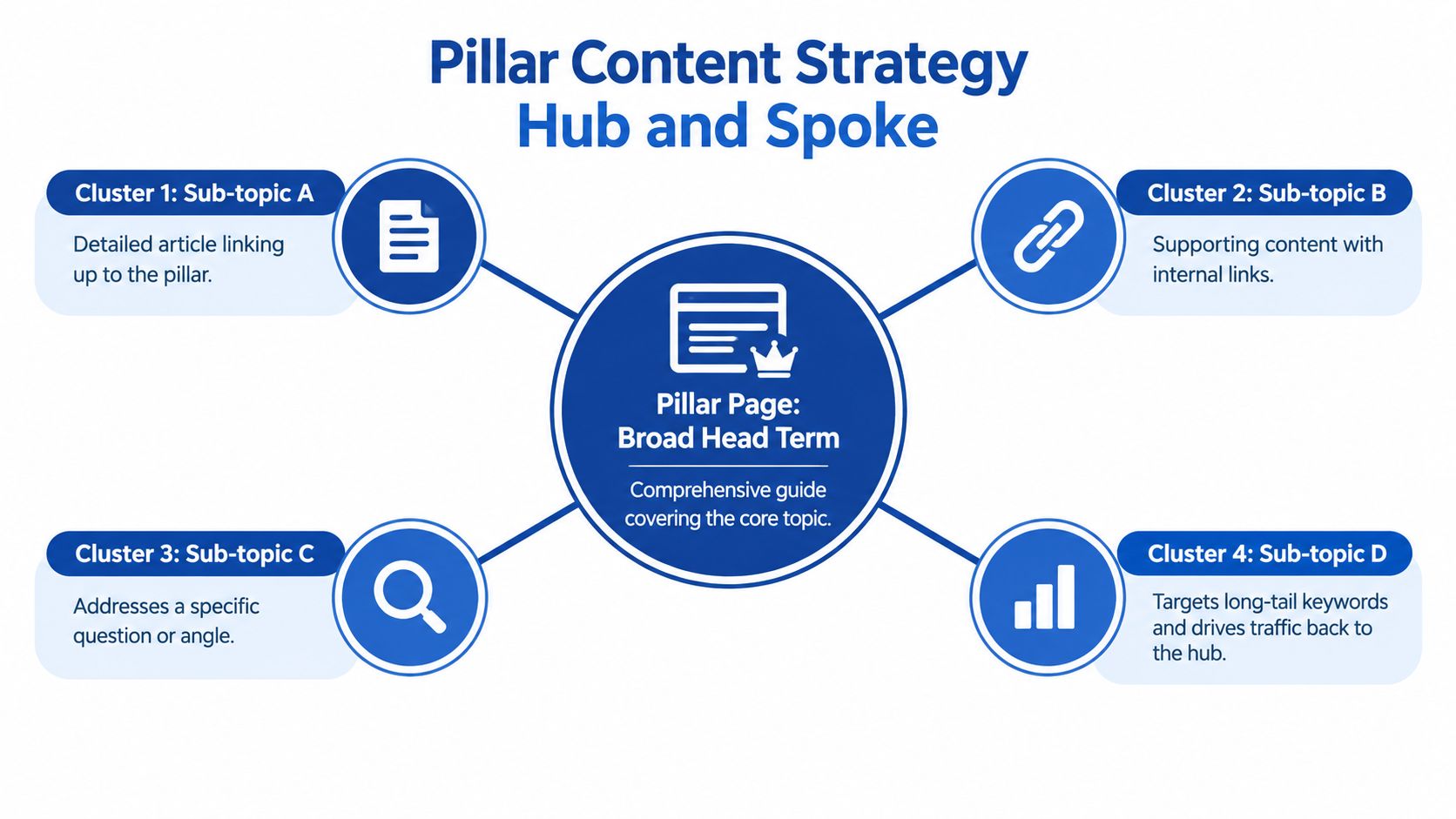
The hub and the spokes
Suppose a B2B consultancy chooses “customer research” as its parent topic. The pillar might explain research methods, planning, interviews, analysis, and reporting. Cluster pages could cover:
- Customer interview questions for SaaS teams
- How to analyse interview transcripts
- Customer research for product launches
- Research consent and data handling
Each cluster serves a specific search intent. Each should link back to the main guide with descriptive anchor text, such as “customer interview questions for SaaS teams.” The pillar should link down to the relevant cluster when mentioning that subject.
The structure also supports crawlability, because search engines can discover related pages through clear paths. It distributes internal link equity across the cluster and reduces topical fragmentation. Search engines can interpret the site as a connected resource rather than a collection of unrelated posts.
Pillars are not just long articles
A long article becomes a pillar only when it has a clear role in a wider system. A page with no supporting content may be valuable, but it doesn't use the full hub-and-spoke model.
A recording can become the source for that system. The transcript supplies original language, examples, objections, and expert explanations. The editorial team then organizes those ideas into the pillar and its supporting assets.
Teams building this model can also review how Bulby helps with content pillars for another practical perspective on turning one source into structured content. A broader content pillar definition can help align writers, editors, and demand generation teams around the same terminology.
The important distinction is simple. The pillar establishes the subject. The clusters capture specific demand. The links connect the two. Distribution assets bring the system to audiences who may never begin with organic search.
Benefits and KPIs That Prove Pillars Work
A pillar turns one recorded conversation into a distribution system. A 45-minute recording can supply the source material for a central guide, then support 20 to 30 cluster assets, including articles, email sections, social posts, and sales enablement pieces. The team spends less time starting from blank pages and more time adapting ideas for each channel.
The value reaches beyond discoverability. A connected system can build authority, guide visitors through related questions, and create more paths to a commercial action. Analysts have reported stronger organic visibility for sites using pillar-cluster architecture than for sites relying on standalone content (pillar-cluster visibility analysis). B2B research also links pillar strategies with stronger performance among successful marketers (B2B pillar strategy research).
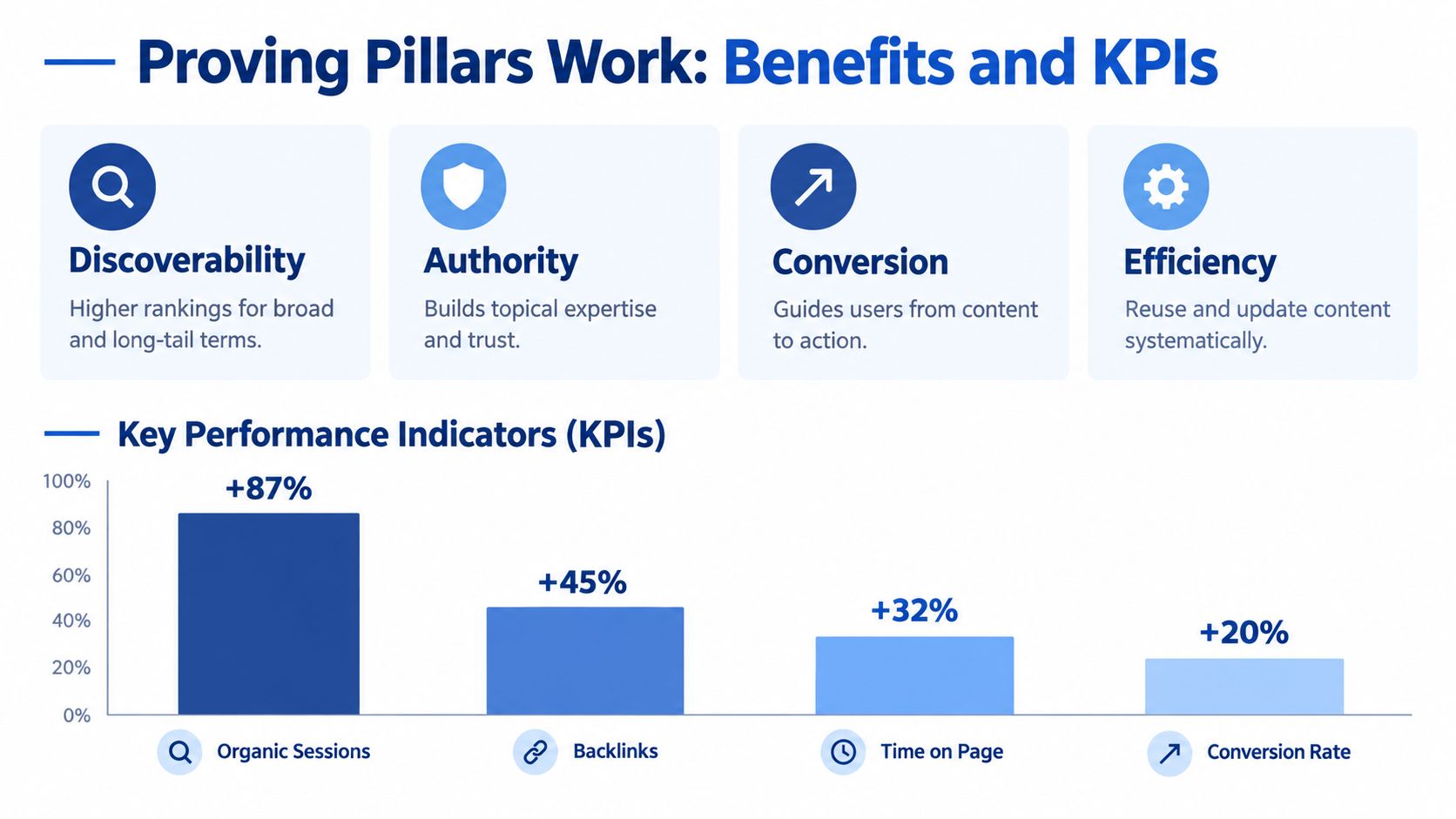
Track the pillar at three levels
Measure the system in three groups:
| KPI group | What to measure | Why it matters |
|---|---|---|
| Discoverability | Impressions, rankings, organic sessions, and related queries | Shows whether the topic reaches new audiences |
| Authority | Referring domains, backlinks, internal links, and cluster coverage | Shows whether the system earns support and topical depth |
| Business impact | Engaged visits, assisted conversions, leads, and sales conversations | Connects content activity to pipeline |
Traffic and conversion benchmarks indicate that structured pillar content can improve organic visits and visitor-to-lead performance, although outcomes vary by topic, competition, content quality, links, technical execution, and distribution (B2B pillar strategy research). Treat benchmarks as reference points, not promises.
Internal linking needs its own report line. Pages with roughly 20 to 44 internal links have been associated with more traffic than pages with very few links, while gains can diminish at higher link counts (internal-link density analysis). Relevance still controls the decision. Add a link because it helps the reader, not to hit a quota.
Report movement, not vanity
A pillar may gain impressions before it produces qualified leads. Cluster pages may attract narrow searches, while the pillar earns broad visibility. Review both levels together.
A useful monthly report shows which queries entered the cluster, which pages attracted links, which internal paths visitors followed, and whether visitors reached a relevant conversion point. That view is more useful than total pageviews alone. Teams can use this content marketing ROI measurement guide to connect content activity with pipeline outcomes.
How to Design Pillar Topics and Cluster Content That Ranks
Topic selection determines whether the system compounds or creates maintenance debt. Teams shouldn't build every possible subject. A 2026 strategy guide recommends choosing only three to five pillars that match audience demand, authority, and business goals, then reviewing them quarterly (content pillar portfolio guidance).
Start with the commercial question. What does the business need to be known for? Which subject appears in sales conversations? Which problem can the team explain with original detail? A high-volume keyword isn't enough if the audience isn't a fit or the business has no credible connection to it.
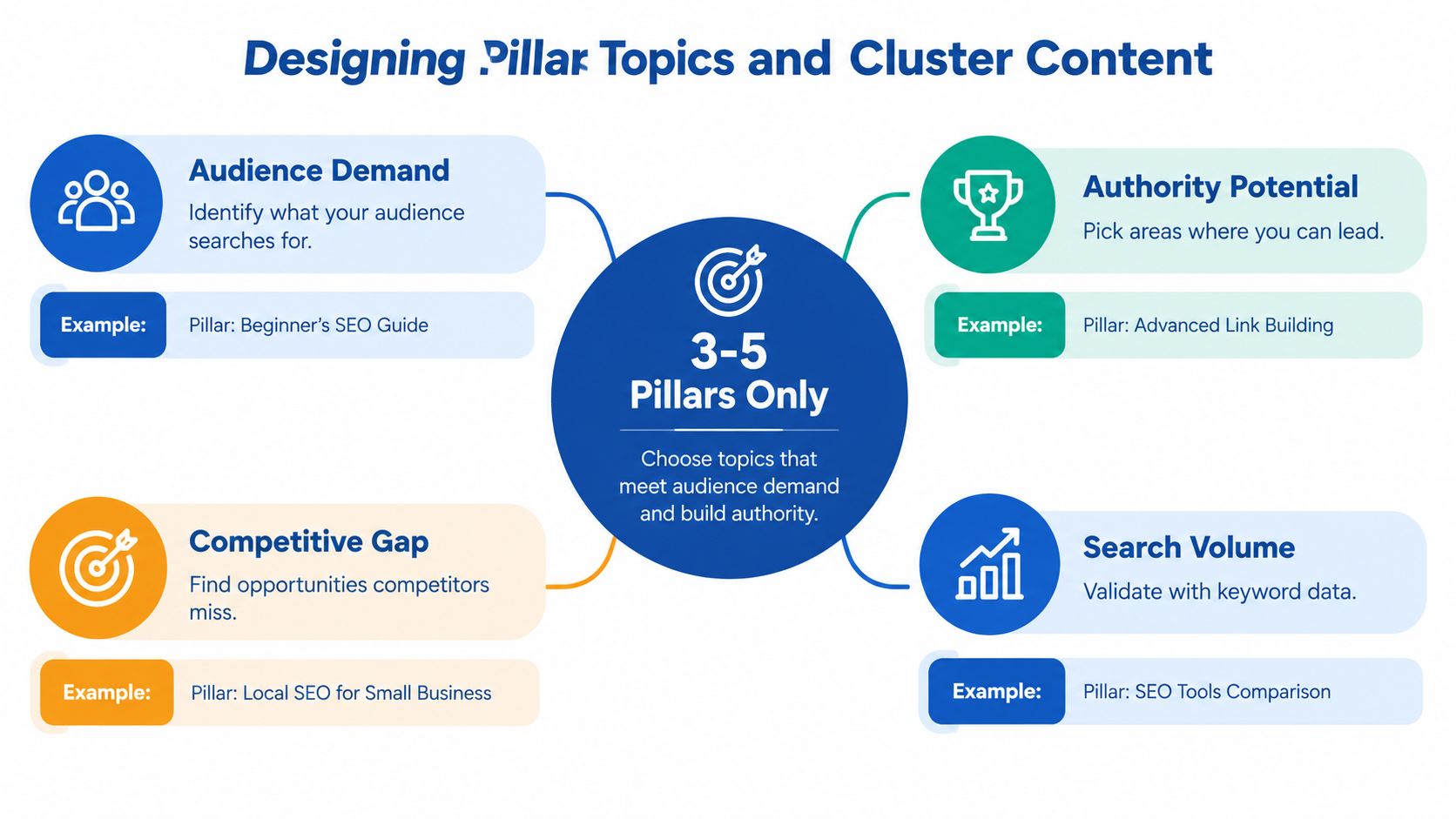
Choose the parent topic
A good parent topic has a broad head term and several meaningful intent variations. Map the topic before writing. Use search data, sales-call questions, customer interviews, support tickets, and competitor gaps.
For each pillar, identify 10 to 15 potential cluster pieces, a common planning rule that makes the ecosystem measurable (cluster planning guidance). Each idea should have a distinct job. If two ideas answer the same question, merge them or define a sharper distinction.
Cluster ideas can target different stages:
- Educational intent: What is the problem, and why does it matter?
- Process intent: How should a buyer complete a task?
- Comparison intent: Which approach, category, or provider fits?
- Commercial intent: What should a qualified buyer do next?
Engineer the link graph
Every cluster page should link back to the pillar. The pillar should link to every relevant cluster. Lateral links can connect related clusters, but only when the next page helps the reader.
Use descriptive anchors that name the destination. “Podcast content distribution workflow” gives more context than “read more.” Keep anchor language natural, and avoid repeating an exact phrase where it makes the copy awkward.
A practical audit checks four things:
- Does each cluster have a link to the pillar?
- Does the pillar link to the strongest supporting pages?
- Are any pages orphaned?
- Do multiple pages compete for the same intent?
Keep, merge, or retire
Review each pillar quarterly. Keep it when it attracts relevant demand, supports business goals, and has clear coverage gaps to address. Merge pages when they overlap heavily. Retire a pillar when it no longer aligns with the audience, authority, or commercial direction.
Before adding another page, check for missing questions, outdated information, weak examples, and broken internal paths. A useful developer content repurposing guide can help teams map source material into narrower assets without publishing disconnected variations.
The best portfolio stays selective. Breadth matters, but relevance and maintenance discipline matter more.
Editorial Planning and Distribution Without Burning a Week
A 45-minute recording can become a pillar source for 20 to 30 cluster assets, but only when you plan distribution before editing. SEO architecture shows how pages connect. Distribution determines whether the ideas reach buyers through search, social, email, and video.
Start with one source asset, then separate its ideas by job and channel. A long-form source of about 2,000 words or more, or a 30 to 60-minute recording, can supply derivative assets when the team maps the main topic, supporting questions, and useful excerpts (pillar content execution guidance). A practical workflow can identify 15 to 25 atomic content units within 24 hours, turn them into platform-native assets over two to three days, and schedule distribution across two to four weeks (content repurposing workflow).
A realistic manual workflow
Take a 45-minute founder interview about building a B2B sales process. The recording may support a pillar article, cluster posts, short videos, social updates, and visual explanations. The production work still takes time.
Step 1, review the recording. A marketer watches it, marks strong moments, removes tangents, and identifies the main narrative. A published manual workflow estimates one to two hours for this stage (manual repurposing time estimate).
Step 2, edit clips. An editor selects useful moments, adds captions, formats the footage, and checks audio. This takes three to four hours in the same workflow.
Step 3, write posts and captions. A writer turns the interview into LinkedIn posts, video captions, hooks, and calls to action. Allow two to three hours.
Step 4, design visual assets. A designer creates quote graphics and carousels from the strongest statements. This requires two to four hours.
Step 5, write the search article. A writer builds the pillar or cluster article from the transcript, then adds structure, links, and on-page elements. This takes two to three hours.
The manual process can require 10 to 16 hours per source asset, before approvals and scheduling. That time explains why a recording often gets published once and then disappears from the content plan.
Assign each asset a job
Choose the channel before production begins. A clip can create awareness. A carousel can explain a process. The article can capture search intent. An email can bring existing subscribers back to the topic.
| Asset Type | Quantity | Channel | Publish Window |
|---|---|---|---|
| Short video clips | 8 to 12 | LinkedIn, YouTube Shorts | First two weeks |
| Social posts | 6 to 8 | Across two to four weeks | |
| Quote graphics | 4 to 6 | LinkedIn, email | Across two to four weeks |
| Image carousels | 1 to 3 | After the first clips | |
| Audiograms | As selected | Podcast and social channels | Alongside episode promotion |
| Pillar or cluster blog post | 1 | Company blog and email | Near the source release |
These quantities are planning ranges, not guaranteed outputs. The recording determines how many distinct ideas deserve publication, while your team's capacity determines the release pace.
Use an editorial calendar template for marketing teams to assign owners, review dates, channels, links, and calls to action. Documented software rollout best practices can also help when several people approve and publish assets.
Real Examples of Recordings Turned Into Pillar Systems
A recording becomes a pillar system when the team extracts one central idea and several narrow questions. The source format can change. The architecture stays consistent.

Example one with a founder podcast
A founder records a 45-minute podcast episode about moving from founder-led sales to a repeatable B2B sales process.
Step 1: The team identifies the broad pillar topic, “B2B sales process design.”
Step 2: The transcript reveals narrower cluster questions, including sales qualification, handoff rules, pipeline stages, and founder involvement.
Step 3: Editors select short clips from the strongest explanations. Writers create LinkedIn posts from objections and lessons. Designers turn the process into carousels and quote graphics. The blog team creates one pillar page and supporting articles.
Step 4: The team releases the episode, publishes the pillar, and distributes the derivative assets across the following weeks. Each relevant post points readers toward the pillar or a specific cluster page.
The system gives the episode several entry points. A buyer searching for qualification advice can find a cluster page. A founder scrolling LinkedIn can encounter a clip. An existing subscriber can receive the practical framework by email.
A resource such as content repurposing examples from one long-form recording can help teams find additional asset formats without expanding the central topic too broadly.
The core pillar should stay narrow enough to be memorable. Adjacent sub-pillars can cover related subjects, but a broad brand bucket usually creates weak connections.
Example two with a keynote or customer interview
A B2B company records a keynote about improving customer onboarding. The marketing team identifies the main pillar as “B2B customer onboarding.” Supporting topics include onboarding milestones, stakeholder education, activation barriers, and customer handoffs.
The keynote becomes the source for clips and social posts. A customer interview adds language from the buyer's perspective. The pillar page explains the complete framework, while clusters answer operational questions in greater depth.
The assets support different stages of the buying journey. Educational posts introduce the problem. Cluster articles help prospects evaluate approaches. The pillar organizes the subject and points toward relevant service or product pages.
Repurposing guidance cited in the research reports that repurposing strategies improve ROI by 32% on average, while 48% of marketers identify a lack of repurposing as a scaling challenge (content repurposing distribution statistics). The practical lesson is clear. Distribution should be designed when the source is planned, not after the recording has already disappeared from attention.
The Done For You Alternative and Your Next Step
DIY repurposing keeps production in-house, but a single recording can consume a full workday or more. Manual processing covers review, editing, writing, design, and the search-led article. It also leaves approval rounds and project management on your team.
A done-for-you workflow treats the recording as a distribution source. You send one podcast, webinar, keynote, interview, or meeting recording. RepurposeYourContent turns it into 20 to 30 ready-to-publish assets in 72 hours, including video clips, LinkedIn posts, quote graphics, carousels, audiograms, and a blog post. One source can then support a pillar page and its cluster content instead of appearing once and disappearing.
The copy follows your brand voice, and delivery includes unlimited revisions. Your involvement takes about 15 minutes. Pricing starts at $14 per finished asset, with a 72-hour turnaround guarantee, or the client doesn't pay.
This option suits B2B teams with strong expertise already captured but limited editing, writing, or design capacity. Review the done-for-you content repurposing service to compare internal production with outsourced execution.
Choose one recording tied to a clear business topic. Book a call or request a sample, then submit the recording for review. The team can map its pillar, identify cluster opportunities, and show how one source can become a month of connected distribution.
Tags: