Podcast Show Notes Writing Service: A Practical Buyer's
Find the best podcast show notes writing service for your needs. Our practical guide helps you choose wisely and save time.

Podcast show notes writing service is what turns a recording into a written episode page built for both podcast apps and Google. For teams that publish regularly, it usually replaces hours of drafting, linking, and formatting with a finished page returned in a few business days.
The market is growing fast enough to matter. Research and Markets puts show notes services at $1.05 billion in 2025 and projects $1.98 billion by 2030, while another estimate places the market at $0.3 billion in 2025 and $0.65 billion by 2034 Research and Markets. That spread reflects different methodologies, but the direction is the same. More shows want written episode pages that do more than sit under the player.
What a Podcast Show Notes Writing Service Actually Does
DIY show notes usually cost more time than hosts expect. A realistic episode takes four to six hours once you count re-listening, drafting, timestamping, link collection, and cleanup. That time disappears into the margins of a publishing week, which is why busy shows keep falling behind.
A podcast show notes writing service handles that work end to end. The client sends the recording, and the writer returns a finished episode page with the summary, timestamps, guest details, resource links, key takeaways, and one CTA. When the show needs it, the same source material can also become a longer blog-style version for the website. A podcast show notes writing service is a fit for weekly hosts, B2B brands, agencies managing client shows, and founders who need consistency. It's less useful for a hobby feed with no search or conversion goal.
What the handoff should feel like
A good service should feel like handing off production, not starting a new project. The host should not need to script the episode after the fact or chase every link. The writer should pull the structure from the recording, verify names and titles, and return copy that's ready to publish.
Practical rule: if the show notes still need a lot of cleanup after delivery, the service hasn't really saved time.
One useful way to think about it is as a content operations task, not a writing task. That's why agencies and publishers often pair this kind of delivery with broader repurposing workflows, like the one described in content repurposing services. A notes-only provider solves one problem. A fuller content system solves the publishing backlog around it.
Why Show Notes Matter for Search and Listener Conversion
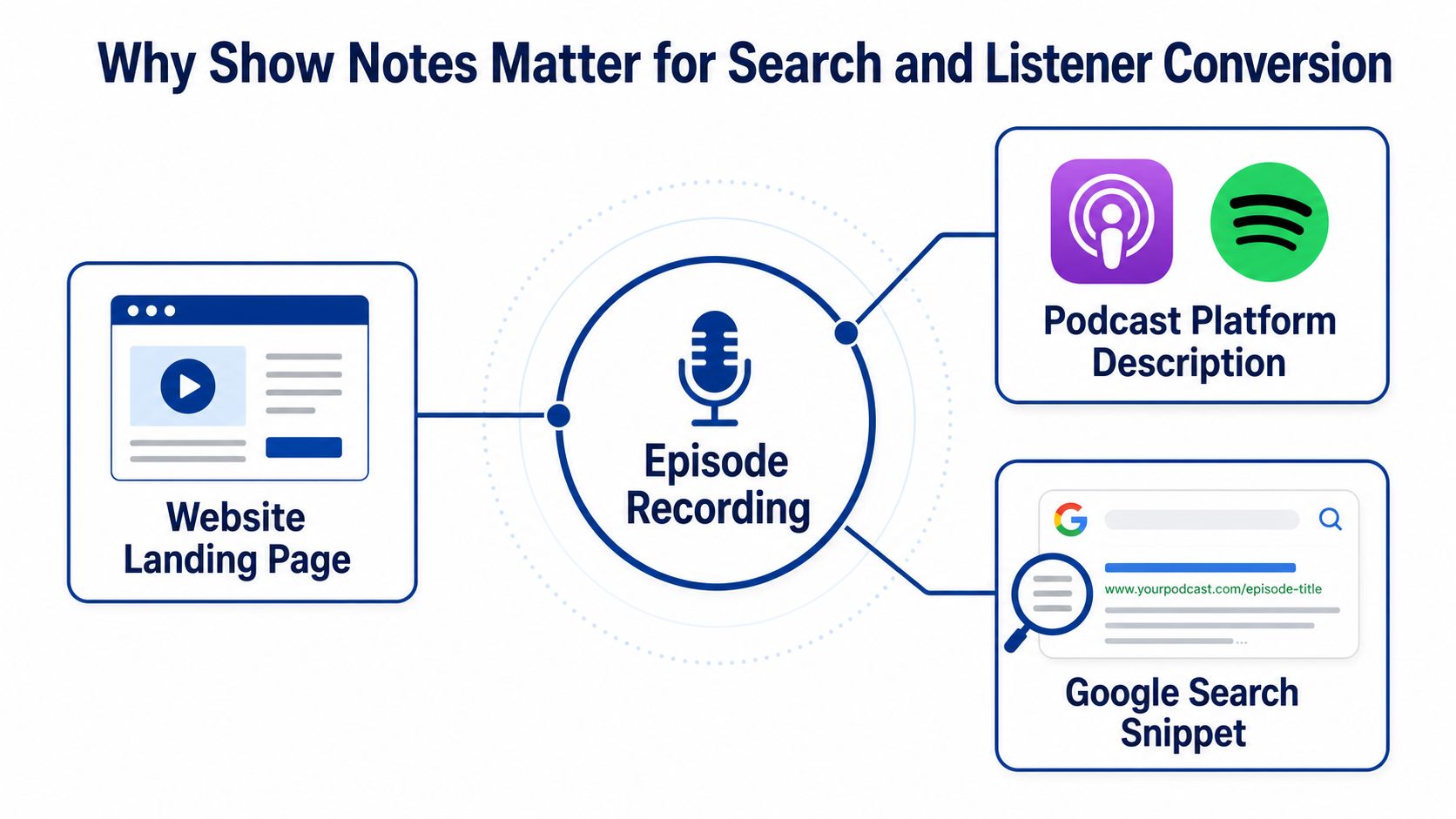
A finished episode page has to do more than list links. It needs to help someone find the episode, understand it quickly, and decide whether to hit play. That is where show notes earn their place in the publishing workflow.
For search, the page gives Google something indexable to read. For listeners, it gives a clear reason to care before they spend time on the episode. In practice, that means the notes are working as a discovery asset and a conversion asset at the same time.
Search and app visibility work together
Podcast apps and search engines both depend on written episode copy, but they use it for slightly different reasons. Podcast players use the description to help users find relevant episodes, while Google evaluates the page like any other web page. Clear topic language, relevant terms, and a readable structure help both sides at once.
That is why a notes page should do more than repeat the episode title. A keyword-aware opening summary gives search engines enough context, and it gives a listener a quick read on whether the episode fits their intent. Descriptive chapter labels and resource links strengthen that effect because they make the page easier to scan and easier to trust.
A weak page misses both jobs. It can be stuffed with search terms and still feel flat to a listener. It can sound conversational and still leave Google with little to work from.
The listener's real question
A browser usually wants one answer fast. Is this episode worth the time?
If the page answers that clearly, the odds of a play button click go up. The summary, the takeaway bullets, and the linked resources should make the topic feel concrete before the listener commits to the full episode.
That is also where conversion starts. A show notes page can point someone to a newsletter, a service page, a related episode, or a booked call, but it has to make the next step obvious. A vague recap leaves that opportunity on the table. For a practical breakdown of turning episode recordings into publishable notes and related assets, how to create podcast show notes from recordings shows how the page functions as published content instead of a leftover task.
Anatomy of a Show Notes Page That Both Google and Listeners Like
A show notes page has to do two jobs at once. It should give Google enough context to understand the episode, and it should give a listener enough clarity to decide whether to press play. If the page feels buried or vague, it loses both audiences.
A strong page opens with a compact summary, then moves into scannable takeaways, timestamps, guest details, resource links, and one clear call to action. The sequence matters because it matches how people read a podcast page in real life, quick scan first, deeper reading second.
Good notes usually start with a summary of 100 to 200 words. Buzzsprout recommends that range, and it also describes the opening as a short description used by podcast apps Buzzsprout. That opening should say what the episode answers, who it helps, and why it matters. The best version reads like a clear promise, not a recap of what happened.
A simple structure that holds up in review
After the summary, add three or four takeaways that a busy reader can scan in seconds. Then add timestamped chapters with descriptive labels, followed by guest bio and links, then the resources mentioned on air. That order is practical because it mirrors how people move through the page.
Rule of thumb: write for the person who wants the answer first and the details second.
The page should also include one clear CTA. That might be a newsletter signup, a related episode, or a service page. Keep it singular. Multiple CTAs split attention and make the next step less obvious. Buzzsprout's guidance on one CTA per episode makes sense because it keeps the page focused.
Show notes page structure at a glance
| Element | Purpose | Typical Length |
|---|---|---|
| Summary | States the episode's value fast | 100 to 200 words |
| Takeaways | Gives a quick skim path | 3 to 4 bullets |
| Timestamps | Helps navigation and scanning | As needed |
| Guest details | Builds trust and context | Short bio plus links |
| Resources | Supports the episode's claims and tools | As needed |
| CTA | Directs the next action | One clear prompt |
A podcast show notes writing service should know how to build this page without padding it. If the provider can't explain why each piece belongs, the output will probably read generic. A service that also handles the related recording-to-notes workflow can keep the page aligned with the episode instead of treating it like afterthought copy. For a practical look at that process, see how to create podcast show notes from recordings.
The Cost of Writing Show Notes Yourself
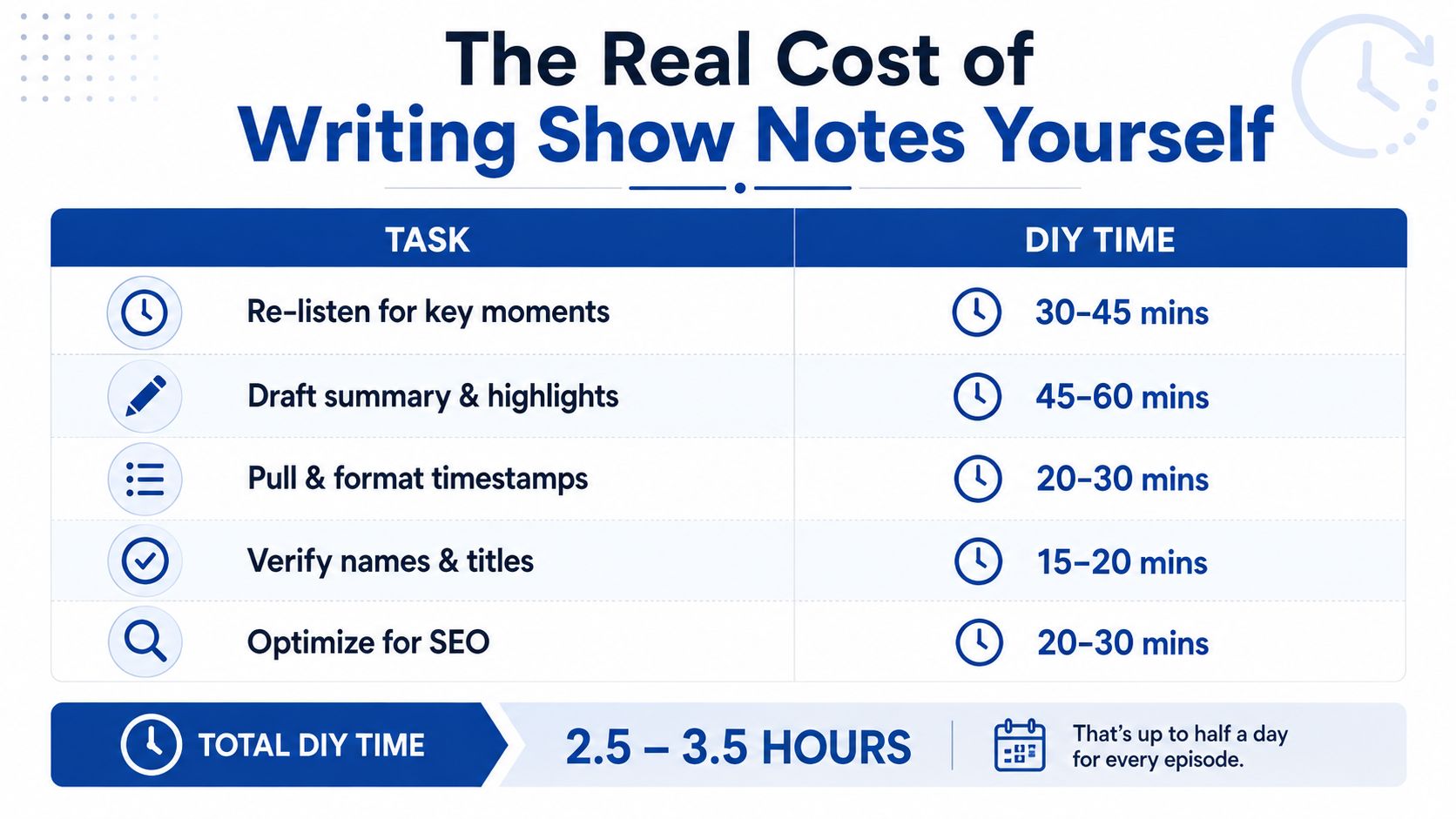
DIY looks inexpensive until the week gets busy. The hidden cost shows up in the back-and-forth between listening, writing, checking links, and publishing. A task that sounds like a quick notes pass can turn into another half day.
The steps hosts often overlook
A typical episode usually includes several separate jobs:
- Re-listen for usable moments. That takes about 30 to 45 minutes when the host is hunting for timestamps and quotes.
- Draft the summary and highlights. Expect 45 to 60 minutes if the goal is to make it readable, not robotic.
- Pull and format timestamps. This usually takes 20 to 30 minutes because the audio has to be matched to the page.
- Verify guest names and titles. Another 15 to 20 minutes disappears here, especially on guest-heavy shows.
- Optimize the page for search. That can take 20 to 30 minutes when the writer is shaping headings and internal links.
Those blocks add up fast. They still leave out revision rounds, publishing, and last-minute link fixes. A host who records weekly can lose an entire content day just keeping the show notes current.
What outsourcing changes
Outsourcing does not remove standards. It removes the labor. The writer still needs solid source material, but the host no longer has to sit in the middle of every edit pass. A podcast show notes writing service starts to make sense once notes are part of discovery and conversion, not a checkbox at the end of production.
For budget planning, a broader look at how much content repurposing costs helps because it frames writing as labor, not magic. If the notes are taking hours each week, the question is not whether the task has value. The question is whether the host should still be the one doing it.
What Show Notes Services Typically Charge
Pricing depends on what gets delivered. A short app description costs less than a full page with timestamps, links, and SEO structure. Once the notes become part of a larger content package, the scope changes again.
| Tier | Includes | Typical Per-Episode Range |
|---|---|---|
| Short in-app description | Brief episode summary only | Low, project-based |
| Full show notes page | Summary, timestamps, guest links, resources, CTA | Mid, per episode |
| Notes plus blog-length article | Show notes plus expanded SEO article | Higher, per episode |
| Notes inside a full repurposing package | Notes, clips, posts, graphics, article | Highest, bundled monthly |
The wide spread comes from four things. Episode length changes the listening and drafting time. Research depth changes the verification load. Revision policy affects how much the provider is accountable for cleanup. Turnaround also matters because faster delivery usually costs more.
A low quote can still be expensive if it creates more cleanup for the host. A higher quote can be reasonable if it includes QA, voice matching, and a publish-ready handoff. That's why vendors should be compared by deliverables, not just by price.
If the page only needs a synopsis, a notes-only freelancer may be enough. If the goal is search, backlinks, and a bigger content footprint, a bundled service often makes more sense. A show notes page is one asset. A blog-length episode article is another. Those are not the same product.
How to Choose a Show Notes Writing Service
A low price can hide weak writing and sloppy QA. The best way to vet a provider is to ask the same questions every time. The answers should be specific, not vague.
Six checks that separate competent from careless
- Writing samples in your tone. Ask for examples that sound like a real show, not a generic template. If every sample reads the same, the service probably isn't adapting voice.
- Named writer or agency. A named team is easier to evaluate than an anonymous marketplace. You need to know who owns the output.
- Revision policy in writing. Unlimited revisions are a structural choice, and they keep quality risk on the provider rather than the client.
- QA for guest names and quotes. This is essential on interview shows. Misspelled names and wrong titles make the page look rushed.
- Turnaround with a deadline guarantee. A service should say how fast it returns deliverables and what happens if it misses the window.
- Ownership of assets. The finished files should belong to the client without extra friction.
A smart buyer also asks for the workflow around transcripts. Some services need a polished transcript before writing. Others handle the source recording directly. That detail matters because it changes how much pre-work lands on the client.
Practical rule: if a provider can't explain its QA pass, the client is usually the last line of defense.
For teams comparing service models, the process overview in content repurposing workflow for small teams is a useful lens because it shows how production should move from raw recording to finished assets without a lot of back-and-forth.
Show Notes Only Versus Full Content Repurposing
A notes-only service solves one job. It gives the episode a written home and helps people scan before they listen. That can be enough for a show with a strong internal marketing team or a separate social workflow.
Full repurposing treats the recording like source material for a wider content engine. That means the notes still get written, but the same episode also becomes clips, social posts, quote graphics, carousels, audiograms, and an SEO blog post. For a podcaster who wants one recording to feed multiple channels, that's a different buying decision.
Who each option fits
Show notes only work best when the host already has someone to publish, promote, and clip the episode elsewhere. Full repurposing fits the host who wants the whole output handled in one delivery. That's where a service like RepurposeYourContent fits naturally, because it turns one recording into notes plus other publish-ready assets from the same source.
The cost difference follows the scope difference. Notes-only is narrower. Full repurposing is a content system. If the goal is to keep the back catalog discoverable and active across channels, the full layer is the more complete answer.
The comparison in outsource content repurposing is helpful because it frames the decision around workflow, not hype. Buyers don't need more content talk. They need to know whether they're paying for one page or a multi-format output stack.
The Done-for-You Workflow and How to Get Started
A clean workflow should start with one recording from any source, including Zoom, YouTube, Vimeo, or a raw file. The client shares tone of voice, audience, and standing links during onboarding, then only needs to send the episode and any specific links mentioned on air.
What happens next
- The recording gets reviewed by a human writer.
- Guest names, titles, and links are checked in QA.
- The show notes are written in the client's voice.
- The delivery lands within the turnaround window.
- The client reviews and requests revisions if needed.
The point is speed without losing accuracy. Unlimited revisions also matter because they keep the burden on the provider instead of the client. For busy podcasters, that means less project management and fewer half-finished drafts sitting in a folder.
If the goal is more than show notes, a fuller delivery can turn one recording into clips, posts, graphics, and an article in one pass. For podcasters who want that broader layer, the practical next step is to book a call or request a sample and review finished notes before committing.
If your show notes are still eating hours every week, stop treating them like a side task. Book a call or request a sample from RepurposeYourContent and see what a finished episode page looks like before your next publish day.
Tags: