Podcast Video Editing Service: Expert Guide for 2026
Discover what to expect from a professional podcast video editing service and how to choose the right one for your show.

49% of creators do not record video at all, while 34% record video for every episode and 16% record video only sometimes. A podcast video editing service turns that raw recording into a tightened full episode, captions, short clips, and platform-ready exports, with turnaround usually landing between 48 hours and two weeks depending on the model and the amount of revision work involved.
That split is the primary reason outsourcing exists. Some shows need full post-production help just to get one usable episode out the door, while others need clip packages that can feed YouTube and social distribution from the same recording.
A podcaster with three unedited interviews sitting on a drive learns fast that editing is not one task. It is review, cut selection, audio cleanup, captioning, thumbnails, exports, and then the revisions that follow when the first pass misses a name or a joke.

What It Really Costs to Edit a Video Podcast Yourself
A solo host can treat editing like a weekend job until the raw file lands in the timeline. After that, the work starts to consume the rest of the day. One industry discussion puts editing at about $60 per hour and says an hour-long episode usually takes 2 to 4 hours of work, which puts a single episode around $120 to $240 in editor time before heavier tasks enter the mix (editing cost discussion).
What the hidden hours look like
Raw footage review is rarely a single watch-through. A realistic pass usually takes 30 to 60 minutes just to mark dead air, crossover moments, and camera issues. Multi-cam assembly adds more time because the editor has to line up angles, watch for mismatched audio, and make sure cuts do not land on a blink or a bad gesture.
Captions and thumbnail work are where many DIY schedules break. Branded captions need a transcript review, name checks, and styling cleanup. Thumbnails need frame grabs, text placement, and a version or two that looks good at small size. If you also want to compare manual edits with what modern tools can automate, this overview of AI video editing tools for marketers shows where software helps and where a human still has to clean up the final cut.
Practical rule: if the recording is not already clean, the edit always takes longer than the recording.
The hidden cost is opportunity cost. While one person is trimming silence and fixing exports, nobody is writing the next episode, booking guests, or repurposing the last one. For teams publishing on a fast cadence, that delay becomes a bottleneck fast. It also changes who ends up doing the work, because the founder, producer, or marketing lead often becomes the editor by default when the budget is tight.
Independent podcast statistics say 34% of podcasts publish every 3 to 7 days, and 38% publish every 8 to 14 days (podcast statistics). That kind of pace leaves very little room for a half-day edit on every recording. It also explains why outsourcing stops feeling optional once the show starts to matter.
What a Podcast Video Editing Service Includes
A podcast video editing service is a production layer, not just a cleaner timeline. Raw footage goes in, publishable files come out. The core split is scope. Full-episode editing and clip repurposing solve different problems, and many teams need both if they want the recording to work across the main episode and social cutdowns.
Full episodes first, clips second
Full-episode editing usually covers multi-cam cuts, audio cleanup, branded captions, lower-thirds, chapter markers, thumbnail creation, and final exports for the main hosting or publishing channel. Usable footage still depends on the recording quality. Editors can work fastest when there are 2 camera angles, decent lighting, and a quality microphone, because that leaves room to cut without exposing every flaw in the room setup (source).
Clip and repurposing services are narrower. They pull the strongest moments from the recording and turn them into short-form assets for LinkedIn, TikTok, YouTube Shorts, and Instagram Reels. The reason this matters is simple, one recording now has to perform in multiple places. Castos found that among creators who publish video, 82% publish on YouTube and 46% post clips to social platforms (Castos survey). That mix is why clip packages now sit inside the normal workflow instead of being treated as an afterthought.
A competent editor also needs real audio and finishing skills, including noise reduction, EQ, compression, de-essing, level balancing, and loudness normalization across channels. They should be comfortable in Adobe Premiere Pro, DaVinci Resolve, and Final Cut Pro (Foxtalkx Studio). Those tools and techniques control background noise, tonal balance, sibilance, and consistency between episodes.
Teams comparing service models against DIY shortcuts can use this overview of AI video editing tools for marketers as a reference point. It shows where software helps with speed and where a human still has to clean up the final cut for brand-safe output.
A Real Workflow From Raw Recording to Published Episode
A clean workflow starts before the first cut. The raw recording comes in, the brand kit gets loaded, and the editor checks whether the footage is workable. That usually means host and guest framing, clean headroom, and enough audio quality to avoid spending the rest of the session fixing the room.
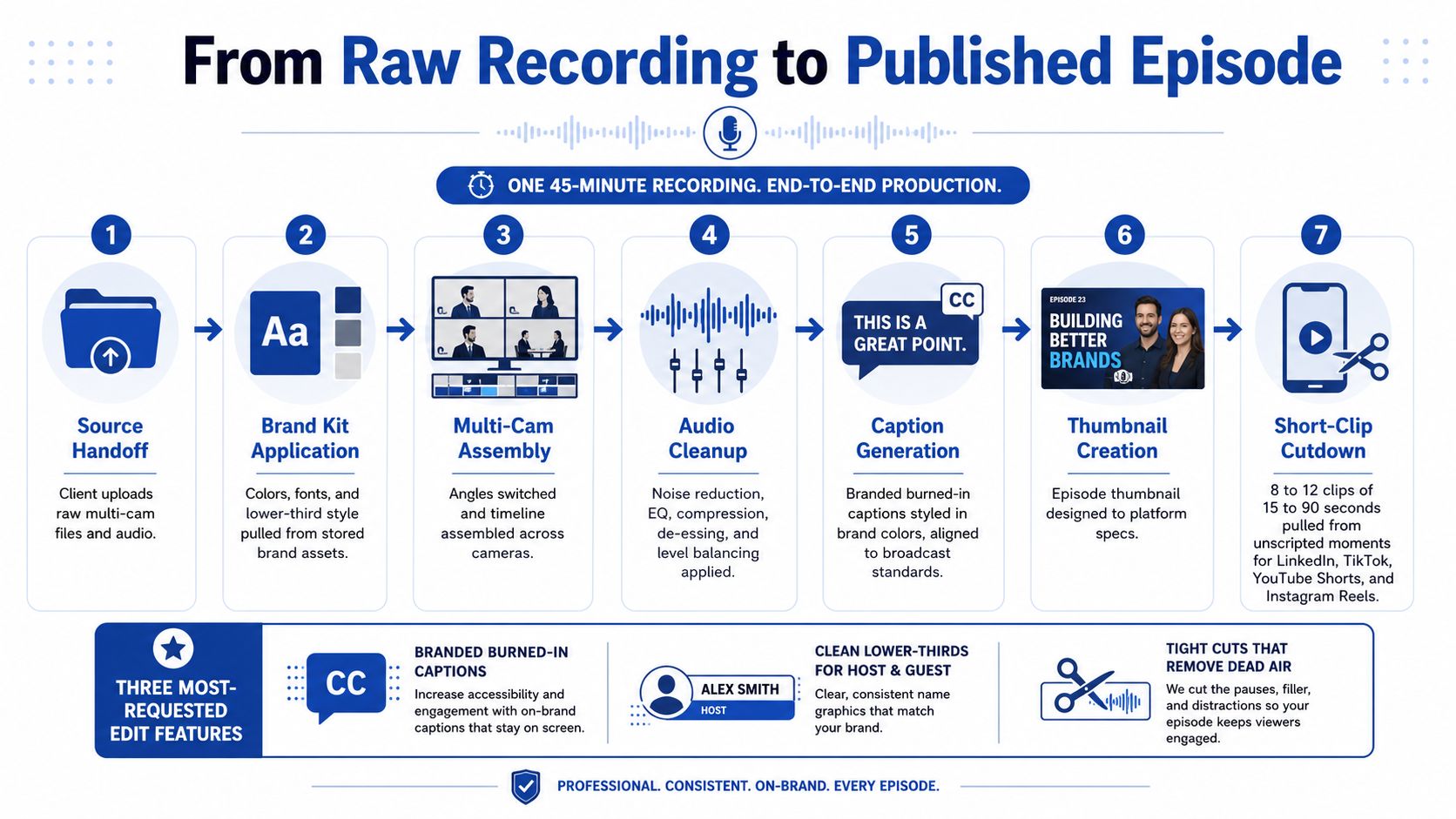
Step by step on a 45-minute episode
- Source handoff. The client sends the raw multi-cam files and audio. This usually takes 10 to 15 minutes of admin on the client side if the file naming is already sane.
- Brand kit application. Logo, colors, fonts, caption style, and intro or outro treatments get applied. That keeps the episode from drifting visually.
- Multi-cam assembly. The editor lines up angles and builds the episode timeline. On a 45-minute recording, this is often the longest human pass.
- Audio cleanup. Noise reduction, EQ, compression, de-essing, and level balancing get applied so the episode feels consistent end to end.
- Caption generation. Branded burned-in captions are checked for names, jargon, and timing.
- Thumbnail creation. A platform-ready thumbnail gets built for the episode itself.
- Short-clip cutdown. Strong unscripted moments become short clips for distribution.
The three edit features clients ask for most often are branded burned-in captions, clean lower-thirds, and tight cuts that remove dead air without flattening the conversation. B-roll matters less in most podcast workflows than readable captions and pacing that still sounds human.
A normal delivery from a 45-minute episode is a tightened full episode plus several short clips, often enough to cover the subscriber channel and the discovery channel from the same recording. The key operational point is simple. The full episode serves the audience that already chose to listen, while the clips do the first job of getting new people to care.
For a fuller breakdown of repurposing flow, the video podcast repurposing workflow guide lines up with how these production passes usually work.
Pricing Across Freelancers, Agencies, and Productized Services
Pricing only makes sense once you know who is doing the editing. A freelancer may handle the edit, the project coordination, and the caption review in one pass. An agency usually splits those tasks across several people. A productized service keeps the workflow tighter and the deliverables more standardized.
Cost bands that buyers actually compare
| Service Model | Typical Cost | Turnaround | Best For |
|---|---|---|---|
| Freelancer | Often anchored to per-episode or hourly work. A typical hour of editing time is about $60, and an hour-long episode usually takes 2 to 4 hours (discussion). | Usually faster when one person owns the file. | Small shows, one-off edits, simple delivery needs. |
| Agency | One report cites dedicated-team pricing around $1,299/month for podcast editing work (Podsqueeze). | Slower handoffs can happen, but team capacity is broader. | Brands that want strategy, consistency, and multiple deliverables. |
| Productized service | Public pricing can reach $14 per finished asset at volume, with monthly plans built around multi-asset delivery (RepurposeYourContent pricing). | Often standardized and predictable. | Teams that want repeatable output from each recording. |
The trade-off is not just sticker price. It is revision burden, decision speed, and how many people touch the file before it comes back to you. Freelancers can move quickly, but the buyer often has to manage feedback directly. Agencies can absorb more complexity, but the retainer only works if the volume justifies it. Productized services sit between those poles when the output is defined and the client wants speed without rebuilding the brief every time.
There is also a market reality behind these pricing tiers. Independent estimates place the global podcast production services market at $5.8 billion in 2025, with a projection of $14.2 billion by 2034 at 12.4% CAGR. Within that market, editing services account for 19.3% of revenue in 2025, or about $1.12 billion, and are projected to grow at 13.8% CAGR through 2034 (market estimate). The point is not the exact forecast. It is that editing now gets bought like infrastructure, not like a side task.
This cost breakdown for content repurposing is useful when you compare per-asset pricing with per-episode pricing.
Red Flags and Green Flags When Reviewing a Sample
A sample edit tells the truth faster than a sales call. If the episode sounds different every week, the vendor is not managing consistency. If the captions miss names or jargon, the review layer is weak. If the thumbnail looks templated, the packaging likely is too.
Red flags that cost you later
- Audio jumps between episodes. That usually means no clear loudness standard.
- Caption mistakes on names or technical terms. Brand trust takes a hit fast when jargon is wrong.
- Generic thumbnails. If every thumbnail looks copied, the feed will too.
- Unclear edit choices. If the editor cannot explain why a cut landed where it did, the work is probably mechanical.
Green flags that signal a better service
- Stable audio floor. A cleaner delivery should sit with a noise floor under -60 dB, which is a practical benchmark for quiet recordings and careful cleanup.
- Captions that respect platform standards. Readability matters more than decoration.
- Clips built from unscripted moments. Good editors pull from the blunt answer, the disagreement, or the specific number.
- One stored brand kit. Logo, colors, fonts, and caption style should stay identical across episodes.
The three features that matter most in a finished sample are branded burned-in captions, accurate lower-thirds, and tight conversational pacing. Those are the tells that the service understands both the visual and narrative job of the edit.
Brand consistency is a system. It should not depend on whether the editor remembers yesterday's font choice.
The section above on workflow matters here for a reason. If the sample looks polished but every episode drifts visually, the vendor is improvising instead of operating.
Full Episodes Versus Short Clips and What Drives Growth
A full episode keeps the audience you already have. Short clips do the discovery work. That is why a smart podcast video editing service should not be judged only by how polished the long cut feels.
Why the clips matter more for growth
A 45 to 75 minute raw episode usually becomes a tightened full episode plus 8 to 12 short clips of 15 to 90 seconds each. Those clips are where new people meet the show first. The full episode matters for subscribers, search, and deeper trust, but the clip stack is what earns the first click.
The clips that travel are rarely the safest moments. They are usually the unscripted ones, a guest's blunt answer, an unexpected disagreement, or a specific number that surprises the room. Human moment selection beats automated interval cuts because the editor has to understand what made the room react, not just where the timer landed.
What to buy first
If the goal is audience growth, clip and repurposing services usually come before deep full-episode polish. That does not make the long cut optional. It means the long cut should be edited well enough to stay watchable, while the strongest moments are extracted for social distribution and platform reach.
The distribution pattern supports that split. Castos found that creators who publish video use YouTube, and many post clips to social channels like Instagram, TikTok, and Facebook (Castos survey). One recording has to serve two jobs, and buyers feel that in both the edit time and the revision load.
For teams focused on social reach, podcast clips for social media is the right lens. The full episode still matters, but the clip selection is what usually changes the top of the funnel.
The Done-For-You Alternative and 72-Hour Workflow
A service model only works if the handoff is simple. With RepurposeYourContent, the client sends one recording, podcast, webinar, keynote, interview, or meeting recording, and the team turns it into publish-ready content without any editing prep on the client side. The usual client effort is about 15 minutes.
What comes back
A typical delivery includes 20 to 30 assets in 72 hours, including video clips, LinkedIn posts, quote graphics, carousels, audiograms, and a blog post. Public positioning also includes a 72-hour turnaround guarantee and pricing from $14 per finished asset, with one 45-minute recording becoming 30 assets in the package described on the company site (product details).
The workflow is built around a stored brand kit. Logo, colors, fonts, caption style, and treatment rules get applied to every episode and every clip automatically. Then human QA checks each delivery against the kit so the look does not drift.
Practical rule: a good repurposing service should make the brand look repeatable, not merely polished once.
That matters for teams that record regularly. A podcast episode, a keynote, or a sales call should not become a one-off project every time. It should become a content system.
The podcast repurposing service overview shows how the service is structured for repeatable delivery from long-form recordings. The promise is not software access. It is finished content that arrives ready to publish.
Choosing the Right Service and Next Steps
Solo podcasters on a tight budget usually need a freelancer or a lean clip package first. Founders building a personal brand usually need short clips, captions, and clean lower-thirds before they need a perfect long cut. B2B teams that record weekly need a service that can turn every recording into a content engine.
That decision gets easier when the questions are practical. Who edits the file, who checks the captions, who writes the clip copy, and who owns the final brand consistency? If those answers are fuzzy, the vendor is probably too thin or too expensive for the job.
For teams that want a done-for-you route, RepurposeYourContent is one option for turning one long-form recording into multi-platform assets on a repeatable schedule. The next step is to book a call or request a sample edit, then bring one question with you, what should the first recording produce if the goal is both subscriber retention and new audience growth?
Tags: