Repurpose Sales Call Recordings for Marketing: Boost ROI
Discover how to repurpose sales call recordings for marketing. Our guide details compliance, workflows, & turning real objections into closing content.

To repurpose sales call recordings for marketing, a team must first secure proper consent, then systematically extract insights like common objections and customer questions to create anonymized content such as FAQ pages, blog posts, and social updates that address real buyer concerns. Recording consent is not publication consent, and that distinction is where many find themselves vulnerable.
Most B2B companies already have the raw material. It sits in Gong, Fathom, Fireflies, and similar systems, untouched by marketing. Sales records the calls. Marketing runs separate keyword research. Meanwhile, the exact questions buyers ask every week stay buried in transcripts.
Your Sales Calls Are a Content Goldmine You're Not Using
73% of B2B marketers confirm that sales call recordings are their primary source of high-quality leads, yet only 1 in 3 marketing teams possess a scalable method to repurpose these recordings into marketing content, according to Avoma's sales call recording analysis. That gap matters because those calls already contain the language buyers use when they're close to a decision.
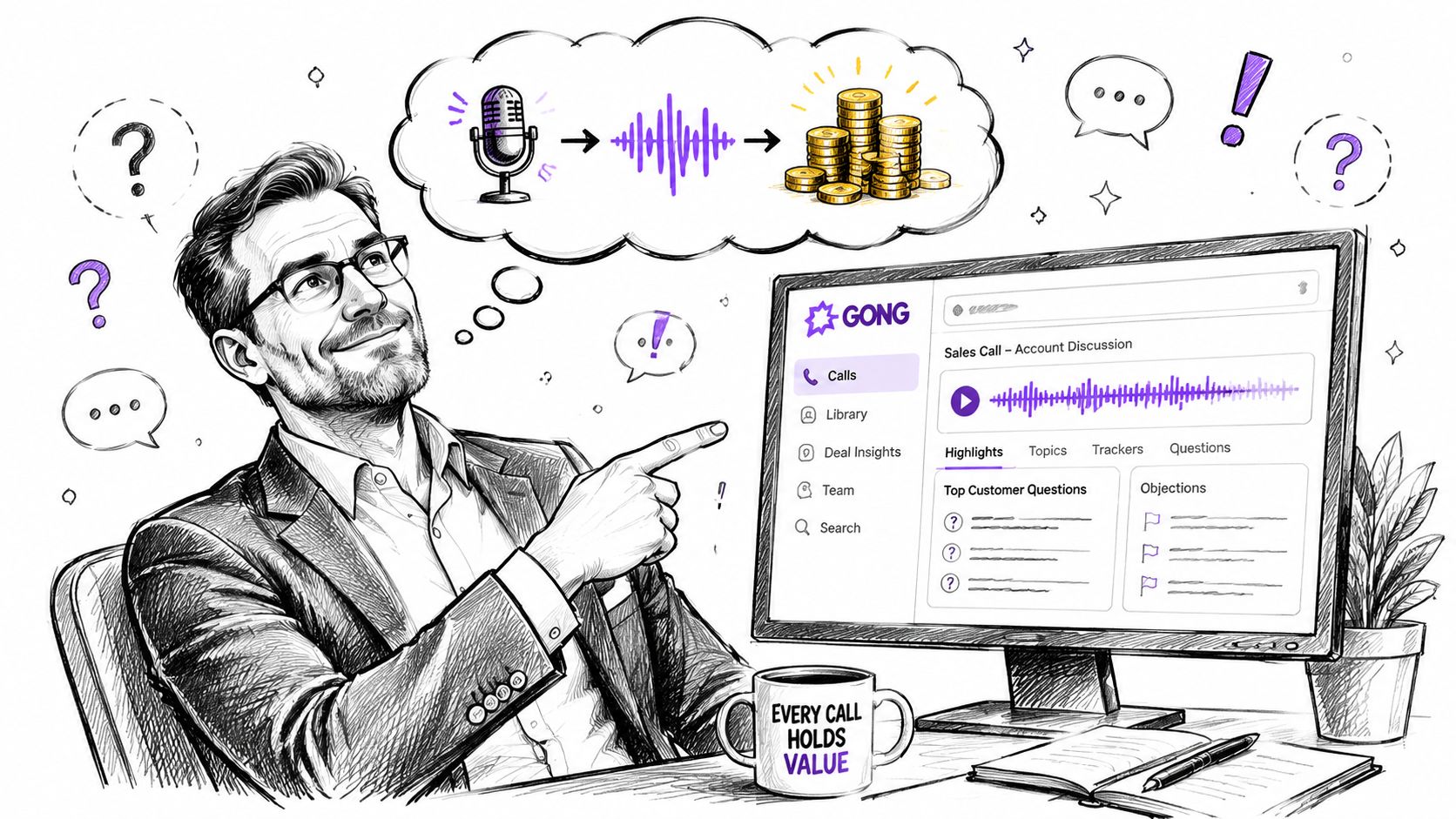
A sales call library isn't just a training archive. It's a market research archive. Every objection, every pricing concern, every competitor mention, and every confused follow-up is a content brief waiting to be used.
Teams pay for keyword tools because they want to know what buyers care about. Sales calls often answer that with more precision. They show what buyers ask when budget, timing, risk, and internal approval are on the line. That's far more useful than a generic list of search terms.
Why call libraries beat guessed personas
Most content teams still write from a blend of CRM notes, anecdotal sales feedback, and planning-session assumptions. That creates polished content that sounds right but misses buyer tension.
Call recordings solve that problem because they capture the exact phrasing that moves deals forward or stalls them. A question like “Won't this just create more work for my team?” is more valuable than a broad persona note about “concerns around implementation.”
Your market is already telling your company what content to create. Sales hears it every day.
A searchable library also helps teams move beyond memory. That's why related workflows for repurposing meeting recordings for marketing often outperform ad hoc note-taking. Recorded conversations preserve context. Notes rarely do.
What sales calls are best for content mining
Not every recording deserves attention. The useful ones tend to include:
- Clear objections: Calls where prospects push on price, timing, complexity, or risk.
- Strong rep explanations: Moments where a rep explains the product or category unusually well.
- Repeated questions: Questions that show up across multiple calls and indicate real demand.
- Comparison language: Mentions of alternatives, workarounds, or internal status quo.
The key shift is simple. Stop treating recordings as content that must be published. Start treating them as raw material that should be mined, filtered, and turned into strategic assets.
The Compliance-First Framework for Using Call Recordings
The first risk isn't content quality. It's legal exposure.
The major bottleneck for B2B teams isn't content quality; it's the lack of a standardized permission playbook for public repurposing, which creates a gap between the 73% of marketers who see recordings as a lead source and the 33% who can scalably create content from them, as explained in BuddyCRM's review of sales call recording trade-offs.
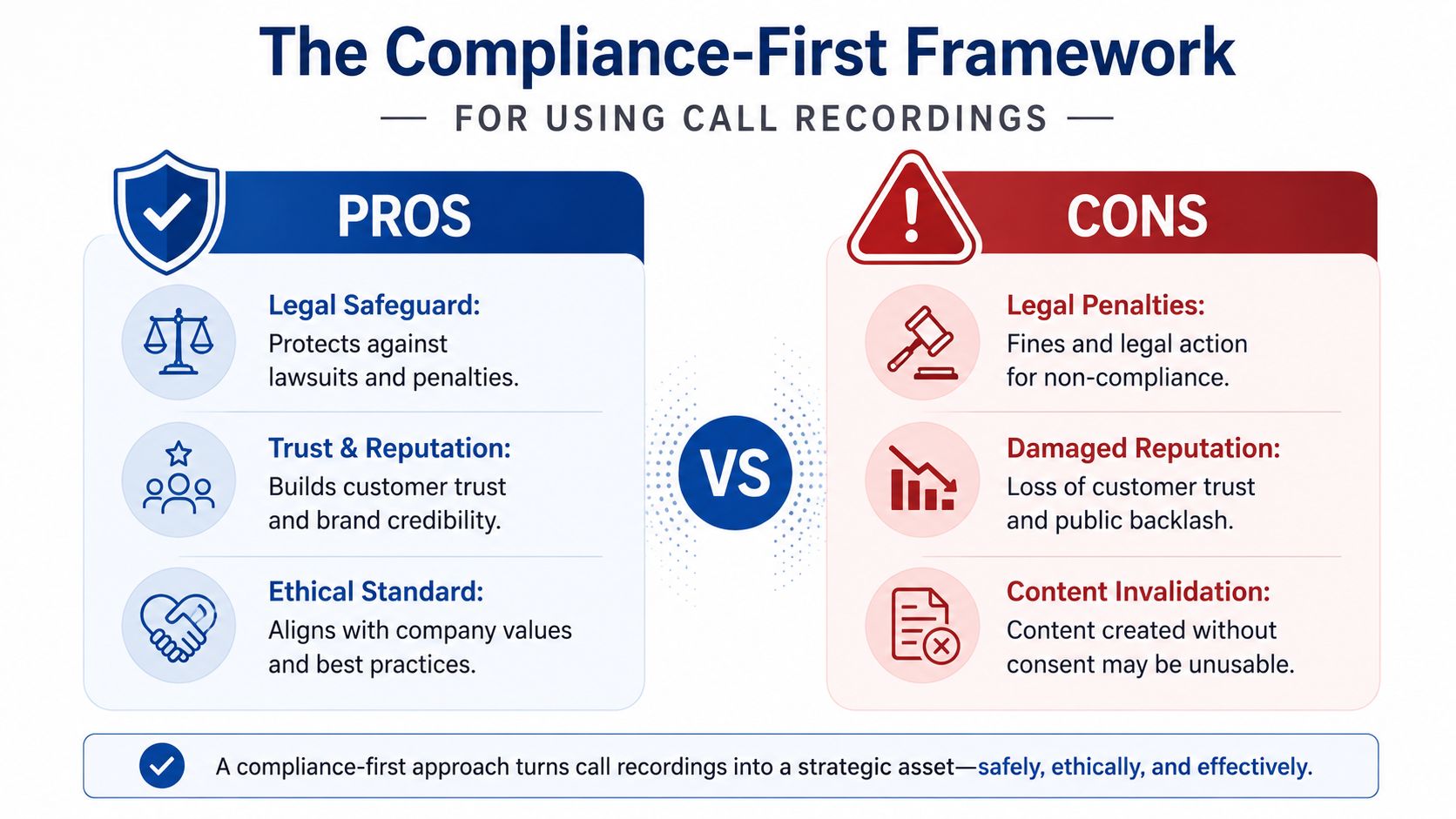
Many teams assume that “this call is being recorded” covers everything. It doesn't. That statement may cover recording. It usually does not cover public marketing use.
Recording permission and publication permission are different
A practical framework starts with two separate questions.
| Permission type | What it covers | What it doesn't cover |
|---|---|---|
| Recording consent | Capturing the conversation for internal use, notes, training, or compliance | Publishing that call externally in marketing |
| Publication consent | Using identifiable audio, video, or attributed quotes in public content | Unlimited future use in any format unless that scope is clearly granted |
If a team wants to publish identifiable call audio, video, or named quotes, it needs explicit written permission that matches the intended use. That permission should be scoped to the formats involved. Social clip. Blog quote. Webinar montage. Case-study excerpt. Each should be clear.
What should never be published
Some material should be off-limits unless counsel explicitly approves it. In practice, that includes:
- Personal identifiers: Names, job titles, faces, voices, email addresses, and company-specific references.
- Sensitive commercial details: Pricing specifics, contract terms, internal process notes, procurement timelines.
- Security or regulated information: Anything tied to legal, financial, health, or confidential operational topics.
- Unscoped call excerpts: Audio or video pulled into content without documented publication permission.
Practical rule: When in doubt, anonymize and aggregate.
That means the safest path usually isn't publishing the call. It's publishing the insight. A recurring objection across ten calls can become a blog post. A repeated question can become an FAQ. A consistent misunderstanding can become a product page rewrite. None of that requires a prospect's voice.
The safer route most teams actually use
The highest-value use of call recordings is often invisible to the public. Teams extract patterns, not personalities. They remove names, company clues, and anything attributable to one person. Then they turn the pattern into content.
That's where careful speaker attribution guidance matters. If a source is identifiable, it needs permission. If the content is aggregated and anonymized, the risk profile changes.
A workable internal rule looks like this:
- Record lawfully based on local consent rules.
- Treat recording consent and publication consent separately.
- Publish identifiable call audio only with explicit written approval.
- Default to anonymized insights for public marketing.
- Get legal sign-off on the process, not just one asset.
This is good operational practice, not legal advice. Each team should confirm its own process with counsel.
How to Repurpose Sales Call Recordings for Marketing A Monthly Workflow
The teams that do this well connect sales ops and marketing once a month. They don't wait for someone to remember a “great call” from last quarter. They build a routine.
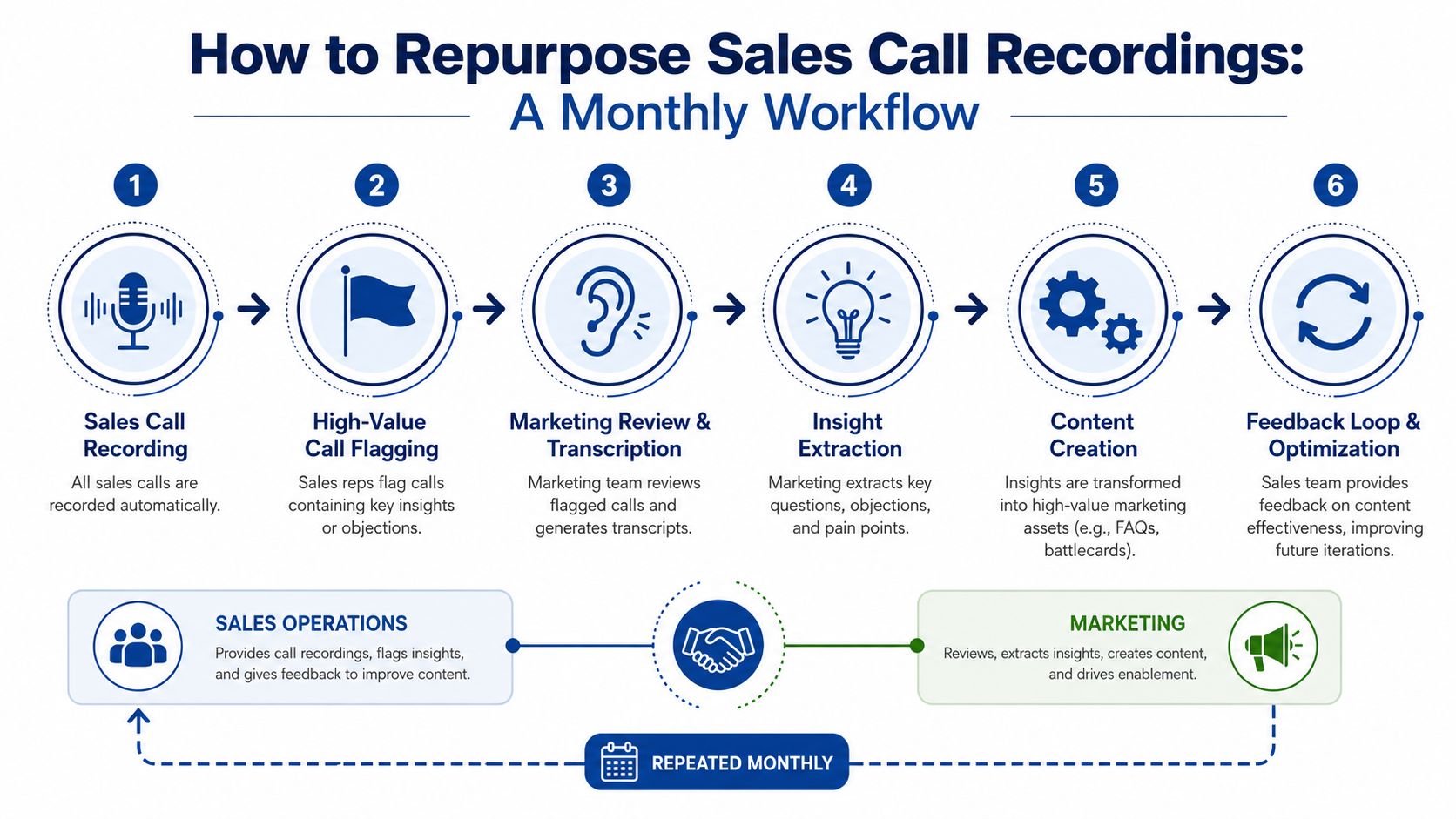
A simple system is enough. Sales flags useful calls inside Gong, Fathom, or Fireflies. Marketing reviews them in batches. The team turns those insights into assets sales can use.
A practical monthly workflow
Step 1
Sales ops creates a tagging rule for calls worth reviewing. Good tags include objection, competitor mention, pricing friction, implementation concern, strong demo moment, and rep explained value clearly.
Step 2
Managers ask reps to flag calls during the month. The standard should be narrow. Flagging every call creates noise. Flagging only calls with clear market signal keeps the review queue useful.
Step 3
Marketing reviews flagged calls in one batch session. The goal isn't to listen to everything. It's to spot repeated questions, language patterns, and sections worth turning into content.
A strong support resource for this kind of process is a documented content repurposing workflow for small teams. Without one, the work gets stuck between departments.
Later in the process, recorded insights can also support live review and editing. This walkthrough is useful context:
The real DIY time cost
Doing this manually is expensive in hours, even before publishing starts.
By hand, expect roughly eight hours to turn one video into reels, carousels, images, an infographic, an article, and text posts, according to St. Ledger Marketing's breakdown of manual repurposing work. A sales call workflow follows the same pattern. The source changes. The labor doesn't.
A realistic breakdown for one useful 45-minute call looks like this:
- Review and note-taking: 60 to 90 minutes to listen, skim transcript, and mark useful sections.
- Pattern validation: 45 to 60 minutes to compare that objection or question against other calls.
- Clipping and cleanup: 2 to 3 hours if a team is preparing publishable audio or video.
- Writing assets: 2 to 3 hours for a blog draft, FAQ copy, social posts, and sales snippets.
- Design and formatting: 60 to 90 minutes for carousels, quote graphics, and approvals.
- Compliance review: Variable, but it adds another layer if anything identifiable appears.
What a good handoff looks like
The best version of this process has one owner in sales ops and one owner in marketing.
| Role | Monthly responsibility |
|---|---|
| Sales ops | Define tags, maintain flagged-call queue, pull top recordings |
| Sales manager | Coach reps on what to flag and why |
| Content marketer | Review calls, extract themes, draft assets |
| Product marketing | Validate claims, refine messaging, shape comparisons |
| Legal or compliance lead | Review external-use rules and edge cases |
Most teams don't have an idea problem. They have an extraction problem.
The monthly outcome should be modest and consistent. A handful of sharp, objection-led assets beats a large pile of generic clips nobody uses.
The Four High-Value Assets to Create from Calls
The biggest mistake is treating sales calls as clip farms. Most published call snippets aren't the best output. The best output is content that removes friction from active deals.
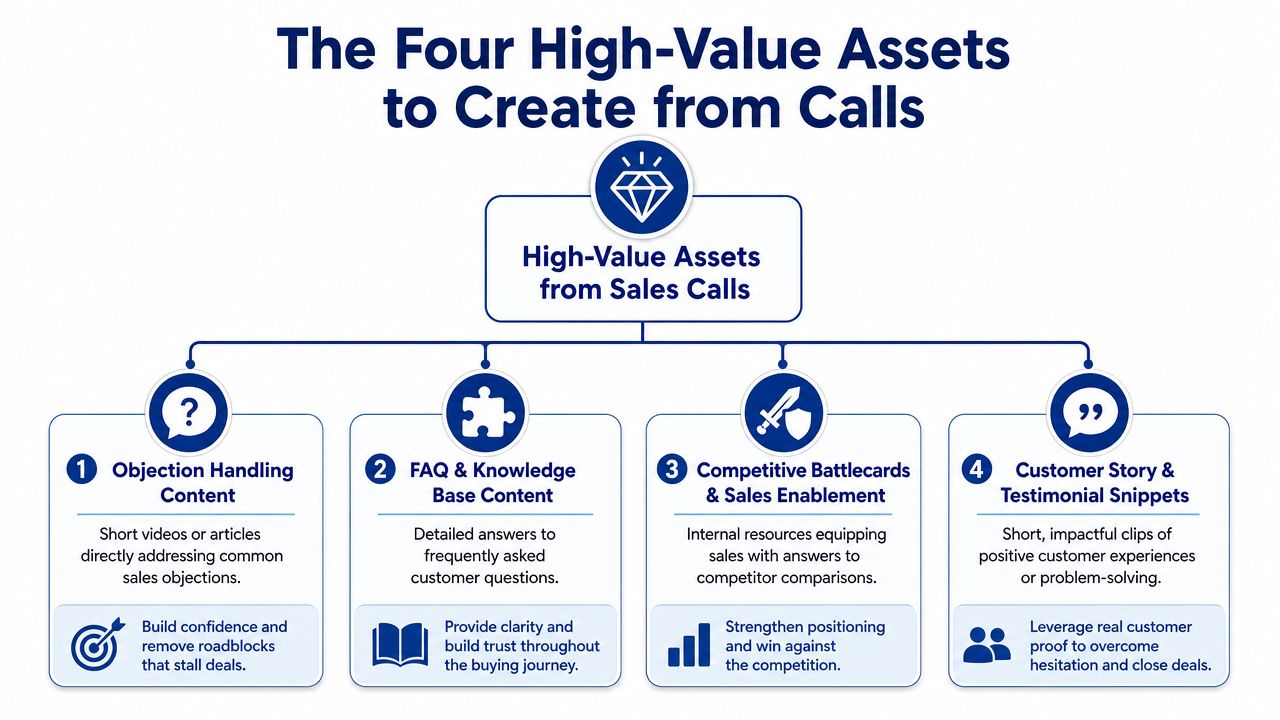
Revenue teams use call recordings to build searchable libraries that improve go-to-market strategy by identifying specific messaging that resonates and patterns where deals move forward or stall, replacing generic personas with authentic phrases, as described in this discussion on using recordings as a single source of truth.
Objection-handling assets
This is usually the highest-value category.
A repeated objection should become an FAQ entry, a comparison-page section, a follow-up email snippet, or a short LinkedIn post. These assets work because they answer the exact doubt that slows deals. They come from reality, not brainstorms.
A compliance-safe highlight post can follow this structure:
- Open with the objection in buyer language, anonymized.
Example: “Won't this just create more work for my team?” - Add the reframe your best rep gives in two or three tight lines.
- Include proof such as a specific example, customer experience pattern, or approved internal evidence.
- Close softly with a next step, not a hard pitch.
The value usually lives in the insight, not the audio.
Guaranteed-demand blog topics
If prospects keep asking the same question on calls, that topic deserves a blog post. Demand is already proven. No one has to guess whether the market cares.
Good examples include:
- Implementation questions: What changes for the team after rollout?
- Risk questions: What happens if adoption stalls?
- Comparison questions: How is this different from doing it in-house or using a competitor?
- Pricing-process questions: What affects scope, support, or buying complexity?
That same logic applies to adjacent formats like turning customer interviews into marketing content. The source may differ, but the signal is the same. Repeated questions indicate demand.
Copy that sounds like the buyer
Sales calls are one of the best places to find the phrases buyers already use to describe their pain, desired outcome, and hesitation. That language belongs in:
- Homepage and product-page copy
- Ad hooks and landing-page headlines
- Email nurture sequences
- Sales collateral and battlecards
This is how teams stop writing “improve operational efficiency” when buyers say “our team is drowning in follow-up work.”
Selective clips from your side of the call
Published clips can still work, but they should usually feature the company's own rep, host, or subject expert. A rep explaining a product concept cleanly. A strong demo moment. A category explanation that stands alone.
That's a better fit than publishing a prospect's voice. It's safer, cleaner, and easier to approve.
For broader inspiration, there are useful content repurposing examples from one long-form recording, even though the strongest sales-call output is often written, not clipped.
How to Measure the Impact on Pipeline and Sales
Sales-call-derived content is more accountable than most marketing content because each asset starts with a known point of friction. A team isn't publishing abstract thought leadership. It's removing a reason deals stall.
Firms that actively analyze conversation data from calls for coaching and content see close rates improve by up to 50% compared to the baseline cold-call success rate of 2-3%, according to NetHunt's review of sales call recording and analysis. That doesn't mean every asset will produce a clean attribution path. It means the category is worth measuring seriously.
Track content-influenced pipeline
Tag every objection-handling FAQ, comparison section, blog post, and sales follow-up asset that came from call analysis. Then watch whether opportunities that touched those assets progress differently.
Attribution will never be perfect. That's normal. The useful question is whether deals that consume those assets move with less friction.
A sound framework for content marketing ROI measurement helps here, especially when marketing and sales already share stage definitions.
Measure sales adoption first
Traffic can mislead. Sales usage is often the cleaner signal.
If reps repeatedly send the same FAQ page or comparison section, that asset is doing a job. If they ignore it, the asset may be polished but irrelevant. A rep's behavior is often the fastest validation available.
Three practical checks work well:
- Repeat sends: Which assets keep appearing in follow-up emails?
- Stage fit: Which asset gets used at discovery, demo, or late-stage review?
- Rep feedback: Which content pieces save explanation time?
An asset reps reach for repeatedly is usually solving a real objection.
Watch the objection itself
The strongest feedback loop is qualitative. If a new asset handles a repeated concern well, that concern should start appearing less often, or get resolved faster, on later calls.
That's the rare advantage of this content category. A team can trace an asset back to a specific deal-stage problem, then listen for whether the problem softens over time. Few content programs get that level of operational visibility.
The Done-for-You Alternative
The workflow is clear. The problem is throughput.
Even a disciplined team burns hours reviewing calls, clipping moments, writing posts, designing assets, and managing approvals. Manual repurposing easily consumes most of a day for one recording. Busy demand gen teams don't have that kind of spare capacity, and founders shouldn't be spending it there either.
A done-for-you service changes the equation. Instead of building an internal mini-studio around Gong exports and transcript review, the client sends one recording and gets finished assets back.
What the service model looks like
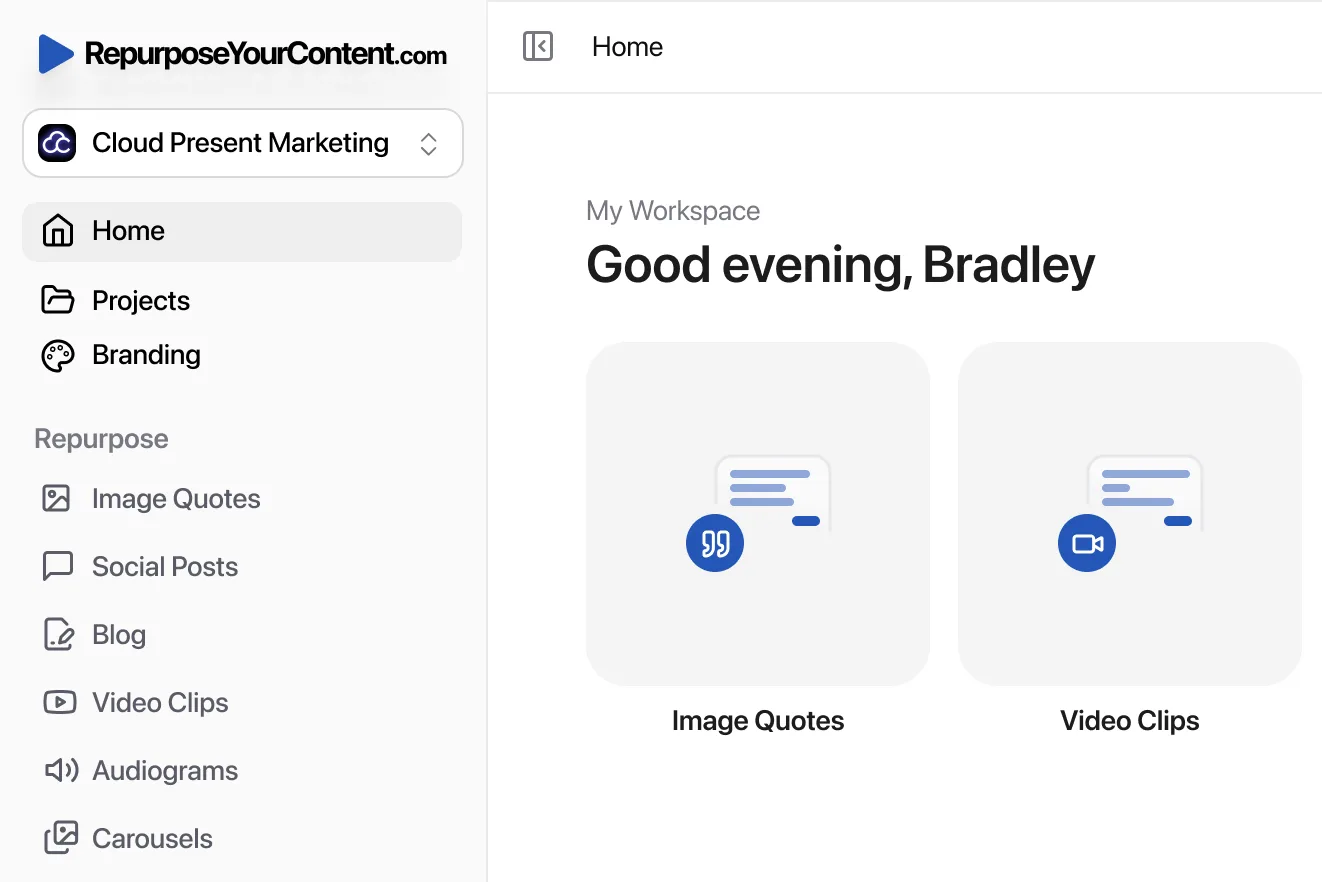
Send one recording. It can be a podcast, webinar, keynote, interview, meeting recording, demo, or sales call. In 72 hours, the delivery includes 20 to 30 ready-to-publish assets:
- Video clips
- LinkedIn posts
- Quote graphics
- Carousels
- Audiograms
- A blog post
Everything is created in the client's brand voice. Revisions are unlimited. Client time is about 15 minutes.
That's a very different operational burden from doing everything by hand. One 45-minute recording becomes 30 assets instead of another forgotten file on a server.
Why teams choose this route
The value isn't just speed. It's consistency.
A service team can keep the workflow moving when internal marketing is already buried under launches, email, paid campaigns, and reporting. It also removes the awkward half-owned process where sales has the recordings, marketing has the brief, design has the queue, and nobody ships on time.
The economics are also easier to justify when assets start from $14 per finished asset and include a 72-hour turnaround guarantee, or you don't pay. That's closer to a fractional content team than a one-off production expense.
Repurpose sales call recordings for marketing if the company already has a library of buyer conversations. Don't let those insights die in Gong, Fathom, or Fireflies because no one has time to process them.
If there's a backlog of recordings waiting to be turned into content, book a call with RepurposeYourContent or request a sample. Send one recording and get back on-brand assets without adding more work to the team.
Tags: