Tone of Voice Guidelines That Actually Work
Build tone of voice guidelines your team will use. A step-by-step playbook with examples, anti-examples, and channel-specific rules for B2B teams and creators.
A tone guide can exist and still fail every writer who needs it. The practical problem is voice drift, when freelancers, employees, and AI drafts each make different decisions about vocabulary, confidence, warmth, and formality.
Effective tone of voice guidelines solve that problem by turning brand personality into operational rules. They show writers what to do, what to avoid, and how the voice changes across channels. They also give editors a repeatable way to review drafts before publication.
The strongest systems began as broad ideas, then became testable frameworks. Academic discussion of brand tone appeared in the Journal of Applied Linguistics discussion of brand tone of voice in 2007. By 2016, Nielsen Norman Group had defined four practical dimensions, funny versus serious, formal versus casual, respectful versus irreverent, and enthusiastic versus matter-of-fact.
That evolution matters. A tone guide shouldn't sit in a shared drive as a personality description. It should control daily content production.
Why Most Tone of Voice Guidelines Fail
Most tone of voice guidelines fail because they describe a personality instead of directing a decision. “Warm but professional” sounds sensible, yet it doesn't tell a writer how to handle a pricing objection, an outage notice, or a LinkedIn post.
The document isn't always the problem. The workflow around it is. A guide becomes irrelevant when nobody owns it, examples don't match current channels, and writers must interpret abstract adjectives under deadline.
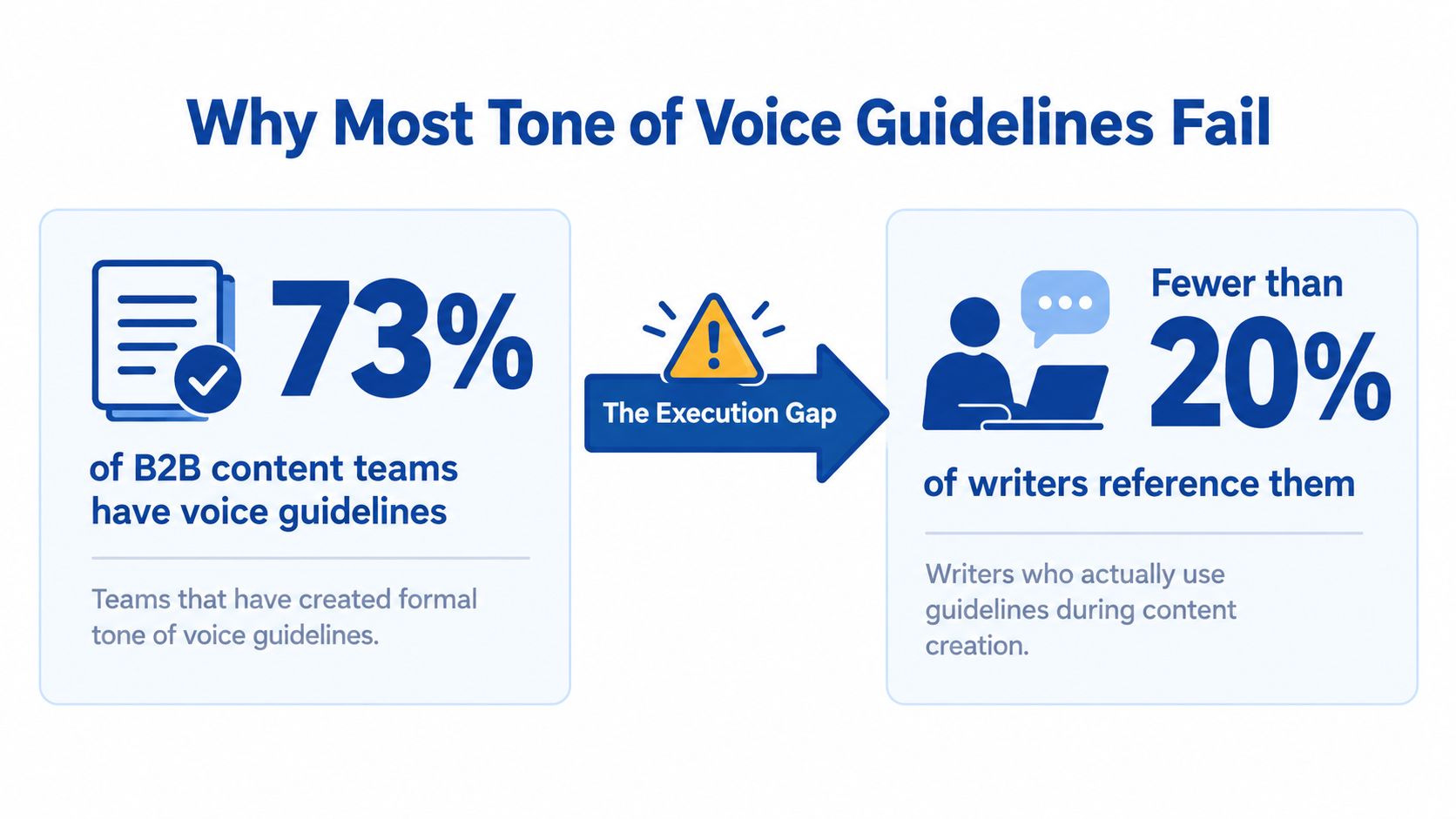
Four recurring failure patterns
- Descriptive voice without behaviour: “Bold” becomes louder claims, longer headlines, or unnecessary certainty. Each writer interprets it differently.
- No channel examples: A playful social post doesn't establish the right tone for a support reply or investor update.
- No governance owner: Without a named steward, outdated rules remain active while new preferences spread informally.
- No production connection: A PDF can't influence an AI prompt, editorial brief, freelancer handoff, or review checklist by itself.
Nielsen Norman Group's four-axis model gives teams a useful starting point, but a framework only works when writers can apply it quickly. The practical test is simple: can a writer make the right choice in ten seconds?
Practical rule: If a writer needs a meeting to interpret a tone rule, the rule isn't operational yet.
The answer isn't adding more tone words. It's reducing the voice to a small set of observable behaviours, then attaching examples to the situations that create the most risk. The system should cover discovery, pillars, examples, channel adaptation, governance, and AI controls.
Run the Discovery Exercises First
Generic voice guides usually begin with adjectives. Stronger guides begin with evidence from existing communication.
Discovery reveals the voice a company already uses, the voice leaders want, and the language customers understand. Those three versions rarely match perfectly. The work is to identify the useful patterns and remove accidental habits.
Four exercises worth doing
1. Run a voice audit. Sample 12 to 15 assets across blog articles, sales emails, support replies, and LinkedIn posts. Tag sentences for formality, confidence, warmth, and jargon. One person needs about 3 to 4 hours for the first pass. A second reviewer can bring the total to roughly 6 hours and expose disagreements.
2. Interview stakeholders. Schedule six 30-minute conversations with sales, support, product, and the founder. Include synthesis time, which brings the exercise to roughly 4 hours. Ask which customer situations require trust, urgency, reassurance, or authority.
3. Mine customer language. Pull 20 verbatim customer quotes from sales calls, reviews, and support tickets. Budget about 3 hours. Look for repeated descriptions of problems, desired outcomes, objections, and category language. Customer interviews can also generate useful campaign material through a structured customer interview content workflow.
4. Complete an anti-brand audit. List three competitors and one company the brand refuses to resemble. Set aside 90 minutes. Identify the signals to avoid, such as empty hype, forced humour, excessive technical language, or corporate distance.
Turn findings into a short summary
The discovery summary should fit on one page. It should contain:
- Observed patterns: Language that already feels recognisably on-brand.
- Desired shifts: Behaviours the organisation wants to increase or reduce.
- Customer vocabulary: Phrases buyers use without internal jargon.
- Risk situations: Moments where the wrong tone could damage trust.
- Rejected signals: Competitor or category habits the brand won't adopt.
That summary gives the pillars exercise a real foundation. Without it, teams choose traits that sound attractive but don't help anyone write.
Define Voice Pillars and a Tone Matrix
Voice pillars convert broad positioning into decisions. Nielsen Norman Group's four axes remain useful here: funny versus serious, formal versus casual, respectful versus irreverent, and enthusiastic versus matter-of-fact. Teams can plot their preferred position on a 1-to-7 scale, then discuss the trade-offs instead of arguing over adjectives.
Most B2B brands don't need six personality traits. Candidate traits should collapse into three to five pillars. For every trait, ask two questions:
- Can a writer use it to decide something in ten seconds?
- Would the opposite create a sentence that feels recognisably wrong?
“Human” often fails both tests. “Explain the customer impact before the internal process” passes.
The guide to mastering tone in writing with RewriteBar offers useful context for separating voice characteristics from situational tone. That distinction prevents a serious support response from sounding like a casual social post.
Build the matrix around situations
Rows should represent real communication moments. Columns should represent pillars. Each cell needs one behavioural instruction, not another adjective.
| Situation | Direct | Warm | Precise | Confident |
|---|---|---|---|---|
| Announcing a price increase | State the change in the opening sentence | Acknowledge the effect on customers | Explain what changes and what stays | Explain the reason without apologising for the business decision |
| Responding to an outage | Lead with the current status | Recognise the disruption | Separate confirmed facts from investigation | Give the next update point without speculation |
| Thought leadership post | Make one clear argument | Respect the reader's existing knowledge | Define specialist terms | Take a position and support it |
| Sales follow-up | State the decision needed | Reference the buyer's stated priority | Remove vague next steps | Recommend a clear action |
This matrix is more useful than a page saying “be approachable and authoritative.” It tells writers how the same voice behaves under pressure.
Teams creating a broader content system can connect these pillars to a content pillar strategy for marketing. The key is keeping the brand's core identity stable while changing emphasis by context.
Build a Do and Don't Library With Real Examples
A do and don't library turns principles into a working reference. Writers shouldn't need to translate “confident but not cocky” into copy while a deadline is approaching.
Each entry needs four parts:
- Trait: The behaviour being controlled.
- Do example: A sentence that demonstrates the desired choice.
- Don't example: A plausible sentence that crosses the line.
- Reason: The decision behind the distinction.
Keep each entry short enough to scan during drafting. The library should focus on high-friction surfaces, including homepage headlines, feature descriptions, error messages, sales follow-ups, and social posts.
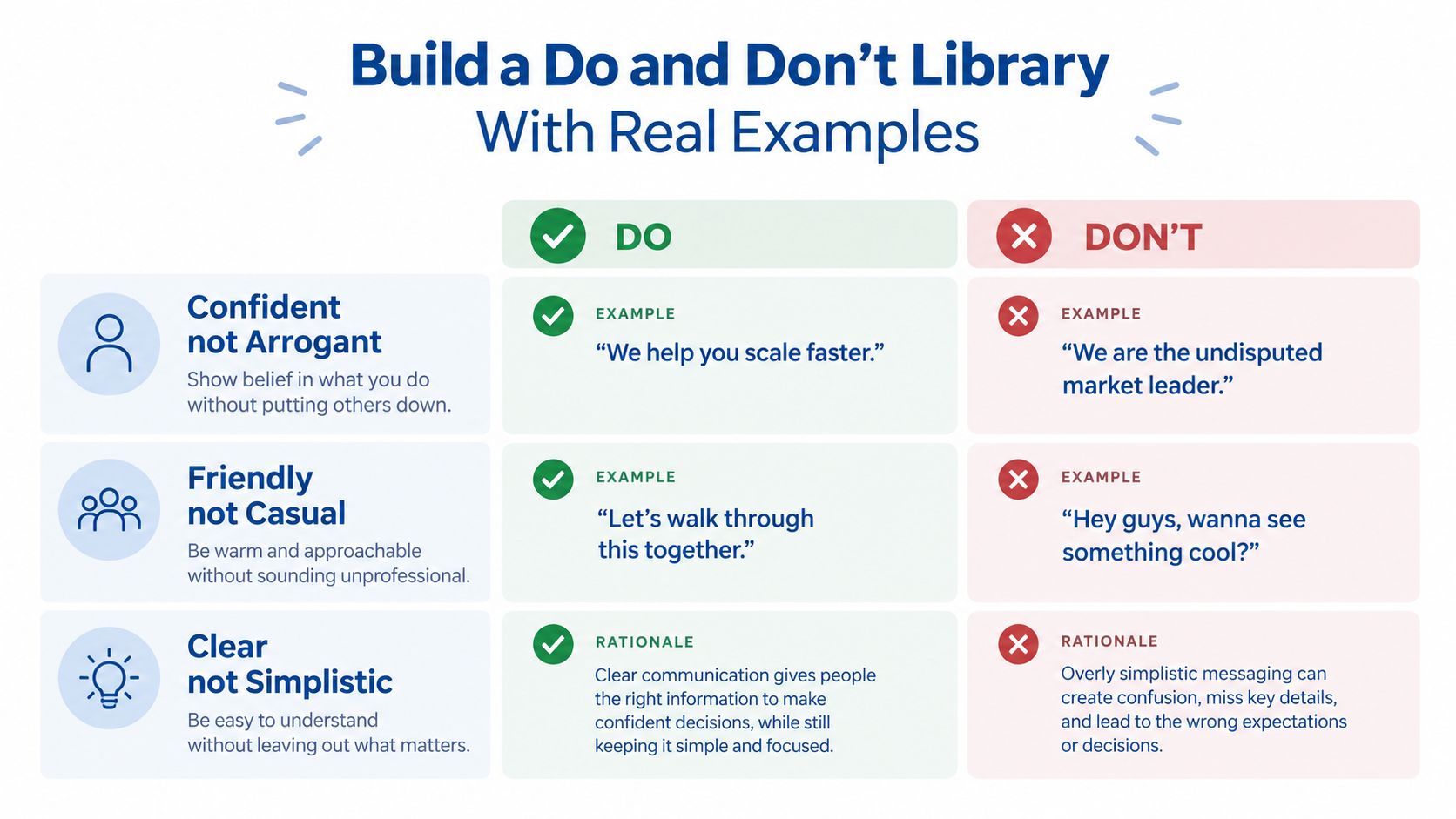
Worked example for a B2B SaaS launch
Confident, not cocky
Do: “The new reporting view helps revenue teams spot pipeline gaps before the weekly review.”
Don't: “Our reporting engine is the undisputed market leader in revenue intelligence.”
The first sentence makes a specific promise without claiming superiority. The second uses inflated language and an unsupported category claim.
Friendly, not casual
Do: “The implementation team can walk through the new workflow with your administrators.”
Don't: “Hey guys, wanna see something cool?”
Clear, not simplistic
Do: “Connect the data source, choose the reporting fields, and review the first dashboard.”
Don't: “Just connect everything and get instant insights.”
Clarity removes friction. It doesn't remove necessary detail.
Add plain-language constraints
A practical library can include these defaults:
- Sentence length: Keep sentences around 15 to 20 words where possible, consistent with common plain-language readability guidance from ReadabilityPro's business writing guidance.
- Sentence structure: Prefer active voice and name the actor.
- Vocabulary: Cut jargon unless the buyer uses it naturally.
- Claims: State the outcome before the mechanism.
- Editing: Remove inflated modifiers and empty intensifiers.
Editing test: If a sentence sounds impressive before it sounds useful, rewrite it.
A library becomes powerful when examples come from actual company copy. Approved examples should be annotated, and weak examples should show the exact failure, not a ridiculous straw man. Teams repurposing source material can also use content repurposing examples to test whether the voice survives different formats.
Adapt Tone by Channel and Audience
Voice should remain recognisable. Tone should change with the channel, audience sensitivity, and job of the message.
A procurement director on LinkedIn needs concise commercial relevance. An end-user practitioner reading a blog needs useful explanation. A frustrated administrator needs accountability before education. Treating all four audiences identically makes the brand sound either robotic or careless.
| Channel | Audience | Formality (1-5) | Average sentence length | Humor allowed | CTA style |
|---|---|---|---|---|---|
| LinkedIn post | Procurement director | 3 | Short | Light, only when relevant | Invite a considered response |
| Blog article | End-user practitioner | 3 | Short to medium | Occasional | Offer a useful next step |
| Cold sales email | VP of Marketing | 4 | Short | None in the opening | Ask for a specific decision |
| Support reply | Frustrated administrator | 4 | Short | None | Give the next action and timing |
The table's numbers are editorial calibration points, not universal rules. Each team should test its assumptions with real readers.
Preserve the core while shifting the delivery
A LinkedIn post can use more energy and a sharper opening. A support reply should reduce emotional distance and avoid cleverness. A sales follow-up can sound decisive without becoming aggressive.
The trade-off is clear:
- Over-tailoring fragments the brand: Every channel begins to sound like a different company.
- Under-tailoring creates friction: Readers receive language that ignores their context.
- Consistent principles protect recognition: Vocabulary, point of view, and honesty should remain stable.
- Situational rules protect trust: Humour, urgency, and formality should change when the stakes change.
For sensitive communications, transparency matters more than personality performance. A practical user transparency strategy guide can help teams think through clarity, accountability, and expectation setting.
A channel matrix should also define CTA style, acceptable proof, formatting, and escalation rules. A broader cross-platform content repurposing workflow works only when the same source idea receives channel-appropriate treatment.
Govern, Audit, and Stop Voice Drift
A guideline without ownership becomes a PDF. A guideline with ownership becomes part of the content operating system.
Assign one voice steward. That person doesn't need to approve every sentence, but they should maintain the rules, resolve edge cases, approve changes, and track recurring problems. Shared responsibility often means nobody makes the final call.
Four governance controls
1. Schedule a quarterly audit. Sample 20 random assets and score each against the tone matrix. Review blog content, social posts, sales messages, support replies, and AI-assisted drafts.
2. Log drift patterns. Record repeated failures in a shared document. Useful categories include overclaiming, excessive formality, unnecessary jargon, weak openings, and inappropriate humour.
3. Add AI guardrails. Put the voice pillars, vocabulary rules, do and don't examples, and negative constraints into a custom GPT or prompt template. Ask the system to flag off-voice drafts instead of blindly rewriting everything.
4. Add the guide to onboarding. Freelancers and new hires should read the relevant sections before drafting. A short calibration exercise works better than passive distribution.
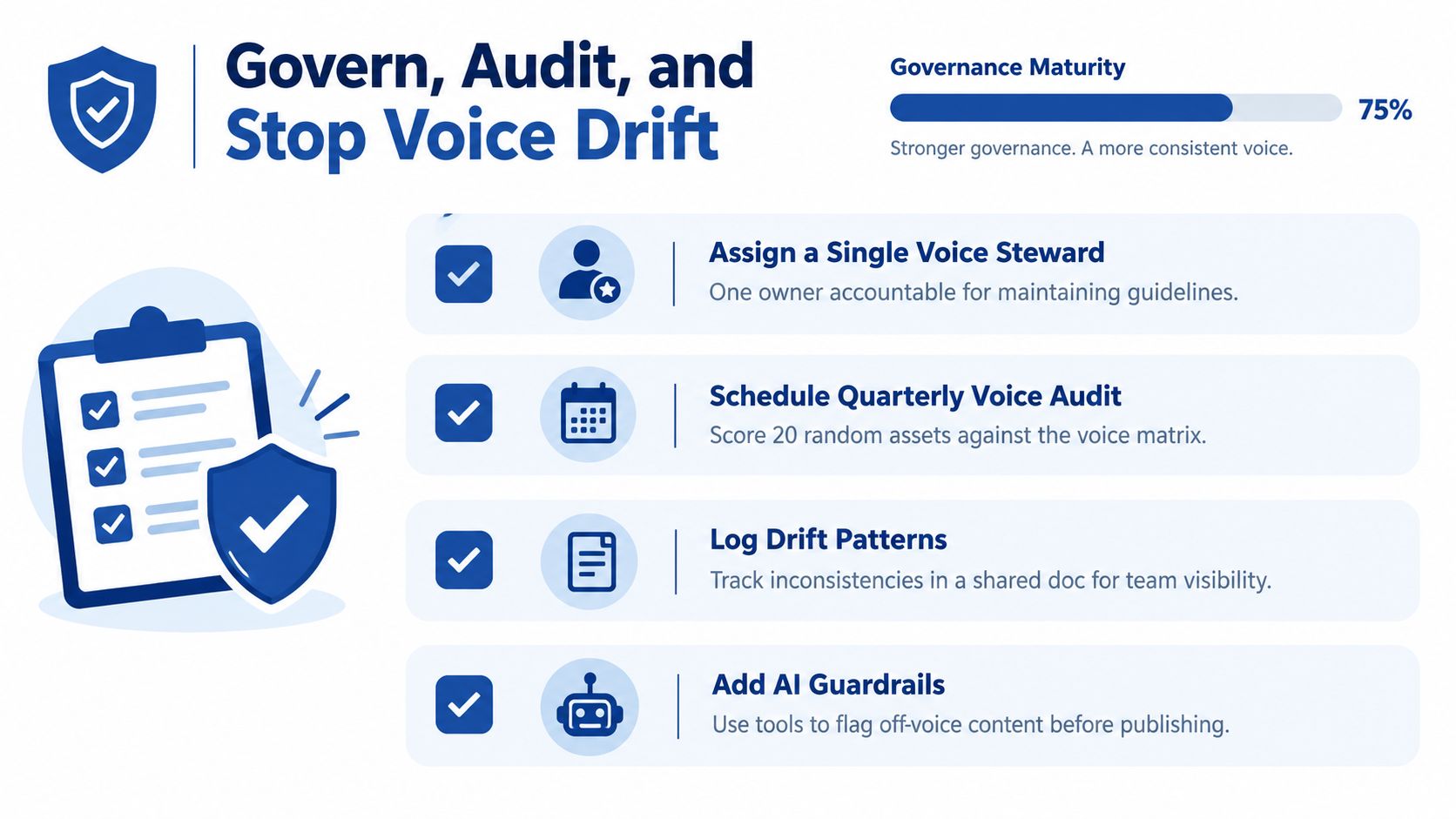
AI drafts need especially explicit controls. Practical guidance on scaling content production is useful when more writers, channels, and generated drafts enter the workflow. The operating principle stays simple: rules must appear where content gets produced.
Implementation checklist
- Discovery complete: Existing copy and customer language have been reviewed.
- Pillars defined: The team has three to five behavioural principles.
- Library populated: High-risk situations have approved examples.
- Channel matrix filled: Audience and context changes are documented.
- Steward named: One person owns decisions and updates.
- Audit scheduled: The review cadence is already on calendars.
- AI prompt live: Positive and negative constraints are ready for drafts.
A useful audit can score consistency on a 1-to-5 scale every 90 days. One independent workflow recommends investigating any average below 4 out of 5, as described in this brand voice guideline workflow. The score isn't the system. It creates a visible trigger for action.
The Done-for-You Alternative and Next Steps
A complete voice system takes real labour. The discovery audit can take 3 to 4 hours for one reviewer. Stakeholder interviews and synthesis take roughly 4 hours. Customer language mining takes about 3 hours, and the anti-brand audit takes 90 minutes. That work happens before anyone writes the guide.
Content production adds another layer. Manual repurposing can take 2.5 to 5 hours for one recording across excerpt selection, platform writing, formatting, and design, according to time-to-publish benchmarks. A documented hand-repurposing workflow can take 2 to 4 hours for one pillar piece, including transcription, extraction, rewrites, clipping, scheduling, and measurement, as outlined in this content repurposing workflow.
A specialist service makes sense when the company has source material but lacks production capacity. RepurposeYourContent is one done-for-you option. Clients send a podcast, keynote, interview, sales call, livestream, course, meeting, or other long-form recording. The service returns 20 to 30 ready-to-publish assets in 72 hours, including video clips, LinkedIn posts, quote graphics, carousels, audiograms, and a blog post, written in the client's brand voice with unlimited revisions.
The client's time is about 15 minutes. A 45-minute recording can become 30 assets. The service states a 72-hour turnaround guarantee, or the client doesn't pay, with pricing from $14 per finished asset.
| Dimension | DIY Internal Build | Done-for-You Service |
|---|---|---|
| Voice discovery | Internal interviews and copy audits | Specialist-led intake using existing samples |
| Pillars and rules | Built around team availability | Defined as a working editorial system |
| Production | Writers, editors, designers, and reviewers coordinate | One team creates and reviews the asset set |
| AI guidance | Internal prompt creation and testing | Voice rules can be incorporated into the delivery workflow |
| Client time | Multiple production sessions | About 15 minutes per recording |
| Revisions | Managed through internal capacity | Unlimited revisions |
| Turnaround | Depends on workload and handoffs | 72 hours for the stated asset delivery |
Teams comparing internal production with external capacity can review outsourcing content repurposing options. The right choice depends on control, speed, internal skills, and the cost of keeping specialists busy with repetitive production.
Book a 20-minute scoping call and bring three items: current writing samples, the main audience persona, and the channel list. The first deliverable is a practical voice assessment, showing the strongest existing patterns, the clearest drift risks, and the next rules worth documenting. Request a sample from a recent recording, or book the call to turn the next 45-minute conversation into publish-ready content.
Tags: