Turn AMA Sessions Into Content: A 2026 Guide
Unlock your AMA recordings! Learn to turn AMA sessions into content for a full month. Extract clips, posts, and articles from any session with our 2026 guide.

Teams that already run AMAs are often sitting on a month or more of usable content without treating it that way.
The missed opportunity is not the session itself. It is the lack of a system for turning live questions into planned assets. A strong AMA gives content teams something far better than another brainstorm. It gives them a list of audience questions that have already been validated in public.
That changes how the session should be used. Instead of seeing an AMA as a one-time engagement play, treat it as a content generation workflow. Each question can become a short clip, a text post, a FAQ entry, a sales enablement asset, or the backbone of a blog section. The recording is only the input. The value comes from how deliberately the team extracts, organizes, and publishes what came out of it.
Live questions reveal intent in the audience's own language. A keyword tool can suggest topics. An AMA shows what people were motivated to ask, where they got stuck, and how they phrase the problem when the answer matters.
Teams already doing this with other conversations can apply the same production logic to AMAs. The process is similar to repurposing meeting recordings for marketing, but AMAs add one advantage. The content roadmap comes from the audience, not from internal guesswork.
Your Best Content Is Already Hiding in Your AMAs
Content ideation usually starts backwards. A team opens a doc, lists topics, checks keywords, watches competitors, then hopes the result lands. An AMA flips that process. The audience tells the team what matters first.
That changes the job. The goal isn't to invent topics. The goal is to capture, sort, and redistribute demand that already showed up in the room.
A Slack AMA with a founder might surface product objections. A Reddit AMA might reveal repeated misconceptions. A LinkedIn Live Q&A might expose buying-stage questions that sales hears every week. Those questions aren't filler. They're the raw material for content that already has an audience.
Practical rule: If someone asked the question live, there's a strong chance someone else still needs the answer asynchronously.
That's why AMA recordings deserve the same treatment as interviews, sales calls, and webinars. Teams already sitting on meeting or community recordings can use the same production logic used in repurposing meeting recordings for marketing.
Why this matters for busy teams
A community manager or content lead doesn't need more topic ideas. That person needs fewer bad bets.
AMAs reduce guesswork in three ways:
- They reveal demand: The topic came from a real person, not a planning session.
- They expose wording: The audience often describes the problem better than the brand does.
- They show priority: Repeated questions point to pillar topics worth expanding later.
The practical shift is simple. Stop treating AMAs as disposable community moments. Treat them as a content generation system.
Why AMAs Are Your Best Untapped Content Source
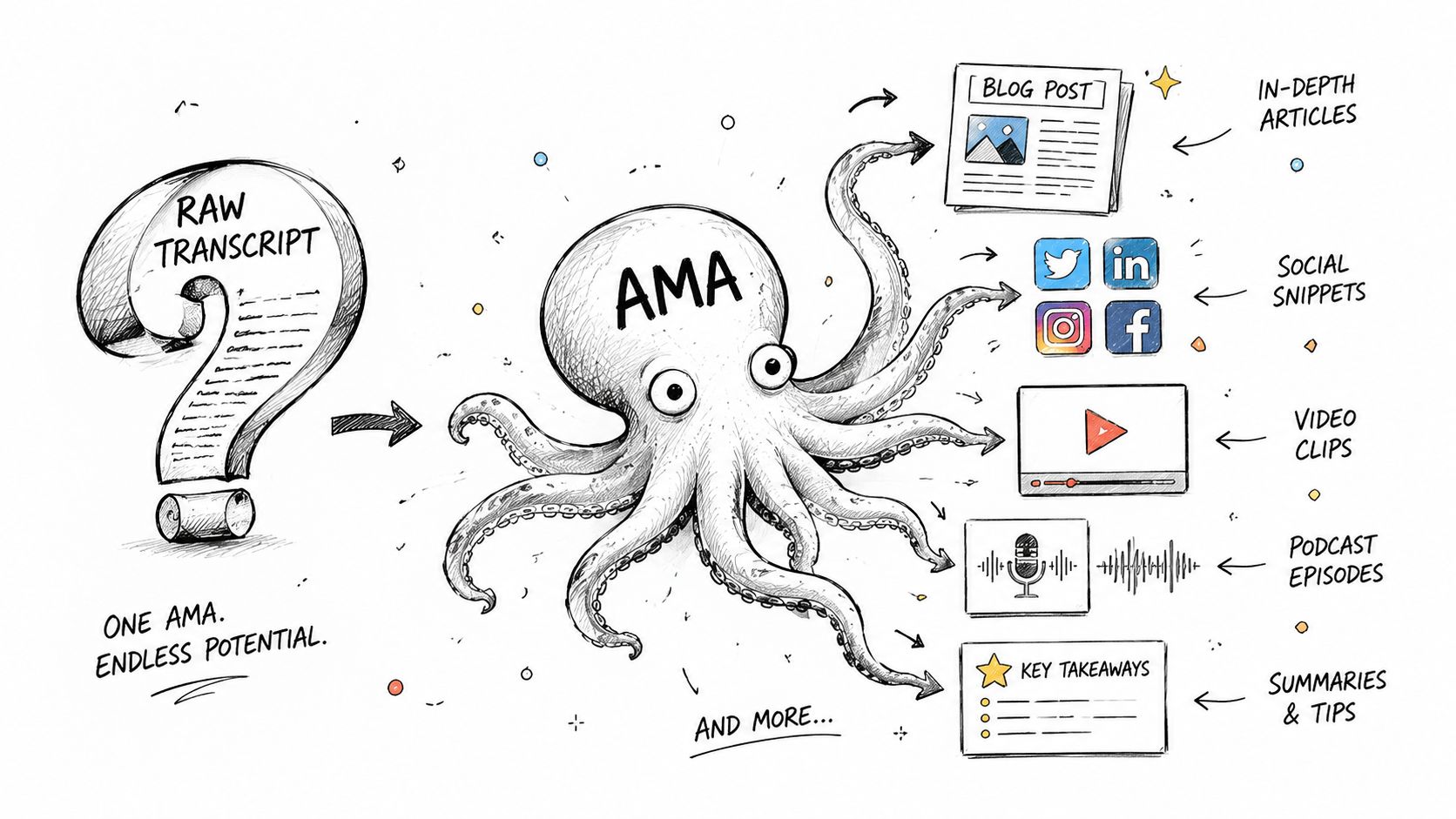
Teams that repurpose content well usually get more output from fewer source materials. AMAs deserve a place at the center of that system because they produce two assets at once: audience research and usable content.
An AMA does more than generate engagement for an hour. It surfaces the exact questions, objections, and decision criteria your audience already cares about. That changes how content planning works. Instead of starting with assumptions and hoping they match the market, you start with language the market already used.
Each question carries strategic value
A strong AMA question is rarely just a request for information. It usually points to a content job you would have had to identify some other way.
One question can reveal:
- A pain point: "How do we get adoption internally?"
- An objection: "Why wouldn't we just keep doing this manually?"
- A comparison request: "How is this different from hiring freelancers?"
- A process gap: "What's the best way to structure the rollout?"
- A buying signal: "What should be in place before this works?"
That is why AMA questions deserve more weight than brainstormed topics. They come with context. You can hear what the audience is stuck on, how they describe it, and how urgent it feels based on the follow-up questions.
I treat that as pre-validation. If three people ask versions of the same question in a live session, that topic has already cleared a basic relevance test.
The format gives you better raw material
AMA sessions also produce source material that is easier to repurpose than many planned formats. The conversation is already broken into question-and-answer segments. The speaker is responding to a real prompt instead of reading polished talking points. That usually means clearer hooks, stronger phrasing, and fewer generic claims.
The channel mix also helps. Teams keep investing in video, live, and interactive formats because they perform well across attention and reuse. The practical takeaway is straightforward in these content repurposing statistics for 2026. Formats that create conversation also create more downstream assets.
A scripted webinar can still work. A polished brand video can still work. But AMAs have an efficiency advantage because the audience helps shape the editorial agenda in real time.
Why AMAs beat guessed topics
Keyword research, competitor reviews, and trend monitoring still have a place. I use all three. But each one needs interpretation, and interpretation introduces risk.
AMAs reduce that risk because the topic arrived with evidence of interest already attached.
| Approach | What drives the topic | Typical risk |
|---|---|---|
| Brainstorming | Internal assumptions | Topics sound good in planning, then underperform |
| Keyword list | Search patterns | The term has volume, but weak fit with your offer |
| Trend chasing | Platform momentum | Fast attention, short shelf life |
| AMA extraction | Real audience questions | Stronger fit with audience need and brand expertise |
That is the reason AMAs are underused. Teams often treat them as community events, then stop there. The better approach is to treat each session as a structured input to the content system. If the audience asked the question live, you already have a stronger starting point than another blank page.
The Content Extraction Map From a Single AMA
A single AMA rarely produces one asset. It usually produces a batch of answers your audience already told you they care about. That changes the job after the session. The goal is not to recap the event. The goal is to turn each useful question into a publishable asset with a clear role in your content system.
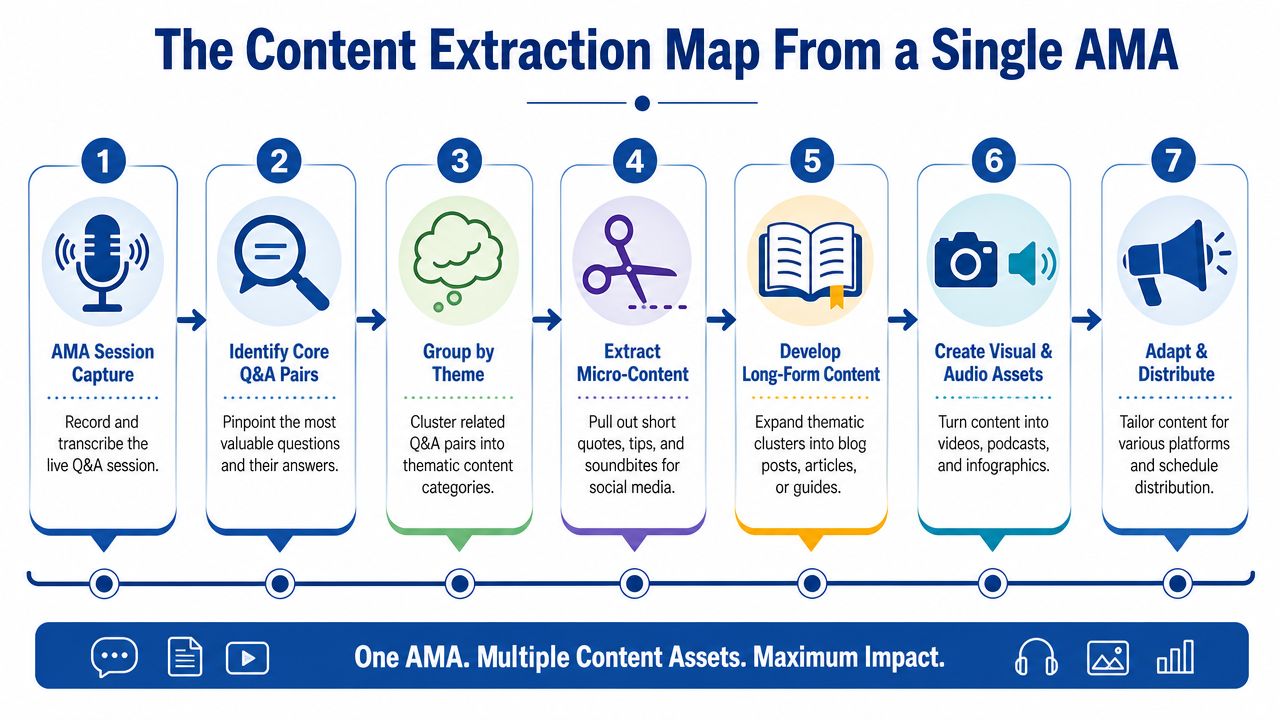
Treat the AMA as a library of Q&A pairs. Each pair is a validated topic, a rough draft, and a distribution opportunity at the same time.
Say the audience asks:
"How do you keep an internal Slack AMA from becoming random and messy?"
That answer can do more work than a single clip posted the day after the event.
The extraction map
One strong Q&A pair can become:
- A short video clip for LinkedIn or YouTube Shorts
- A text post summarizing the answer in plain language
- An FAQ entry for the site or help center
- A quote graphic with the strongest line from the answer
- A carousel breaking down the steps visually
- A blog section inside a larger recap article
- An email snippet that points people to the full recording
A similar process works for webinar recordings too. The mechanics are nearly the same in this guide to turning webinar Q&A into blog and social content. The source format changes. The extraction logic stays the same.
What manual extraction actually takes
The bottleneck is not clipping. It is all the small production decisions around the clip.
Teams usually count the edit and ignore the rest: reviewing the transcript, choosing the strongest segment, cleaning the language, writing supporting copy, formatting for each channel, and routing assets for approval. That is why repurposing from a live session often drags even when the original recording is solid.
A realistic manual workflow for one good Q&A pair looks like this:
Find the moment: 15 to 25 minutes
Review the transcript or recording. Mark where the question starts and where the clean answer ends.Cut the clip: 30 to 45 minutes
Trim dead air, remove interruptions, tighten pacing, and choose the best opening line.Add captions and polish: 20 to 40 minutes
Fix transcript errors, format captions, and add missing context if the speaker did not restate the question.Write the text post: 10 to 20 minutes
Pull the core takeaway into a LinkedIn post, Slack recap, or follow-up thread.Create a quote graphic: 15 to 30 minutes
Choose a single line that stands alone and pair it with a branded visual.Turn it into an FAQ entry: 10 to 15 minutes
Rewrite the answer so it reads cleanly without the live chat context.Expand it into blog material: 20 to 30 minutes
Add framing, examples, and connective copy so the answer works in long form.
That is one answer. A useful AMA usually gives you several.
A practical workflow example
A community marketer running a LinkedIn Live AMA can process the session in five steps.
Step 1
Export the recording and transcript right after the session. Label each question block clearly while the context is still fresh.
Step 2
Tag the strongest questions by content type: objections, tactical how-to questions, comparisons, recurring problems, and purchase-stage concerns. This step matters because distribution usually follows intent, not chronology.
Step 3
Create four core outputs for each high-value Q&A pair:
- Clip
- Text summary
- FAQ answer
- Blog section
These four cover the channels many teams already manage. Start there before adding more formats.
Step 4
Group related questions into themes. Three or four questions about moderation, for example, can become a full guide, a newsletter issue, a sales enablement asset, or the outline for your next live session.
Step 5
Publish the assets over several weeks. One AMA should feed the calendar, not create a one-day spike and then disappear into the archive.
A raw AMA is an event. A tagged AMA archive is a working content library.
Recurring questions should become pillar content
Repeated questions are not noise. They are editorial direction.
If the same issue shows up in Discord one month, LinkedIn Live the next, and an internal AMA after that, you are looking at a durable content theme. Build for that pattern. Create the definitive guide, the FAQ hub, the landing page, or the executive point of view piece.
This is the shift that raises AMAs from engagement tactic to content system. The session gives you answers. The audience questions give you the roadmap.
Designing AMAs for Maximum Repurposing Value
Teams usually lose repurposing value before the AMA starts. The problem is not editing. It is session design.
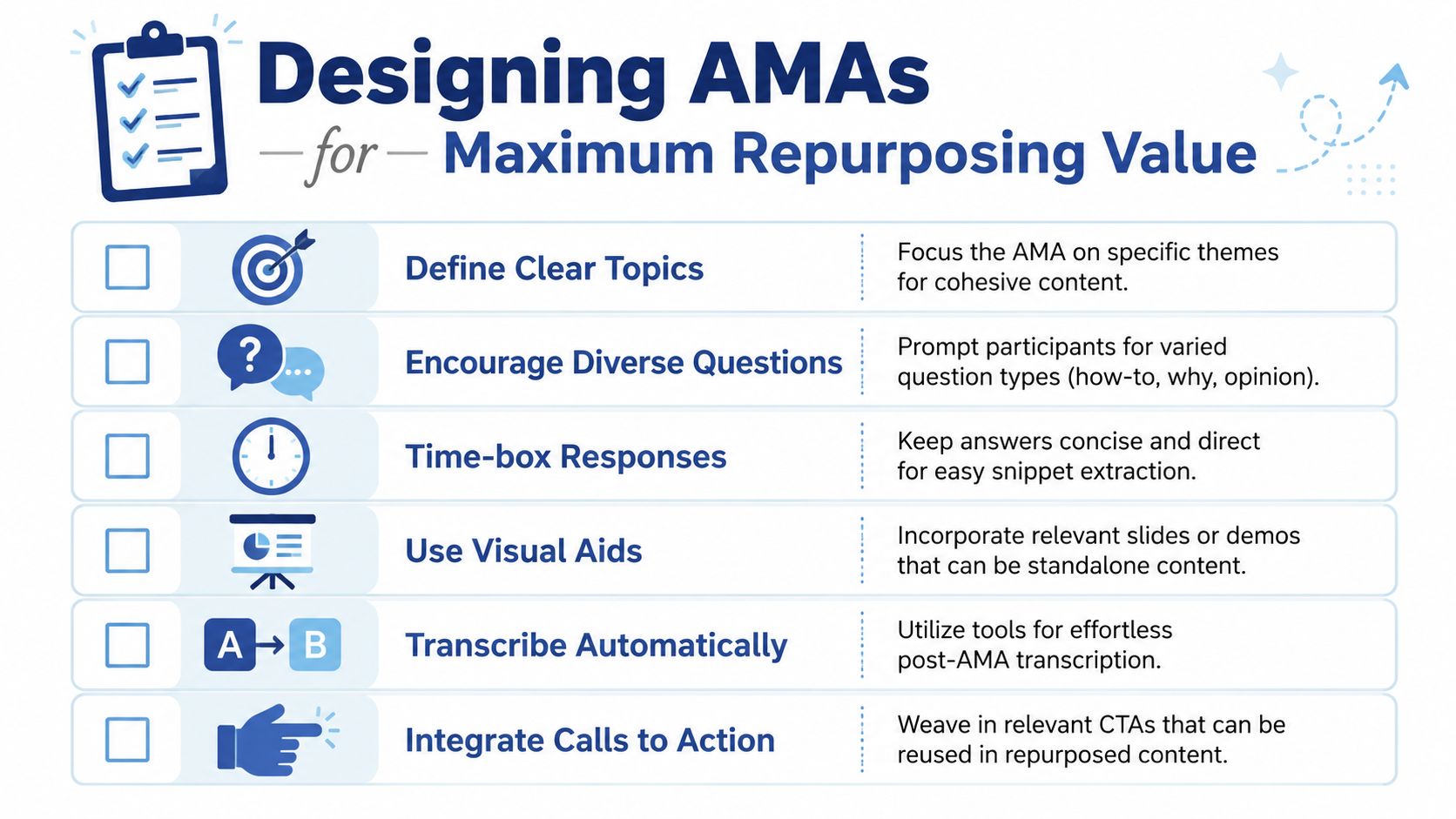
If the goal is to build a content engine, the AMA cannot be treated as an open mic. It needs to be structured like a recording session built around audience demand. The live event still matters, but the stronger play is to design every part of the session so the answers can become standalone assets later.
What to set up before the AMA
Start with the editorial outcome, then work backward into the live format.
A repurposable AMA usually has one clear audience, one narrow problem space, and a question list shaped before the event starts. That focus gives the speaker room to go deep without turning the transcript into a pile of unrelated answers.
Set these pieces before you go live:
- A defined angle: Pick a specific theme, such as onboarding, attribution, or pricing objections. Broad AMAs create broad answers, and broad answers are harder to publish well.
- Pre-collected questions: Pull them from customer calls, Slack communities, email replies, comments, and sales notes. Good AMA planning starts with existing demand, not guesswork.
- A prioritized question bank: Rank questions by post-event value. Put recurring objections, tactical how-to questions, and comparison questions near the top.
- Backup prompts: Keep extra questions ready so the session does not depend on audience energy in the moment.
- Speaker guidance: Tell guests to restate the question, answer the main point first, then add context. That small change saves a lot of editing time.
- Moderator rules: One person should combine duplicates, tighten wording, and protect the topic boundary.
Teams that already run webinars can borrow the same production discipline from how to host a webinar that converts, especially around pacing, moderation, and question flow.
What the host should do during the session
The host is not there just to keep the conversation friendly. The host shapes the raw material.
That means guiding answers into formats your team can publish with minimal cleanup. Short setup. One question at a time. One answer at a time. Clear transitions.
Use this operating standard during the session:
- Ask clean, single-focus questions.
- Break audience submissions into separate prompts if they contain multiple ideas.
- Ask the speaker for a direct answer first, then the supporting explanation.
- Stop and reframe when an answer gets too abstract or too long.
- Mark strong timestamps and quotable lines in real time.
- Notice repeated themes and ask one follow-up that pulls the pattern into the open.
One prompt does a lot of work here: “Give me the short answer first, then walk me through it.”
That line improves clips, text posts, FAQs, and sales-ready excerpts in one move.
Design choices that improve repurposing
Some AMA decisions create better content later, even if they make the live session feel a little more controlled.
| Design choice | What it improves later |
|---|---|
| Narrow topic scope | Stronger thematic grouping for posts, guides, and FAQ sections |
| Pre-screened questions | Less cleanup and fewer dead-end answers |
| Speaker restates the question | Standalone clips with built-in context |
| Moderator takes live notes | Faster extraction after the session |
| Answers capped by time or structure | Better editing efficiency and clearer takeaways |
There is a trade-off here. The more open the AMA feels, the more spontaneous it may seem to attendees. The more structured it is, the easier it becomes to turn one session into weeks of useful content. For marketing teams that need output they can publish, structure usually wins.
What weakens the archive
A few habits reduce the value of the recording fast:
| Mistake | Result |
|---|---|
| No topic guardrails | The transcript becomes difficult to organize by theme or intent |
| Audience questions asked exactly as submitted | Long, messy prompts lead to long, messy answers |
| Speaker never gives a direct answer up front | Editors have to reconstruct the point after the fact |
| No one logs timestamps or standout moments | The best material gets buried in review |
| No owner for post-event extraction | The AMA gets posted once and then ignored |
The standard to aim for is simple. Every answer should make sense on its own, and every question should earn its place in the archive.
A practical pre-flight checklist
Before the session starts, confirm five things:
- Clear topic and audience
- Ranked question bank with backups
- Clean audio and reliable recording
- Fast transcript access
- Named owner for post-event asset creation
AMAs produce more value when they are designed as a content generation system. The audience supplies the roadmap. The session captures the raw material. The team publishes from a plan instead of hoping a few clips turn out well.
Building a Publishing Calendar From Your AMA Assets
Creating assets is only half the job. The value shows up when those assets are spread across weeks, channels, and buyer stages.
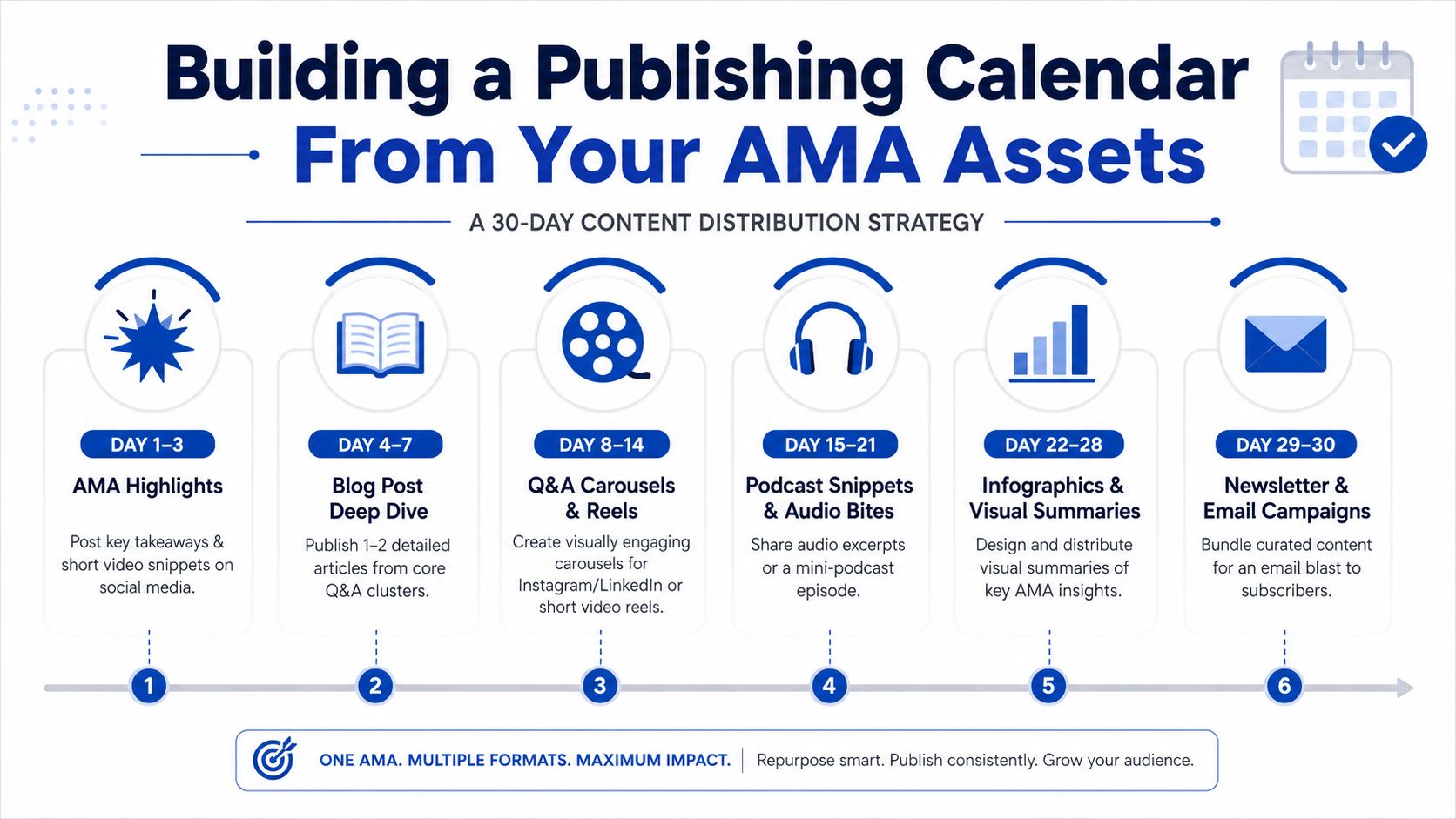
A single AMA can feed a real publishing calendar if the assets are sorted by function. Some pieces are built for reach. Others are built for trust, retention, or conversion.
A practical weekly schedule
Here is one way to spread a single AMA across one week:
| Day | Asset | Purpose |
|---|---|---|
| Monday | Short video clip on LinkedIn | Grab attention with one strong answer |
| Tuesday | Text post from a second Q&A | Reinforce a practical takeaway |
| Wednesday | Blog post recap with embedded clips | Create a durable owned asset |
| Thursday | Carousel summarizing three questions | Turn complexity into something skimmable |
| Friday | Email section featuring the top answer | Push subscribers back to the best asset |
That sequence keeps the AMA alive without repeating the same post five times.
For teams that need more structure, a dedicated guide to building a B2B content calendar helps map formats to cadence and channel.
Sort assets by shelf life
Not every AMA output should be treated the same way.
Fast-turn assets
These go out first while the session still feels fresh:
- clip highlights
- quote graphics
- direct answer posts
- short community recaps
Mid-cycle assets
These deepen the topic a few days later:
- carousels
- FAQ entries
- founder posts
- thread-style summaries
Long-shelf assets
These carry value well beyond the event:
- blog posts
- pillar pages from recurring questions
- resource hubs
- onboarding documentation for internal communities
One AMA doesn't need one launch day. It needs a release schedule.
Use recurring questions to plan the next month
Publishing shouldn't stop with the first batch.
After distribution, the team should review:
- which questions got the strongest response
- which objections appeared again in comments
- which answers deserve a fuller article
- which themes should become the next AMA topic
AMA content starts compounding. One session creates the next session's agenda. The audience keeps signaling what matters. The team keeps responding in formats that fit different channels.
Match format to channel behavior
A Discord community might want a pinned FAQ summary. LinkedIn might want a native short clip. Internal teams might want a cleaned-up knowledge base entry. Reddit readers might prefer a text recap with direct takeaways.
That means the same answer should often be adapted, not copied.
A good publishing calendar doesn't ask, "What else can be posted?" It asks, "What format fits this answer best on this channel?"
The Done-for-You Alternative
Teams that treat AMAs as a content system usually hit the same bottleneck. Extraction is straightforward in theory, but production still needs someone to cut clips, shape posts, clean up language, route feedback, and package assets for each channel. That work is repetitive, detail-heavy, and easy to postpone when the team is already carrying launches, reporting, and day-to-day community work.
That delay is expensive.
A strong done-for-you service solves the operational gap, not just the editing task. The point is not to turn one recording into a pile of clips. The point is to turn a question-led session into a publishable asset set while the topic is still timely and the audience signals are still clear.
In practice, the handoff should be simple. Send one AMA, webinar, podcast, interview, or meeting recording. Get back a full batch of channel-ready assets that reflect the actual questions people asked and the themes that deserve follow-up. That often includes short video clips, text posts, quote graphics, carousels, audiograms, and a blog draft, all aligned to the brand voice and ready for review.
The main advantage is focus. Internal teams keep ownership of message and priorities. The service handles extraction, packaging, and production. That matters because the failure point in AMA repurposing is rarely strategy. It is throughput.
Cost still matters, but fixed numbers are less useful here than the trade-off itself. Hiring separate freelancers for editing, writing, and design can work well if the team already has a content operator managing briefs, revisions, and deadlines. If not, the coordination cost often cancels out the savings. A productized service usually costs more than doing one asset in-house and less than building a reliable multi-specialist workflow around every session.
That model fits teams that already know their experts are saying useful things. They just do not want those insights trapped in recordings and scattered notes.
A good offer should be specific about scope and delivery. Clear asset counts. Defined turnaround times. A revision process that does not create another project to manage. Outputs that are ready to publish, not half-finished files waiting on extra formatting.
If one 45-minute AMA should become 30 assets instead of one forgotten replay, book a call with RepurposeYourContent or request a sample to see how one recording turns into finished content. For teams building zero-click distribution around expert-led content, it's also worth reviewing a zero-click content strategy for B2B.
Tags: