Turn One Podcast Episode Into 30 Pieces of Content
Learn how to turn one podcast episode into 30 pieces of content with a repeatable per-episode system, DIY time costs, and a done-for-you alternative.

In 2026, 89% of podcast listeners watch podcast clips on at least one social platform sometimes, while 72% do so often or always, according to the 2026 Sounds Profitable Podcast Atlas findings. A podcast episode shouldn't disappear after its launch week.
To turn one podcast episode into 30 pieces of content, extract the strongest ideas from one recording and reshape them into video clips, written posts, visual assets, newsletters, and an SEO article. The practical system below maps one 30 to 45-minute interview into 30 finished, ready-to-publish assets, with every piece tied to a real transcript moment.
What 30 Pieces of Content From One Episode Actually Means
The headline only matters if the inventory is literal. A 30-asset package isn't one transcript copied into thirty captions. Each deliverable needs a finished format, a written hook, platform-appropriate copy, and a clear purpose.
A typical 30 to 45-minute interview contains enough material for several distinct ideas. Longer recordings may provide more usable moments, but length alone doesn't guarantee quality. A weak conversation produces repetitive clips. A focused interview with clear opinions, practical examples, and structured answers gives an editor better raw material.
The production map uses the following breakdown:
| Asset Type | Count | Primary Channel |
|---|---|---|
| Short video clips | 12 | LinkedIn, Instagram, YouTube Shorts |
| Audiograms | 4 | LinkedIn, Instagram, podcast channels |
| Quote graphics | 6 | LinkedIn, Instagram, X |
| Carousel posts | 4 | LinkedIn, Instagram |
| SEO blog post | 1 | Company blog and search |
| Email newsletters | 2 | Email list |
| LinkedIn newsletter | 1 | |
| Total | 30 | Multiple channels |
This structure differs from a generic content dump. A clip should stand alone in a social feed. A carousel should teach a framework. A quote graphic should express one complete thought. The article should answer a search question rather than repeat the episode transcript.
For a broader view of how teams organize source material across formats, this content repurposing for busy founders guide offers useful context. A content repurposing matrix can also help assign each transcript moment to a channel before production starts.
The audience journey matters. Podcast clips at least sometimes lead 81% of respondents to watch a specific episode, and 84% to become regular listeners, based on the same Sounds Profitable research. About one-third said clips often or always produce those outcomes, with 30% for watching a featured episode and 33% for becoming a regular listener. Clips aren't filler when they create a clear route back to the full conversation.
The next step is assigning each asset to specific transcript moments. That prevents duplicated messaging and makes the 30-piece promise repeatable.
The Per-Episode Asset Map
A strong episode starts as one recording and becomes a marked transcript. Every useful moment receives a tag such as clip, quote, framework, email, or article section. The production team then builds each asset from those marked passages.

Twelve clips from the strongest moments
The first group contains 12 vertical video clips, each between 20 and 90 seconds. The editor selects moments that work without a long setup:
- Narrative beats: A short story with tension, context, and a clear conclusion.
- Contrarian takes: A claim that challenges the audience's default assumption.
- Tactical answers: A process, checklist, or practical recommendation.
- Quotable moments: A concise statement that can lead a conversation.
Each clip needs a new opening hook. The first spoken sentence may not be the strongest entry point, so captions and edits should lead with the central claim. A clip that begins with background often loses the viewer before the useful point arrives.
Four audiograms for audio-first distribution
The next four assets are 30 to 45-second audiograms. These work best when the speaker's delivery carries emotion or authority that doesn't require a visual demonstration. Mid-episode reflections, a strong answer, and the closing call to action are suitable sources.
The design should remain simple. Use the episode title, speaker name, readable captions, waveform movement, and a destination link. An audiogram shouldn't compete with the words.
A clean transcript is the production spine. The Typist podcast guide provides practical background on converting recorded conversations into searchable text. The finished transcript should include speaker labels and timestamps, not just raw paragraphs.
Six quote graphics and four carousels
The team pulls six image quotes from complete, verbatim lines. Each quote comes from a roughly 15-second window, then receives a speaker name and headshot. Editors should check the surrounding context before publication. A powerful sentence can become misleading when separated from the answer that qualifies it.
The four carousels come from frameworks or lists the guest delivered. Each should teach one idea across several slides, using a three to five-point structure where the conversation supports it. Don't force a carousel from a single observation.
The article becomes one 1,200 to 1,800-word SEO post built around the episode's core argument. It should use clear headings, direct answers, practical examples, and timestamps that point readers back to the recording. Two broadcast emails reuse the strongest clip and top quote from different angles. One LinkedIn newsletter summarizes the three sharpest insights.
For a deeper podcast-to-article workflow, the guide on repurposing podcast episodes into blog posts covers the editorial decisions that separate an article from a pasted transcript.
Every asset must trace back to a transcript timestamp. That is why the DIY process starts with transcript cleanup, not clip cutting.
The DIY Workflow From Recording to Published Assets
Most solo marketers underestimate the work before the first post goes live. The task isn't just selecting moments. It includes file handling, transcript review, editing, captions, design, writing, scheduling, and quality control.
A competent marketer can follow this nine-stage workflow:
Export the source files, 10 minutes. Download the audio and video, check that both files play correctly, and organize them with the episode name and date.
Generate and clean the transcript, about 20 minutes of review. Correct speaker labels, obvious transcription errors, names, product terms, and timestamps. A transcript with inaccurate wording creates bad captions and unsafe quotes.
Tag the transcript, 45 minutes. Mark potential clips, quotable lines, frameworks, objections, stories, CTAs, and article sections. This is the editorial stage. Skipping it creates random asset selection later.
Cut the video clips, 90 to 120 minutes. Select twelve moments, reframe the footage vertically, add captions, remove dead air, check speaker changes, and export each file. Short-form video is widely used because it can fit discovery behavior, but every clip still needs deliberate editing.
Create the audiograms, 30 minutes. Choose four audio sections, add waveform treatment, write captions, place the speaker identity, and export the final files.
Design the quote graphics, 60 minutes. Pull six verbatim lines, check context, apply the brand template, add the speaker's name and headshot, then review readability on a phone.
Build the carousels, 90 minutes. Outline four separate frameworks, write slide copy, design each sequence, and check that every carousel teaches something independently.
Draft the SEO article, 120 minutes. Build the article around the episode's main thesis, not the transcript's chronological order. Add headings, timestamps, internal links, examples, and a useful conclusion.
Write the emails and LinkedIn newsletter, 45 minutes. Give each email a different angle. The newsletter should synthesize the strongest insights rather than paste the same captions.

That sequence adds up to 8 to 11 hours per episode for a capable solo marketer. The total rises when the source has poor audio, inconsistent branding, missing speaker labels, or no clear CTA.
For teams refining their production line, this video podcast repurposing workflow provides another practical reference.
The time estimate also explains why short-form production needs a real process. HubSpot's 2024 report says 93% of marketing videos are created in three weeks or less, 32% are made in under a week, and 91% of marketers believe the optimal video length is under 10 minutes (HubSpot video marketing report). Fast delivery still requires organized production.
The Mistakes That Wreck a Repurposing Run
Four mistakes repeatedly reduce the value of a good recording.
Editing for polish instead of the hook
A polished clip can still fail if its first seconds lack tension. Rewrite the opening caption and first spoken beat around the boldest accurate statement. Lead with the claim, then provide enough context for the viewer to understand it.
Pulling quotes out of context
A quote may look strong in isolation but misrepresent the speaker's meaning. Read roughly 30 seconds before and after every pull quote. If the surrounding explanation changes the interpretation, choose another line or include more context.
Posting the same caption everywhere
LinkedIn, Instagram, and X reward different reading patterns. Reshape the hook, caption length, emoji use, line breaks, and CTA for each platform. The underlying idea can stay consistent, but the packaging shouldn't be identical.
Treating clips as the entire strategy
Short clips can create discovery, but they don't replace the article, newsletter, or full episode. Completion rates also vary sharply with length. Vidyard benchmark data cited by Komet Media's B2B video statistics reports a 65% completion rate for videos under one minute, compared with 20% for videos over 20 minutes.

Editorial rule: A repurposed asset earns its place by adding a new entry point, not by repeating the episode louder.
The long-form article remains important because it gives the episode a durable written home. Quotes and clips may fill a feed quickly, while the article can answer the audience's question in a more complete format.
A 3 to 4 Week Posting Playbook
Thirty assets shouldn't publish in one burst. A staggered calendar gives each format room to perform and lets the same episode reach people through different entry points.
Week one builds discovery
Use short clips on a Monday, Wednesday, and Friday cadence. The first group should introduce the episode's central problem. Later clips can present the guest's strongest opinion, a tactical answer, and a direct route to the full recording.
Publish the SEO article on Day 5. The article gives search visitors a complete answer while social interest remains fresh. Link from the clips and email copy to the article or episode, depending on the desired conversion.
Week two adds depth
Release the quote graphics and carousels on alternating days. Quotes are useful for keeping the feed active without demanding the production time of a video. Carousels should carry the most structured material, such as a framework, checklist, or sequence.
A practical calendar might look like this:
- Monday: Quote graphic with a short interpretation.
- Tuesday: Carousel built from the episode's first framework.
- Wednesday: Text post answering a related objection.
- Thursday: Quote graphic tied to the article.
- Friday: Second carousel with a practical list.
Continue that pattern with the remaining assets. Don't publish every related idea back to back.
Week three and four extend the shelf life
Week three can feature the audiogram, guest-focused post, LinkedIn newsletter, and remaining quotes. The newsletter should point readers to the article, full episode, and one useful takeaway.
Week four reformats selected clips for YouTube Shorts and Pinterest where suitable. The same source moment may work again when the caption, framing, and destination change. This isn't permission to repost identical files everywhere.
A practical video content calendar template can help assign each asset a date, platform, CTA, status, and source timestamp. For additional planning ideas, these proven repurposing strategies from experiments offer useful comparisons between extraction and editorial adaptation.

Short clips generally earn the widest reach. Carousels tend to earn deeper engagement through saves and shares. Text posts often invite replies, quotes keep feeds active cheaply, and the article supports longer-term search visibility. The calendar works because it gives each format a distinct job.
The Done-For-You Alternative
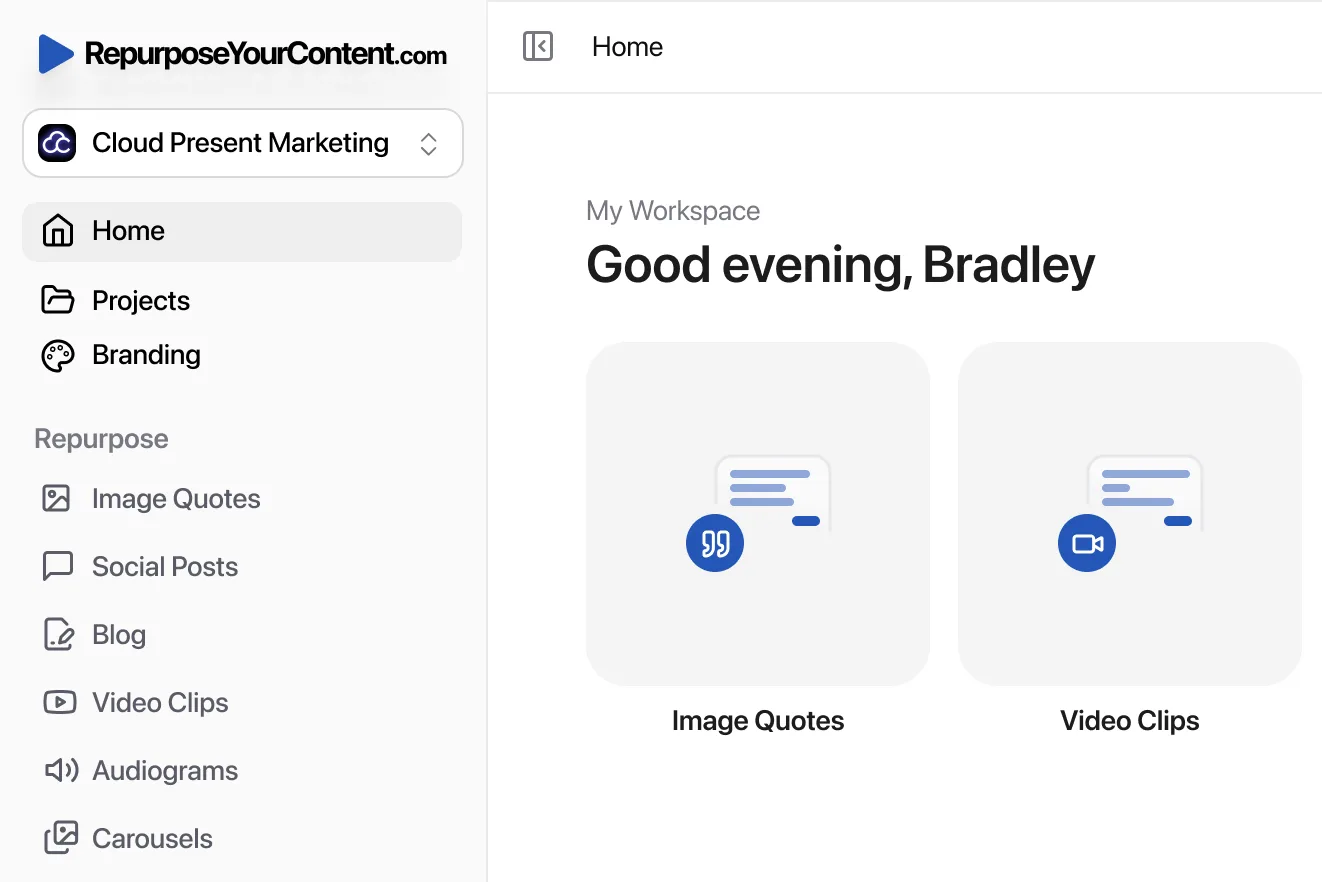
A done-for-you service uses the same production map without assigning every stage to the founder or marketing manager. The client sends one recording, such as a podcast, interview, keynote, sales call, livestream, course session, or meeting recording. The production team returns 20 to 30 ready-to-publish assets within 72 hours, including video clips, LinkedIn posts, quote graphics, carousels, audiograms, and a blog post.
RepurposeYourContent is one service that follows this model. Clients send the source recording and receive finished content in their brand voice, with a short review pass and unlimited revisions. The service states a 72-hour turnaround guarantee, or the client doesn't pay, and pricing starts from $14 per finished asset.
| Factor | DIY | Done-For-You |
|---|---|---|
| Source material | Client prepares files | Client sends one recording |
| Production time | 8 to 11 hours per episode | About 15 minutes of client time |
| Deliverables | Client builds each asset | 20 to 30 finished assets |
| Formats | Clips, posts, graphics, article, emails | Clips, posts, graphics, carousels, audiograms, article |
| Editorial work | Client selects and checks moments | Production team maps transcript moments |
| Revisions | Client manages corrections | Unlimited revisions |
| Turnaround | Depends on internal capacity | Within 72 hours |
| Cost structure | Staff time and production overhead | From $14 per finished asset |
The value isn't only speed. A repeatable service also separates selection, editing, writing, design, and quality control. That reduces the chance that a promising recording becomes one under-edited clip and a delayed transcript.
The done-for-you podcast content service is most relevant when the recording already exists but the internal team can't consistently produce the derivative assets.
Practical boundary: The client should own the point of view and final approval. The production team should own the repetitive transformation work.
Questions Busy Marketers Ask Before They Start
How long does DIY repurposing take?
A focused DIY run usually takes 6 to 9 hours across three or four sessions when the recording is clean and the brand assets already exist. The full nine-stage map can take longer when transcript cleanup, revisions, and scheduling require extra review.
What does an outsourced 30-asset package cost?
Pricing varies by format mix, editorial depth, and revision policy. A service priced from $14 per finished asset establishes a clear per-asset starting point, while the final package depends on the agreed deliverables.
Which episodes produce the strongest clips?
Interview episodes with four to six distinct topics usually provide more selection options than conversations that repeat one point. A focused recording between 25 and 50 minutes often gives enough material for a balanced asset set, provided the guest offers clear answers and specific opinions.
Does the guest need to approve the clips?
Guest approval is good practice when the episode contains sensitive claims, commercial details, or personal stories. A practical review process sends a five-clip preview within 72 hours and waits for sign-off before distributing the wider set.
Can this run on every episode?
Yes, provided the show has a consistent recording and review process. A 10-day lag between recording and full asset delivery gives the team room to edit, approve, and schedule without rushing publication.
Does the workflow work for solo shows and other recordings?
Yes. Solo podcasts need stronger structure and speaker-led hooks. Webinars, keynotes, YouTube interviews, courses, livestreams, sales calls, and meeting recordings use the same source-to-transcript process, but the editor adjusts the asset mix and privacy checks.
Book a call to map the next episode into a 30-asset plan, or request a sample delivery if the team needs to assess fit before talking.
Send one podcast episode, interview, keynote, sales call, or other long-form recording to RepurposeYourContent and request a sample. The team will show how that source can become finished clips, posts, graphics, carousels, emails, and an SEO article within the 72-hour delivery window.
Tags: