How to Turn Podcast Episodes Into Newsletters
Learn how to turn podcast episodes into newsletters that listeners actually open, with workflows, subject lines, and a done-for-you alternative.

Episode 142 is live. The host pastes the show notes into Mailchimp, writes “New Episode Out Now,” and moves on to the next recording.
That email wastes the strongest asset in the episode, the idea. To turn podcast episodes into newsletters, extract one sharp insight, write it as a standalone email, and give subscribers one clear reason to listen. The process works best when the newsletter isn't a transcript dump or an episode notification. It's an editorial product with its own angle, subject line, and conversion path.
Podcasting has reached a mainstream audience in major markets. Fifty-four percent of U.S. adults said they had listened to a podcast in the past 12 months, up from 49% when Pew Research Center first asked the question in 2022, according to podcast email metrics guidance. The opportunity isn't just reaching more listeners. It's moving part of that audience into an owned channel.
Why Most Podcasters Still Email Their List Like It's 2014
A podcaster without an email list can publish consistently and still lose control of the relationship. Spotify, Apple Podcasts, and other listening services distribute the episode, but they don't give the host a dependable way to reach every listener when the next episode drops.
RSS downloads can make reach look healthy. They don't show how many people the host can contact directly, segment, re-engage, or invite to a paid offer. A listener may hear one episode through a recommendation, then disappear into an algorithm the host can't manage.
Email changes that arrangement. A subscriber has chosen to hear from the show directly. The inbox doesn't depend on a chart position, a recommendation engine, or a social feed deciding whether the episode deserves attention.
The notification problem
The standard episode email usually contains a title, a guest name, a short description, and a play button. That format asks subscribers to do all the work. They must understand why the episode matters, decide whether it applies to them, and find time to listen.
A useful newsletter does the thinking first. It gives the reader the strongest insight in plain language, adds context, and then offers the episode for people who want the full conversation.
Practical rule: The email should deliver value even when the subscriber doesn't press play.
Nielsen Norman Group's eyetracking research examined 42 participants across 117 newsletters and found that readers spent about 51 seconds on a newsletter after opening it. Readers fully read only 19% of newsletters, while they skimmed or glanced at 35%, as documented in newsletter eyetracking research. A show-notes dump is poorly matched to that reading behavior.
The owned audience matters
The podcast remains the source material. The newsletter becomes the dependable distribution layer. One industry guide says podcast newsletters commonly target 15% to 30% open rates and 2.5% to 3.5% click-through rates, as outlined in podcast newsletter engagement guidance.
The practical system is simple:
- The episode earns attention through audio.
- The newsletter packages the idea for fast reading.
- The email sends interested subscribers back to the episode.
- The list creates a direct audience that the host can contact again.
That system beats sending “Episode 142 is out” because it respects the reader's limited attention. The newsletter becomes a reason to open, not just a reminder that publishing happened.
Three Newsletter Formats Built From a Single Episode
A single transcript can support several newsletter formats. The right choice depends on the show, the audience's reading habits, and the role of the email.
| Newsletter Format | Best For | Length | DIY Time | Primary CTA |
|---|---|---|---|---|
| Takeaway digest | Tactical guest episodes and weekly shows | 300 to 400 words | 45 to 60 minutes | Listen to the episode |
| Expanded essay | Thought leadership and opinion-led shows | 400 to 600 words | 60 to 90 minutes | Read or listen for depth |
| Curated links plus episode | Interview episodes with useful references | 250 to 400 words | 45 to 75 minutes | Explore the resources |
Takeaway digest
The takeaway digest gives subscribers the episode's usable ideas quickly. It usually includes a strong opening insight, three or four short takeaway blocks, one pull quote, and one listen CTA.
This format suits tactical interviews. A guest discussing sales hiring, demand generation, or founder productivity may offer several useful points. The email should select the points that stand alone, rather than reproduce every exchange.
A good digest doesn't begin with “This week on the show.” It begins with the clearest lesson.
Expanded essay
The expanded essay takes one idea and develops it into a short argument. The audio becomes supporting evidence, not the structure of the email.
A host with a strong point of view can use the episode to explain a problem, challenge an assumption, or add an observation that didn't fit the recording. The email should feel complete without the audio, while the episode offers nuance, examples, and the guest's full reasoning.
Guidance on creating email newsletters from video content follows the same principle. Repurposed content needs editorial shaping. Copying spoken material into an email rarely produces clean reading.
Curated links plus episode
The curated format works well for dense interviews. It packages the episode's sources, books, tools, reports, and related pages with a short host introduction.
Each link needs context. “Mentioned in the episode” isn't enough. Explain why the resource matters and where it fits into the conversation.
The transcript supplies the raw material for all three formats. The producer can identify ideas, quotes, and references once, then shape them around a different reader promise. The format should change the editorial treatment, not force a full rewrite from zero.
The Episode to Newsletter Workflow With Real Time Costs
DIY production takes longer than most podcasters expect. Automatic transcription reduces typing, but it doesn't remove editorial judgment, formatting, review, or scheduling.

A realistic production sequence
Capture and transcribe, 15 to 45 minutes. Export the final audio and generate a transcript with Descript or Whisper. Check names, companies, technical terms, and speaker labels. A transcript that hasn't been reviewed will often produce embarrassing errors.
Extract the editorial angle, about 20 minutes. Read for the strongest claim, not the most representative summary. Select one central idea, three or four supporting points, and one quote. The email needs a clear reason to exist.
Outline around the angle, about 15 minutes. Write the opening line first. Then place the supporting points in a logical order. Don't outline the interview chronology unless the story depends on it.
Draft the email, 45 to 90 minutes. The first draft takes longer because spoken language needs compression. Remove repetition, throat-clearing, weak transitions, and references that only make sense inside the recording.
Create one visual, about 20 minutes. A pull-quote card or simple branded graphic is enough. The visual should reinforce the lead idea, not compete with it.
Write the subject line and preheader, about 15 minutes. Create specific variants based on the email's claim or question. Avoid generic episode announcements.
QA and schedule, about 10 minutes. Test every link, check mobile formatting, confirm the listen destination, and review the sender name and preheader.
That adds up to roughly 2.5 to 4 hours per episode. A transcript-assisted workflow can take 45 to 90 minutes, compared with 3 to 5 hours manually, according to transcript-first podcast repurposing guidance. Another workflow estimates 30 to 60 minutes with automatic transcription, including about 3 minutes for transcription, 10 to 15 minutes for idea extraction, and 20 to 30 minutes for writing and review, as described in AI-assisted podcast newsletter production.
A per-episode template
Subject: [Specific claim or question from the episode]
Preheader: [One detail that adds context or tension]
Opening insight:
[State the strongest idea in one or two sentences. Never start with “This week on the show.”]
Takeaway one:
[Idea]
[One sentence explaining why it matters.]
Takeaway two:
[Idea]
[One sentence of context or an example.]
Takeaway three:
[Idea]
[One practical implication.]
Pull quote:
“[Use a short, accurate quote from the episode.]”
Listen CTA:
[Listen to the full conversation for the examples, objections, and deeper context.]
The template cuts drafting friction, but it doesn't replace judgment. The producer still needs to decide which idea earns the email slot.
For a broader view of production economics, see content repurposing cost considerations.
Subject Lines and Preheaders That Get the Episode Opened
The subject line carries the first decision. A strong newsletter can still fail if the subject sounds like a calendar notification.
The most reliable approach is curiosity plus specificity. “Episode 42 is live” says nothing about the reader's problem. “Why most podcasts die at episode 7” names a tension and creates a reason to investigate.
Five subject line approaches
| Subject Style | Best For | Example Subject Line |
|---|---|---|
| Contrarian claim | Opinion-led shows | Most B2B content advice creates worse leads |
| Specific takeaway | Tactical episodes | The sales follow-up rule that prevents ghosting |
| Guest name plus proof point | Recognizable experts | April Dunford on why positioning gets diluted |
| Question from the episode | Diagnostic conversations | Are your best customers avoiding your homepage? |
| Behind-the-scenes tease | Personal or founder shows | The hiring mistake hidden in our last launch |
A preheader extends the idea. It can add the consequence, name the audience, or explain what the reader will gain. The useful range is qualitative rather than fixed, but the line should stay short enough to scan beside the subject.
Subject-line advice from EmailScout's email subject line best practices 2025 is useful for the mechanics. The larger editorial point matters more. The subject must reflect the actual value inside the email.
Test one variable
A practical test compares two subject styles while keeping the email, sender, and timing consistent. Change one variable only, then record opens and clicks separately.
The relevant decision signals are:
- Open behavior: Shows whether the subject earned attention.
- Click behavior: Shows whether the email delivered enough motivation to listen.
- Replies: Shows whether the angle created a real response.
Discard subjects that rely on vague urgency, hide the topic, overpromise the episode, or repeat the same announcement pattern. A subject that earns opens but produces no listening action needs a stronger email promise, not another punctuation change.
A useful follow-up structure can also inform podcast sends. The webinar follow-up email sequence template offers patterns for sequencing value and action without turning every message into a hard pitch.
Turning Subscribers Into Listeners and Listeners Into Subscribers
The newsletter should move in both directions. Listeners need a clear reason to join the list, while subscribers need a consistent reason to keep listening.
A welcome sequence handles the first transition. The first email delivers the promised lead magnet or a useful episode takeaway. The second gives the subscriber a reason to stay connected, such as access to practical notes, bonus context, or future resources. The third explains the cadence and points to a strong episode for listening.
The sequence should sound like the show. A formal B2B podcast needs different language from a personal founder show, but both should set clear expectations.
Segment for relevance
Segmentation becomes useful when it changes the message. Tag subscribers by the episode or topic that brought them in, the source that generated the opt-in, and their recent engagement.
Useful segments include:
- Entry topic: Sales, leadership, product, or another episode theme.
- Acquisition source: Apple, Spotify, the website, or a partner.
- Engagement level: Active readers, occasional readers, and inactive subscribers.
Cold readers don't need the same weekly send as active listeners. Suppressing disengaged contacts protects attention and gives the team a cleaner picture of content fit.

Give every email one job
Every newsletter should have one primary CTA. The secondary link can point to the next episode, but it shouldn't compete with the main action.
At the end of each episode, the host can mention the next newsletter's promise. At the end of each newsletter, the host can connect the listen CTA to the current episode. This creates a simple loop:
- The episode invites the listener to join the list.
- The email delivers a useful takeaway.
- The email invites a listen for deeper context.
- The next episode repeats the invitation with a new reason.
Subscribers don't need to listen before receiving value. That independence makes the newsletter stronger. Readers can understand the idea first, then choose the audio when they want the fuller exchange.
Cadence, Automation, and What to Measure
A one-host show needs a cadence that survives busy weeks. A practical weekly pattern is Monday recording, Tuesday editing and transcription, Wednesday newsletter drafting, and Thursday morning sending.
A Tuesday or Thursday morning send can fit a listener's routine when it arrives in the recipient's local time zone. The exact schedule should follow the show's publishing rhythm and audience behavior, not an arbitrary universal clock.

Automations worth wiring
- New subscriber: Start the welcome sequence immediately.
- Episode published: Create the newsletter task or draft section.
- Link click without purchase: Tag the subscriber for follow-up.
- Inactive subscriber: Move the contact into a re-engagement path rather than sending every issue.
Reusable templates, scheduled sends, basic segmentation, and welcome automation matter more than the email platform. CleanMyList's newsletter tips provides useful context on the operational features that keep newsletters organized.
Measure decisions, not vanity
Each metric should answer a production question.
Open rate evaluates the subject line. Reply rate evaluates the voice and emotional relevance. Click-to-play rate evaluates whether the email's angle makes the episode worth hearing. List growth evaluates whether the podcast is building a durable channel.
The benchmarks available for podcast newsletters vary by audience and list quality. One podcast newsletter guide uses 35% or higher as a good open-rate target, 45% or higher as excellent, 2% to 5% for replies, and 15% or higher for click-through, as stated in podcast newsletter performance guidance. These are working targets, not guarantees.
A low reply rate may call for a warmer opening. Strong clicks on bonus material may support a paid tier. A healthy list with weak episode clicks may need a sharper connection between the email insight and the audio.
A monthly review can take 30 minutes. Check the strongest subject, the most clicked episode, the replies that reveal audience language, and the source of new subscribers. Choose one test for the next send.
For broader team workflows, marketing automation for content teams offers useful operational context.
The Done for You Alternative When You Are Out of Hours
The DIY workflow consumes roughly 2.5 to 4 hours per episode before a host considers promotion, social content, guest approvals, or the next recording. The work usually breaks at predictable points. Transcripts wait in a backlog, Tuesday deadlines create rushed drafts, subject lines stay generic, and CTAs change from issue to issue.
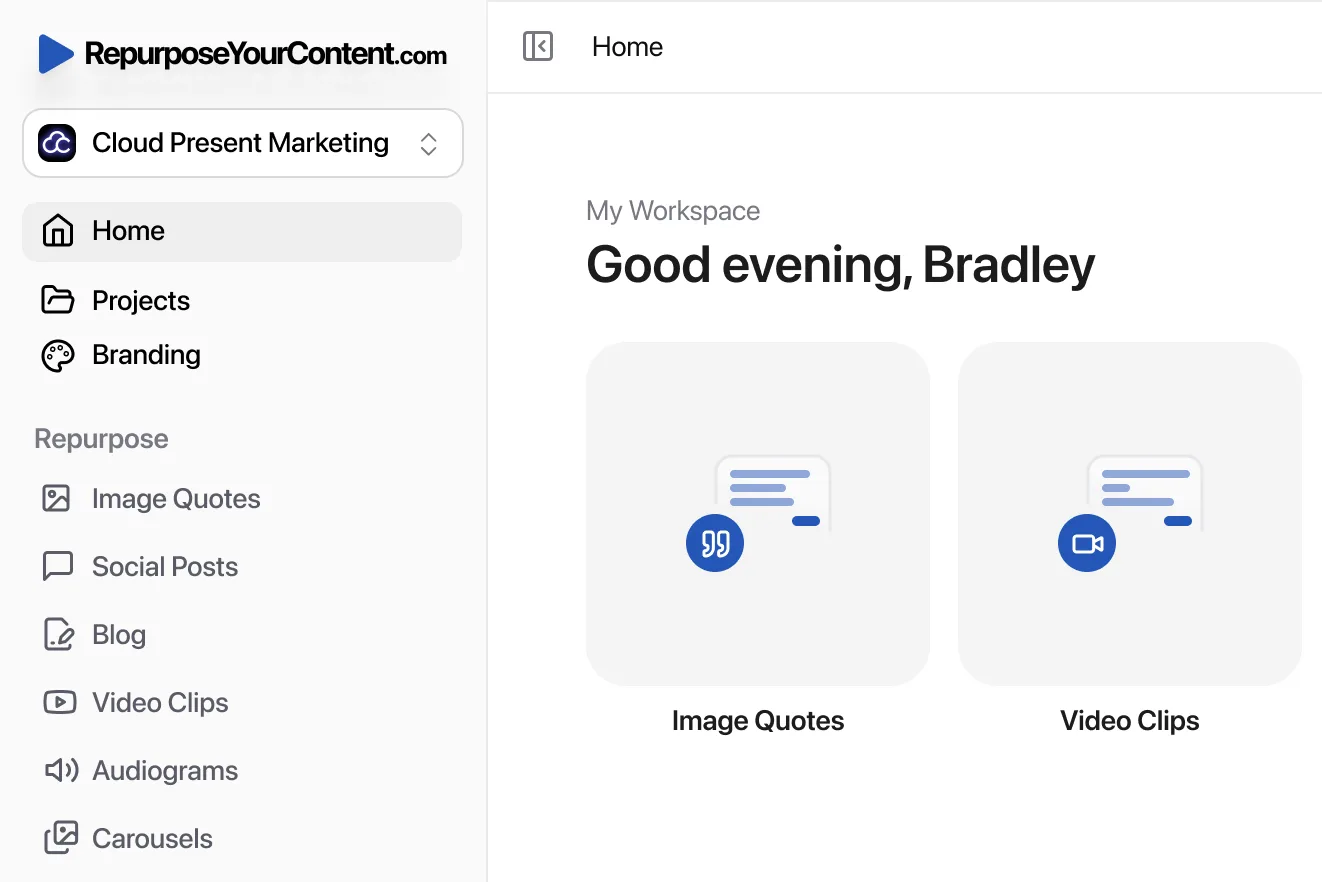
A done-for-you service returns those hours to the show. A client sends one recording, such as a podcast, webinar, keynote, interview, or meeting recording. The provider returns 20 to 30 ready-to-publish assets within 72 hours, including video clips, LinkedIn posts, quote graphics, carousels, audiograms, and a blog post, written in the client's brand voice with unlimited revisions.
What the newsletter delivery includes
For each episode, the newsletter production can include:
- A lead: The strongest insight, written for the inbox.
- Narrative body: A standalone digest, essay, or curated resource email.
- Quote blocks: Accurate pull quotes formatted for easy placement.
- Simple design: Branded formatting or a supporting quote graphic.
- Two subject variants: Different angles for testing.
- One primary CTA: A focused invitation to listen or take the next step.
- Platform-ready copy: Delivery formatted for the client's existing email system.
RepurposeYourContent produces the newsletter from each episode as part of its service. Clients send the recording, and the delivery includes finished content ready to paste into the email platform they already use. The client still owns the list, platform, brand voice review, and final approval.
The client's time is about 15 minutes per recording. A 45-minute recording can become 30 assets, and pricing can start from $14 per finished asset, based on the service's published offer. The service also provides a 72-hour turnaround guarantee, or the client doesn't pay.
The useful comparison isn't outsourcing versus doing nothing. It's four hours of producer time versus a short review window, with the newsletter shipped alongside the episode instead of added to a backlog. More detail on the broader service model is available in done-for-you podcast content repurposing.
A short call can clarify the fit. Book a 20-minute call with RepurposeYourContent and request a sample edition built from a back-catalog episode, with no commitment.
Send one podcast episode, interview, keynote, sales call, or livestream recording to RepurposeYourContent. Book a call to see how a single recording can become a newsletter and a complete set of ready-to-publish assets in 72 hours.
Tags: