Create Once Publish Everywhere Strategy: The 2026 Playbook
Build a create once publish everywhere strategy that turns one recording into 30 assets. Learn the modern COPE playbook for B2B marketers and founders.

The old advice is too simple. Create once publish everywhere does not mean one asset gets copied to every channel. That model breaks the moment your audience expects native video on one platform, carousel-first storytelling on another, and conversational copy in email. The modern version is create once, adapt everywhere, and it starts with one real recording that becomes the source of truth.
COPE began as a content architecture idea, not a social growth hack. Practitioners described it as a single source, multi-channel content management approach, and by 2015 it was already framed around keeping content free of display and system-specific formatting as documented in this COPE history. That mattered when content flowed into pages, feeds, and apps. It matters less when each channel now wants its own native shape.
Why the Original COPE Model Fails in 2026
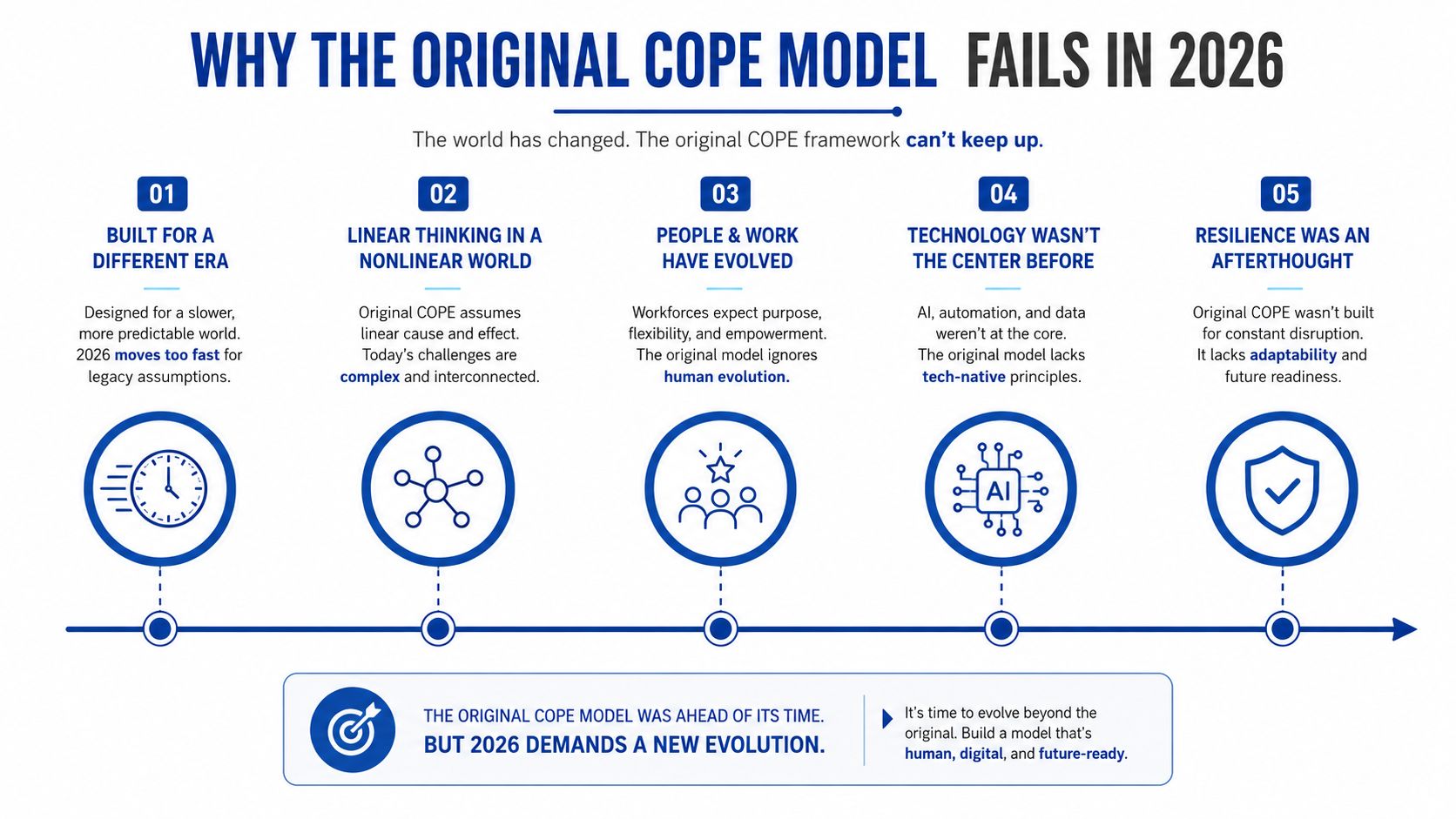
The original model assumed distribution was the hard part. Put content in one system, push it to many endpoints, and the job is done. That worked when the endpoint was a web page or an app feed. It breaks when LinkedIn wants a native carousel, YouTube Shorts wants vertical video with captions, and email wants copy that reads like a person wrote it.
The CMS idea was right, but the channel reality changed
COPE came out of a CMS world, where the main goal was to keep content clean, separate from presentation, and reusable across systems. That logic still holds. Modern headless CMS setups and omnichannel workflows still depend on the same foundation in this COPE background piece.
The channel layer changed. Social platforms do not behave like neutral endpoints anymore. They reward format-native assets, not just republished ones. A clipped podcast segment can work well on one feed, but only if the pacing, framing, and caption style fit that feed's language. That is a production issue, not a distribution afterthought.
The revision is adaptation, not duplication
The modern playbook is create once, adapt everywhere. One strong recording becomes the source of truth, then each channel gets a version that feels native. The source stays singular. The outputs do not.
Practical rule: if a channel needs a different opening, different framing, or different visual structure, it needs adaptation, not a blind repost.
That is why the better teams now plan for cross-platform content repurposing instead of simple syndication. The distribution picture gets bigger, but the starting point gets narrower. One anchor. Many outputs. Different shapes. For a closer look at that workflow, see a detailed cross-platform content repurposing guide.
The strategic mistake is trying to preserve one artifact unchanged everywhere. The strategic win is to preserve one idea, one conversation, or one teaching moment, then re-author it per channel. That shift turns COPE from a CMS plumbing concept into a 2026 content strategy built around one authentic long-form recording as the source of truth, with adaptation baked into production instead of bolted on later.
Choosing Your Anchor Recording Format
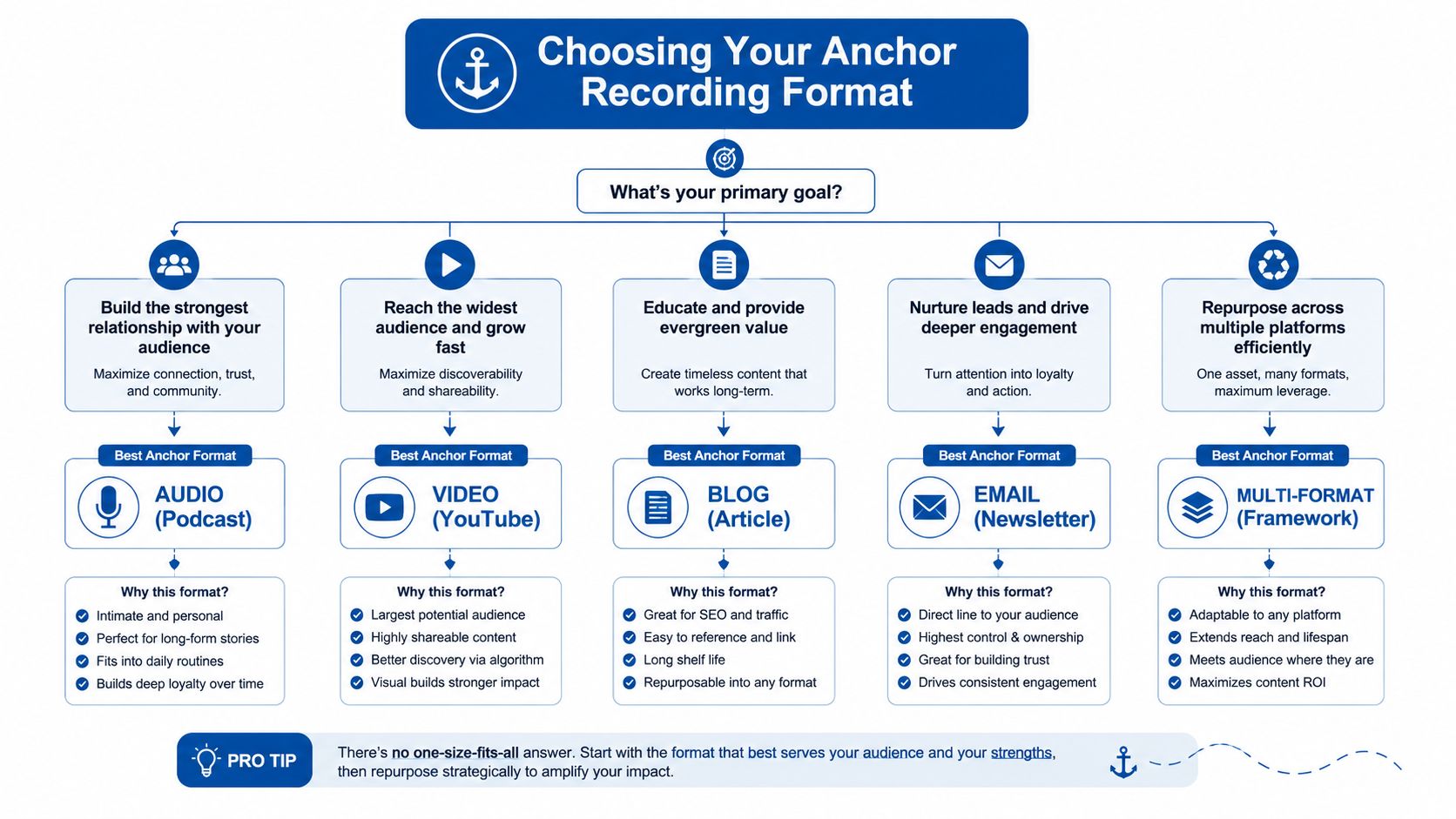
Every workable COPE system starts with an anchor. Not the fanciest format. The format your team can sustain weekly without drama. If a format can't be recorded consistently for six months, it's a bad anchor, no matter how polished the plan looks in a deck.
Pick the recording you can repeat
For most B2B teams, the best anchor is a 30 to 90 minute conversation. A podcast episode, livestream, interview, keynote, sales call, or internal expert session works because people already know how to talk in that format. The content has density. It produces usable language. It gives editors something real to mine.
The wrong anchor is usually aspirational. A webinar that only happens when three calendars align is not stable enough. A course that needs slide design every week is too heavy. A keynote can be excellent, but only if speaking events are already part of the operating rhythm. The anchor must fit the production reality, not the marketing fantasy.
Use a simple decision filter
A good anchor format should answer three questions cleanly:
- Can it happen weekly? If not, the pipeline will stall.
- Does it produce unscripted language? If every word is overly polished, repurposing gets sterile.
- Will your audience care about the raw conversation? If the answer is no, the source lacks usable signal.
The COPE model evolved. It began as a CMS strategy and became a content strategy. The 2026 version is not about distribution plumbing. It is about selecting one authentic source of truth and letting every channel drink from it. For teams that want a deeper map of how one long-form recording breaks into formats, the content atomization strategy guide is useful.
The best anchors also reduce prep time. A weekly podcast or founder interview usually needs less setup than a fully scripted teaching session. That matters, because the bottleneck is not recording. It is everything that happens after recording. If the team can't sustain the source, no downstream strategy survives.
The Real Time Cost of DIY Repurposing
DIY repurposing looks cheap until the clock starts. Then the hidden cost shows up in every step. The recording is done, but the work has barely started.
The work adds up fast
A realistic manual workflow usually starts with watching the full recording, which can take 45-90 minutes. Then someone has to identify clip-worthy moments, another 30-60 minutes. After that come the edits, captions, social copy, design, and writing. The math gets ugly fast. A long-form episode turns into a miniature production project.
| DIY Repurposing Time Breakdown Per Recording | ||
|---|---|---|
| Task | Time Estimate | Skill Required |
| Watch the full recording | 45-90 minutes | Editorial judgment |
| Identify clip-worthy moments | 30-60 minutes | Content analysis |
| Edit video clips | 2-3 hours per recording | Video editing |
| Write social posts | 60-90 minutes | Copywriting |
| Design quote graphics | 45-60 minutes | Graphic design |
| Build carousels | 90 minutes | Layout and messaging |
| Write a blog post | 2-3 hours | SEO writing |
The repurposing cost breakdown becomes obvious once the workflow is mapped. For one recording, the total lands around 8 to 14 hours of work. That's not a side task. That's a workday, sometimes more.
Why most recordings get posted once
The reason is simple. The content is good, but the operating model is expensive. A team records one strong conversation, publishes one clip or one post, then the rest sits unused because no one has spare hours to multiply it.
A recording only looks inefficient when it's treated like a single asset. It becomes efficient when it is treated like a source.
At scale, DIY repurposing becomes a staffing problem. Weekly publishing means someone is spending most of their time in post-production, not strategy. That's how teams end up with inconsistent output and stale pipelines. They don't lack ideas. They lack throughput.
The hard truth is that manual repurposing is often invisible labor. The meeting ends. The work doesn't. If the team wants consistent multi-channel publishing, the production cost has to be treated as part of the system, not as a bonus task after the recording.
A Complete COPE Workflow From Recording to Published Assets
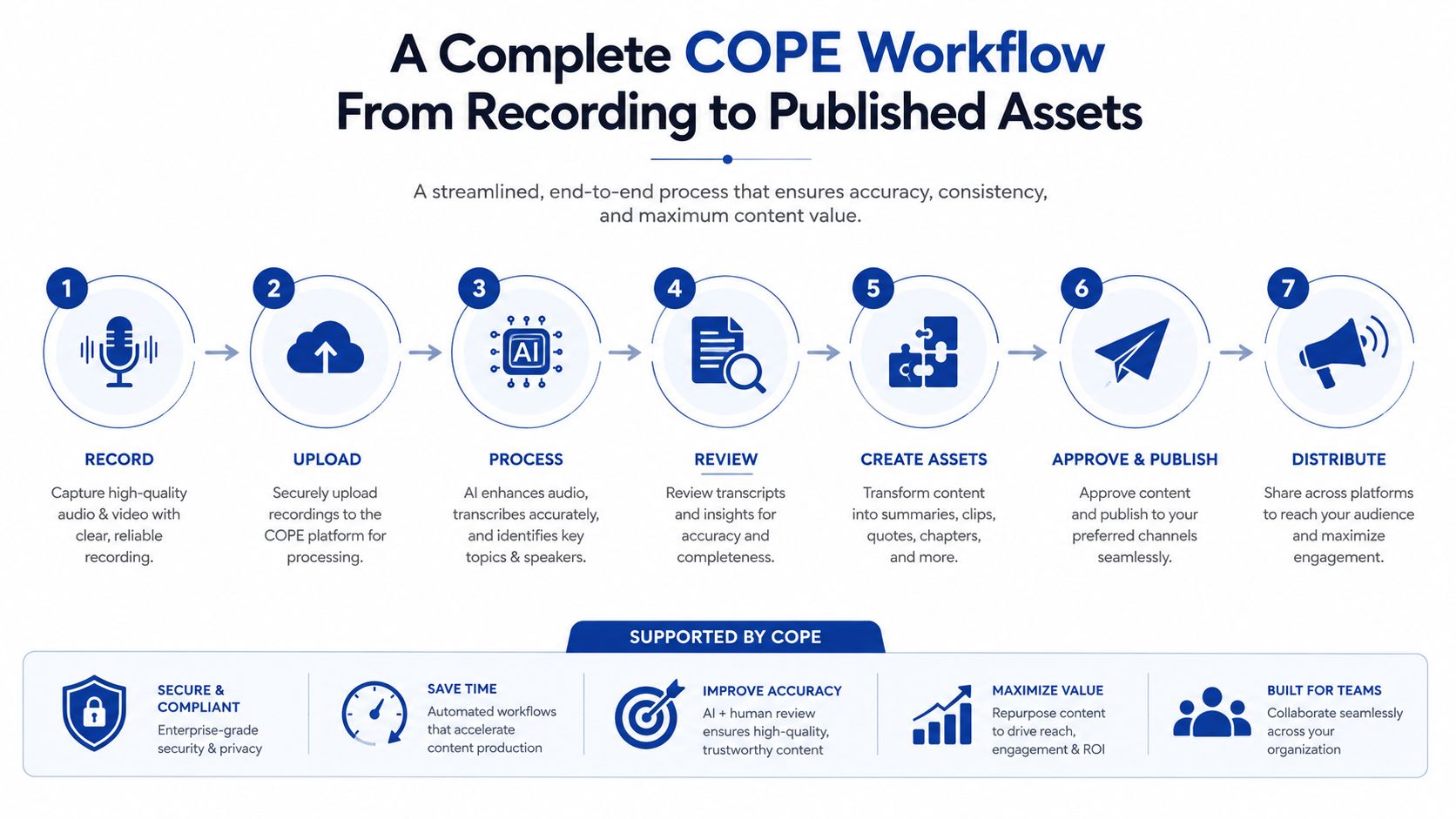
A working COPE pipeline is not mysterious. It is a sequence of decisions, edits, and packaging steps that start with one source recording and end with channel-ready assets. The key is to make the adaptation happen during production, not after someone on the team feels motivated enough to post.
The workflow in practice
Step 1 starts with one recording. That can be a podcast, interview, keynote, sales call, livestream, or course module. The client sends the file, and nothing has to be cleaned up first. The point is to capture a real conversation, not a studio-perfect artifact.
Step 2 is segment selection. The production team pulls out the strongest moments, usually the ones with a clear idea, sharp opinion, or useful framework. Step 3 turns those moments into platform-specific clips with native captions, title conventions, and the right pacing for each channel. The recipe matters because different feeds reward different levels of energy and visual density.
Build the outputs from the brand kit
Step 4 converts the same source into written assets. Social posts are drafted in the client's voice. Step 5 creates quote graphics and carousels from the brand kit, which keeps visual identity consistent without rethinking the design each time. Step 6 produces an SEO-ready blog post from the same source material. Step 7 maps the posting sequence, so the outputs roll out over weeks instead of all at once.
The content repurposing workflow diagram template is useful for teams that want to formalize this flow. The important operational rule is simple. The tweaks happen inside the pipeline. They are not left for whoever happens to schedule the post later.
Operational rule: store clip lengths, caption style, title conventions, and CTA phrasing once in the brand kit, then apply them to every batch.
A realistic output example
A single 45-minute recording can become 20-30 ready-to-publish assets across six formats when the workflow is tight. That can include short-form video or audio clips, social posts with visuals, quote graphics, image carousels, and a blog post. The point is not volume for its own sake. The point is that one strong conversation can feed an entire content calendar when it is handled correctly.
For channel mapping, the content repurposing matrix helps teams decide what belongs where. The best systems do not just create more content. They create the right content in the right shape for each destination.
The Done-for-You Alternative
Some teams understand the model perfectly and still can't staff it. That's where the done-for-you route makes sense. The offer is straightforward. Send one recording, a podcast, webinar, keynote, interview, or meeting recording, and get 20-30 ready-to-publish assets in 72 hours.
What comes back
A typical delivery includes 8-12 short-form video or audio clips, 6-8 social posts with visuals, 4-6 quote graphics, 1-3 image carousels, and an SEO-ready blog post. Everything is written in the client's brand voice. Everything is built from the brand kit. Unlimited revisions are part of the process, so the assets are ready to publish, not halfway there.
The client's time is about 15 minutes per recording. That usually means sending the source file, sharing brand details, and approving the output. After that, the production work is off the client's plate.
Why the pricing model matters
Plans run from $999 per month for one recording to $2,499 per month for a full weekly content engine with 4-6 recordings and 80-180 assets. That works out to as little as $14 per finished asset. The 72-hour turnaround is guaranteed or the client does not pay.
That matters because speed is part of the value. Content that arrives late often misses the moment it was meant to support. A clean production system solves that without forcing the team to hire editors, designers, and writers in-house.
The outsource content repurposing guide is the right follow-up for teams comparing internal labor with a managed workflow. For B2B marketers, founders, and podcasters, the key decision is not whether the content can be reused. It's whether the team has time to do the reuse well.
Book a call or request a sample if the goal is to turn one weekly recording into a dependable content engine without adding another internal production burden.
Measuring COPE Success With the Right KPIs
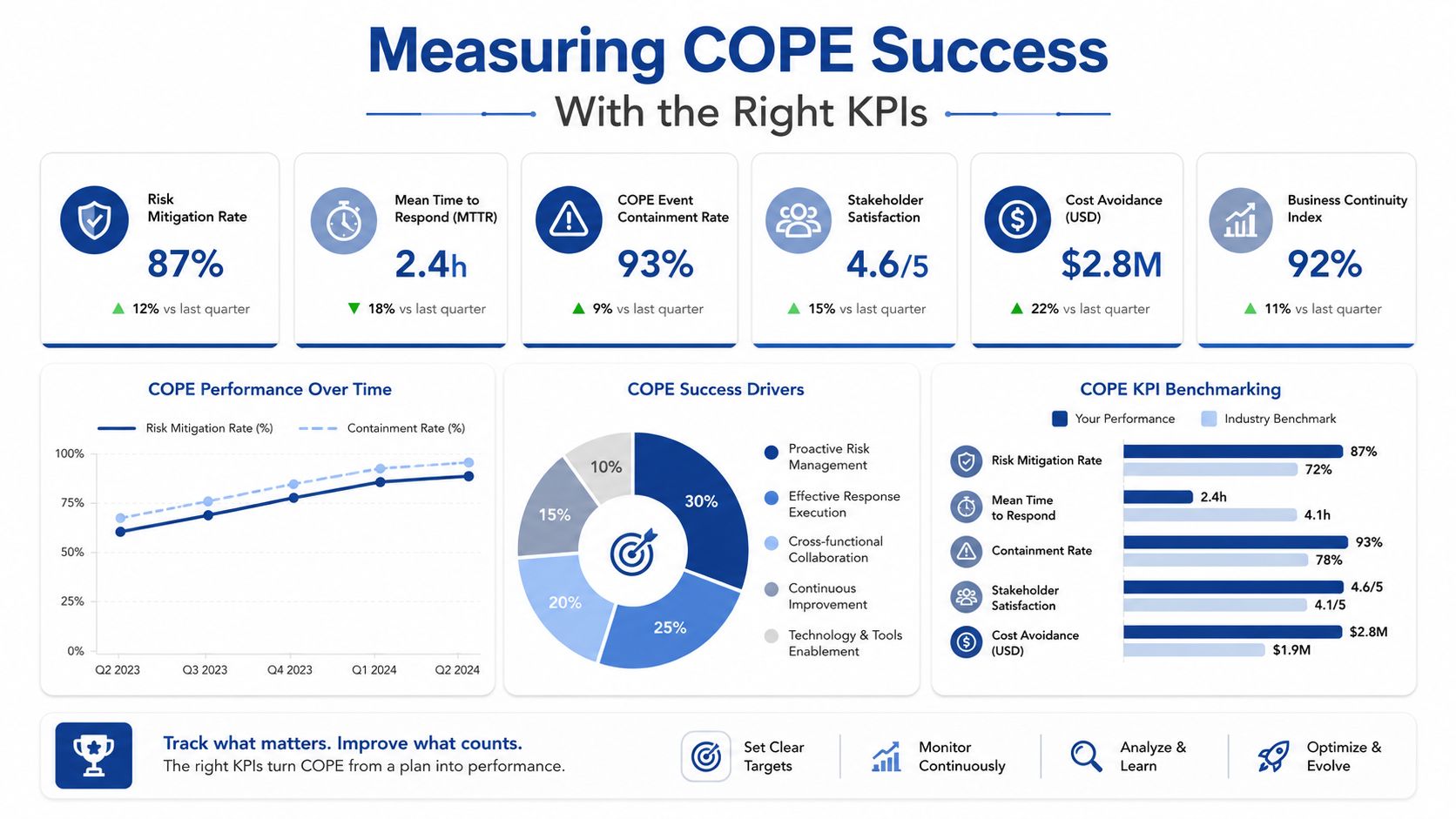
A create once publish everywhere strategy only works if the outputs get used. The cleanest KPI is content utilization, which means assets published per recording. The target is 20 or more assets from each anchor. If one recording doesn't reliably generate enough publishable material, the source or the workflow needs adjustment.
Track the right signals
The next measure is weeks of consistent posting sustained from a single anchor. That tells you whether the system is feeding the calendar or just creating a pile of assets. If one recording can fuel a full week on every channel, the strategy is doing its job.
Downstream, watch aggregate reach across platforms, email list growth, and inbound inquiries per month. Those are business signals, not vanity metrics. They tell you whether the repurposed content is reaching people who care enough to respond.
Treat distribution like an experiment
The strongest pitfall is publish and forget. That usually happens when a team posts a clip once, then stops measuring whether that format worked. Mature teams map each asset to a channel first, then monitor performance on websites, landing pages, social, search, apps, and email, and keep improving based on feedback as described in this distribution-focused COPE playbook.
A practical measurement template can stay simple:
- Recording source: podcast, interview, keynote, sales call, livestream, or course.
- Assets created: total outputs from one anchor.
- Assets published: what went live.
- Weeks sustained: how long the recording fed the calendar.
- Business response: reach, email growth, and inbound inquiries.
If one recording reliably fuels a full week on every channel, the strategy is working.
The content marketing ROI measurement guide is helpful when those business signals need to be tied back to revenue conversations. The point is not to chase every metric. The point is to prove that one source can support a durable publishing system.
If the goal is a COPE system that does more than tidy up content storage, book a call or request a sample and see how one recording turns into a repeatable publishing engine.
Tags: