8 Marketing Playbook Example Templates
Explore 8 marketing playbook example templates for podcasts, B2B teams, founders, and personal brands, with workflows and adaptable content assets.
A strong marketing playbook example turns one long-form recording into a repeatable sequence of channel-specific assets, owners, timing, and KPIs. Manual repurposing can take 8 to 15 hours of editor time for every hour of source content, so the system must control both production effort and distribution.
1. The Podcast Clip-to-Social Repurposing Playbook
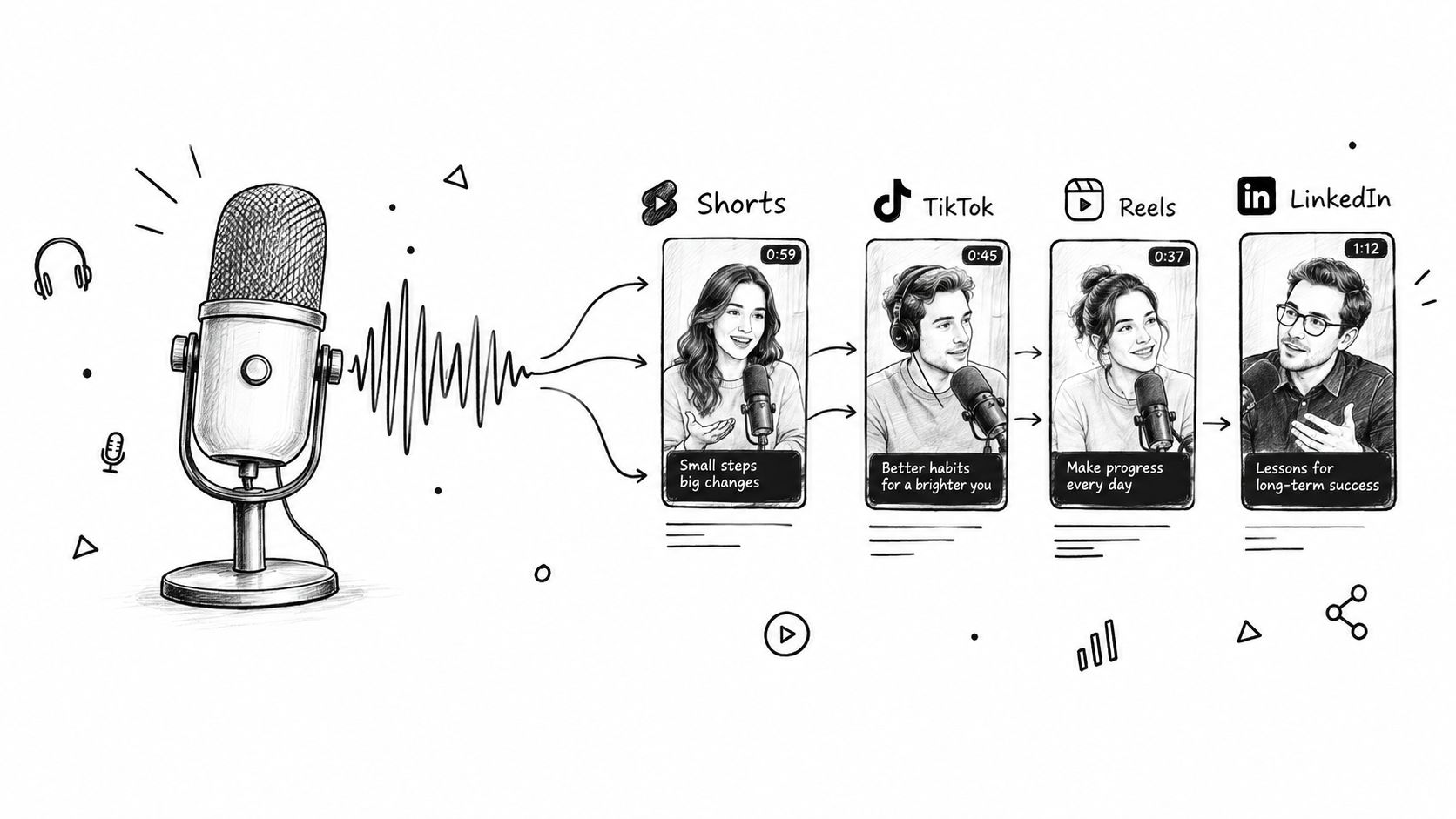
A podcast episode should keep working after publication. The practical model is simple: identify the strongest moments, edit them for each channel, add platform-native copy, then point attention back to the full episode.
A typical episode can produce short clips for YouTube Shorts, TikTok, Instagram Reels, and LinkedIn video. The exact output depends on the recording, but each clip should have one clear idea, one strong opening, and one reason to watch beyond the first few seconds.
A 2024 Adobe survey found that 70% of small business owners had repurposed content. Among those respondents, 83% said TikTok was the most effective platform for repurposed content, while 49% reported an 11–25% increase in engagement and 35% reported an 11–25% increase in conversions. The survey also found an average reuse lag of 7.5 months, which suggests that many teams wait far too long before extracting value from existing recordings. The survey findings and repurposing benchmarks are summarized by TapVids.
Workflow and deliverables
- Mark the source: Find specific claims, useful examples, disagreements, and memorable explanations.
- Edit the clips: Remove pauses, tighten openings, add captions, and apply brand elements.
- Adapt each channel: Shorten captions for TikTok, add context for LinkedIn, and use search-friendly phrasing for YouTube.
- Publish quickly: Schedule the first clip while the episode is still fresh.
- Review performance: Track views, saves, comments, profile visits, and full-episode clicks.
Manual clipping, captions, branding, and platform optimisation can consume several hours per episode. A guide to podcast clip formats for TikTok helps teams choose formats before editing begins.
The strongest candidates usually contain a specific number, sharp opinion, practical instruction, or unexpected contrast. Generic advice rarely gives a viewer a reason to stop scrolling.
A done-for-you team can receive the recording and return formatted clips, captions, and a posting calendar. The client keeps the strategic decisions, while production moves outside the weekly marketing queue. Sup's creator content repurposing approach shows how extracted moments can also support paid distribution.
2. The Keynote-to-Thought Leadership Playbook
A keynote contains more than a presentation. It often includes a central argument, supporting stories, audience questions, and language that can shape an entire thought leadership series.
The best keynote workflow starts by extracting three core messages. Each message becomes a small content pillar. One can support a LinkedIn article, another can become an email sequence, and the third can anchor a downloadable framework, checklist, or executive brief.
A speaker shouldn't publish the full transcript everywhere. That approach creates repetition and weakens the original talk. Instead, each channel should answer a different audience need.
A practical extraction sequence
- Core argument: Turn the keynote's main thesis into a concise LinkedIn post.
- Supporting proof: Build a longer article around one example or tension.
- Audience questions: Convert Q&A into objection-handling posts and email topics.
- Signature phrase: Use a memorable passage as the basis for a quote graphic or carousel.
- Framework: Package the process into a downloadable resource.
Manual production includes reviewing the recording, selecting passages, drafting copy, designing visuals, formatting the lead magnet, and preparing email content. The workload rises quickly when the speaker wants a consistent voice across every asset.
A thought leadership content strategy guide can help define the relationship between the original keynote and its derivative assets. The central rule is to preserve the speaker's point of view. Editing should improve clarity, not turn a distinctive argument into generic business language.
Practical rule: Record the Q&A. Audience questions often reveal stronger follow-up topics than the prepared presentation.
A useful keynote playbook includes a named owner for approvals, a publishing sequence, and a single destination for the lead magnet. It should also track qualified inquiries, downloads, email replies, speaking requests, and assisted conversions. Those metrics matter more than impressions when authority must lead to commercial conversations.
3. The Product Demo-to-Sales Enablement Playbook
Product demos and sales calls contain language that marketing teams often rewrite from scratch. That wastes valuable customer-facing material. A better marketing playbook example turns one approved demo into a sales enablement library.
The source recording can produce feature clips, FAQ answers, persona-specific follow-up emails, comparison visuals, onboarding explanations, and a battle card. Each asset should answer one buyer question without requiring a sales representative to explain the entire product again.
Build the library around buyer roles
A finance stakeholder may care about cost control and reporting. An IT stakeholder may need implementation details, permissions, and security context. An end user may want to see the shortest route from problem to result. One generic demo rarely serves all three audiences well.
The workflow should follow a controlled sequence:
- Record and approve a master demo.
- Tag sections by feature, persona, product version, and objection.
- Cut short clips for follow-up emails and internal sales channels.
- Convert recurring questions into written FAQs.
- Assemble a battle card with approved comparisons and responses.
- Archive outdated versions when the product changes.
Version control matters. Every clip needs a date, feature label, and owner. Without those details, sales teams may share outdated claims or old interface footage.
Manual work includes reviewing the recording, selecting moments, editing visuals, writing email copy, designing comparison assets, and checking technical accuracy. A product demo content guide provides a useful starting point for matching demo sections to buyer questions.
The key metric isn't merely video completion. Track demo-assisted opportunities, content-influenced pipeline, sales usage, reply rates, and the number of repeated questions that the library resolves. A good enablement system reduces duplicated explanation and gives newer representatives approved material to use immediately.
4. The Customer Interview-to-Case Study Playbook
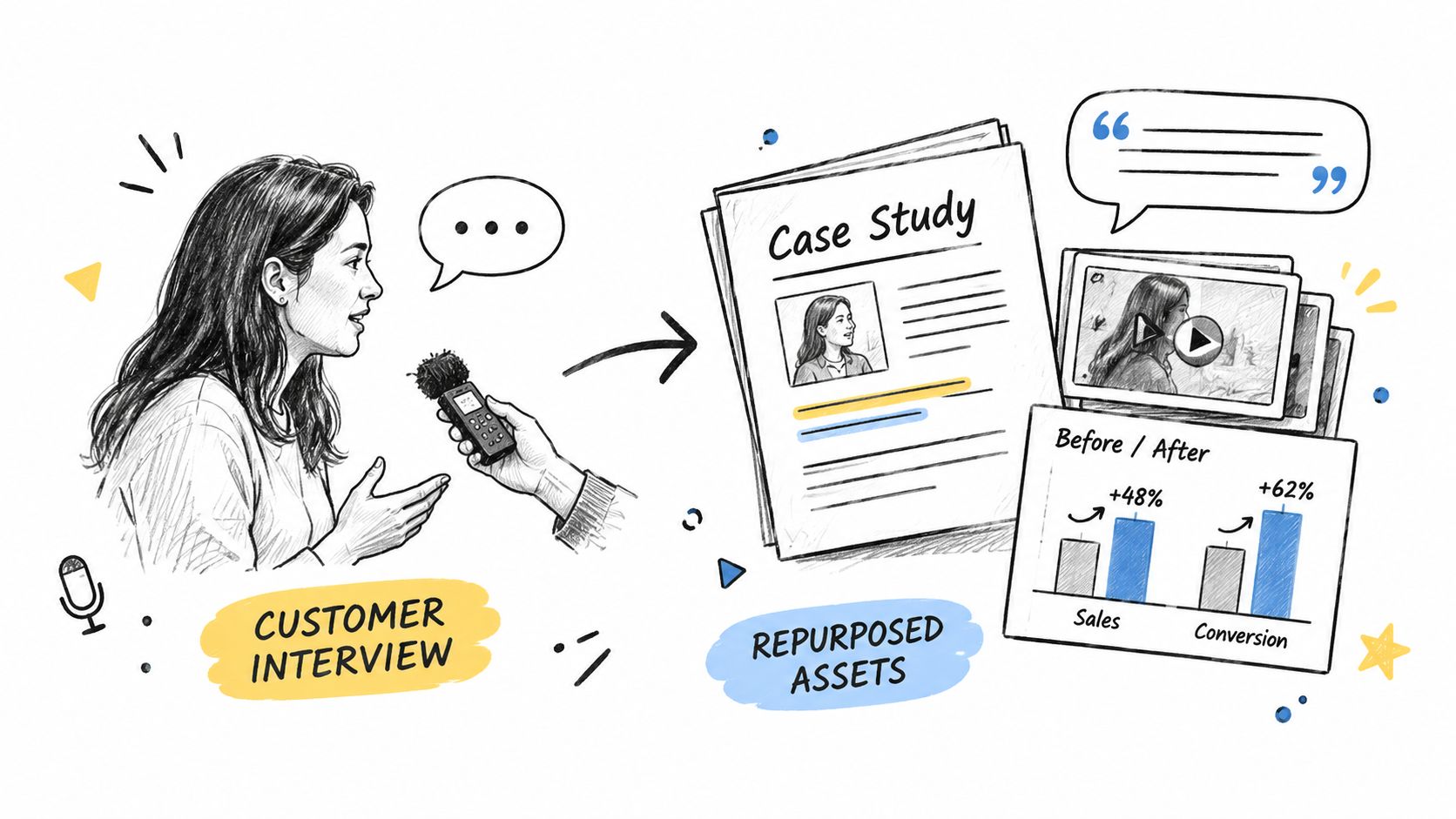
A customer interview becomes valuable when the recording captures a clear before-and-after story. The strongest source material includes the customer's original problem, the decision process, implementation details, and concrete evidence of change.
That interview can support a written case study, customer testimonial clips, social posts, an email sequence, an audio excerpt, and an infographic. Each asset should preserve the customer's language while adapting the depth to the channel.
Start with evidence, not promotion
Before recording, the marketing team should ask for specific operational details. Useful prompts include:
- Original problem: What failed, slowed down, or created unnecessary work?
- Decision criteria: Why did the customer choose this approach?
- Implementation: What changed in the workflow?
- Business effect: What improved in revenue, time, cost, quality, or capacity?
- Advice: What would the customer tell a similar company?
The interview should also capture usable visual material, such as a headshot, workplace footage, product context, or a screen recording. Those elements make the resulting assets feel specific rather than staged.
Manual production involves transcription, fact checking, quote selection, writing, design, video editing, customer approval, and legal review. The customer approval stage often determines the final timeline, so the workflow needs one clear reviewer.
A customer interview content guide can help teams organise the source around challenge, solution, and result. The case study should appear on the website before social promotion, giving every later asset a stable destination.
Strong proof doesn't require louder claims. It requires enough detail for a similar buyer to recognise the situation.
Track case study page visits, sales usage, assisted conversions, replies from target accounts, and content engagement among lookalike prospects. Avoid publishing unsupported customer outcomes. If the customer hasn't approved a number, describe the improvement qualitatively.
5. The Panel Discussion-to-Content Series Playbook
A panel gives a company access to several perspectives in one recording. That makes it suitable for co-marketing, provided each participant receives a useful, easy-to-share asset.
The recording can become individual expert spotlight videos, a discussion guide, LinkedIn posts, email copy for each panelist, and a consensus report. The panel host gains a content series, while participants receive material that supports their own distribution.
Make every contributor part of the workflow
Panel preparation should include a short set of shared questions. The questions need enough structure to create focused answers, but enough flexibility to preserve disagreement and personality.
After recording, the team should:
- Segment speakers: Mark each contribution and connect it to a topic.
- Create spotlights: Give every panelist a concise video and visual header.
- Extract disagreements: Turn contrasting opinions into discussion posts.
- Build a report: Summarise areas of agreement, open questions, and practical actions.
- Prepare sharing copy: Give each participant a ready-to-send email and social caption.
Manual production can become expensive because every speaker needs review and approval. A single generic edit is faster, but it gives away the co-marketing advantage. Segmentation takes longer, yet it makes distribution easier for every participant.
The virtual event content repurposing guide offers a useful structure for turning one discussion into multiple formats. The first spotlight should go live while panelists still remember the event and feel motivated to share it.
Metrics should include registrations, target-account engagement, participant shares, qualified conversations, report downloads, and assisted pipeline. The consensus report shouldn't always be gated. Open distribution may create more reach when the company is still building an audience.
6. The Webinar-to-Lead Magnet Playbook
A recorded webinar can become an evergreen demand asset, but only when the team removes the event-specific framing. The replay date, introductions, housekeeping, and audience pauses rarely belong in the lead magnet.
The source should be divided into a small number of practical lessons. One lesson can become a guide section, another can become a checklist, and another can support a short email sequence. Clips then answer common questions and send visitors to a focused landing page.
Separate the assets by buying intent
A short clip should create interest. A search-led article should answer a specific question. A gated guide should help a qualified reader apply the method. Sales follow-up should address the next decision, not repeat the presentation.
A reliable workflow looks like this:
- Identify the strongest framework or process.
- Remove event-only material.
- Draft the guide around the framework.
- Create a landing page with one clear promise.
- Build nurture emails for attendees and non-attendees.
- Cut clips that address objections or explain individual steps.
- Review every claim against the original recording.
Manual production requires transcription, editorial planning, guide writing, design, landing page copy, email drafting, clip editing, and quality control. The source is long, so teams should prioritise the guide and the strongest clips before producing every possible derivative.
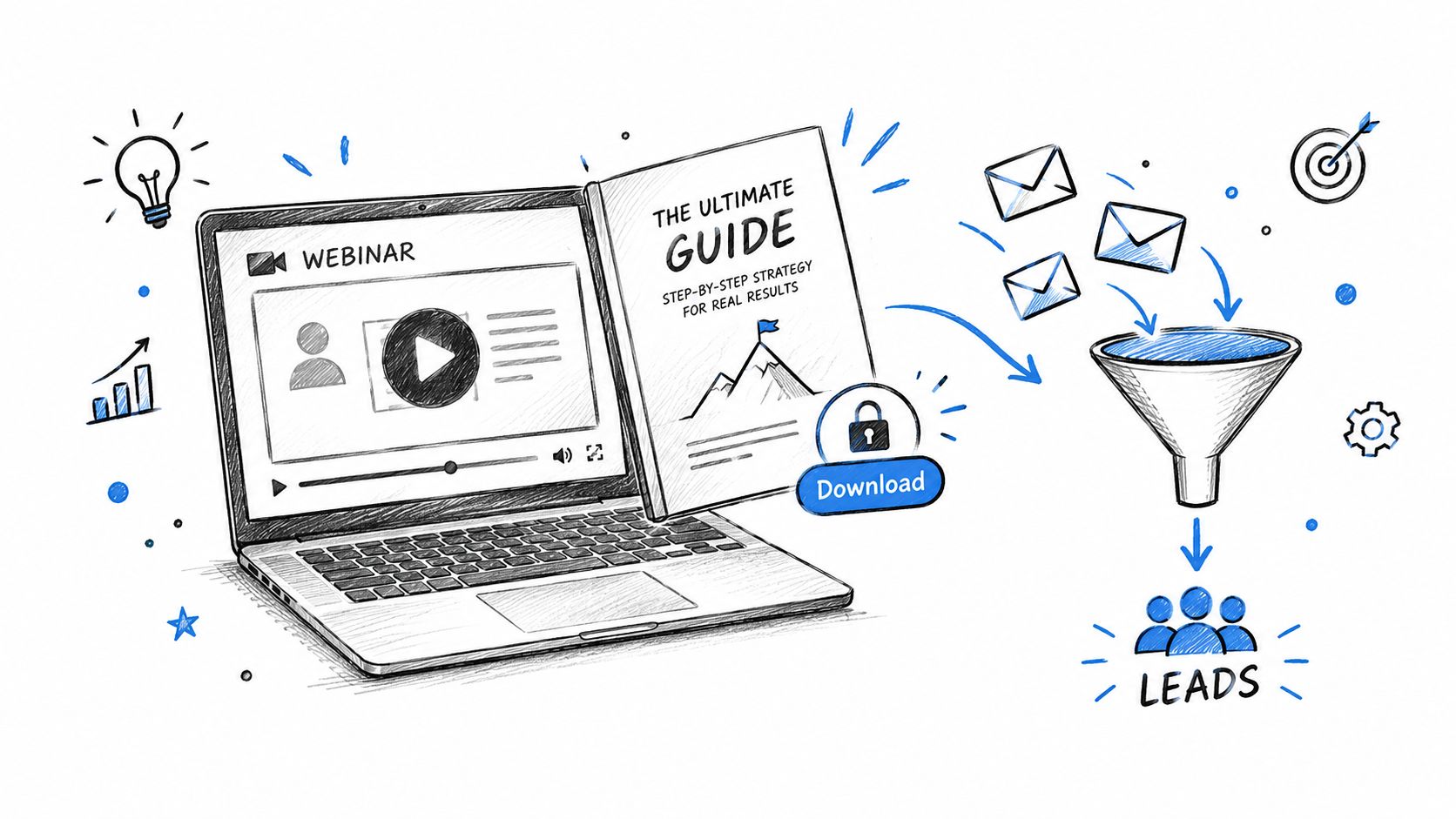
A lead magnet should contain a useful framework, not a lightly edited transcript. The landing page should state who the resource is for, what problem it addresses, and what the reader can do after downloading it.
Track landing page conversions, qualified leads, email replies, assisted conversions, pipeline, and content reuse efficiency. CXL recommends connecting playbook goals to metrics such as MQLs, SQLs, CAC, LTV, organic traffic, referral traffic, and social engagement, with measurement across analytics, CRM, email, and social systems. CXL's marketing playbook guide provides the measurement foundation.
7. The Repurposing Done-for-You Service Overview
A done-for-you service removes the production queue from the internal marketing team. The client sends one recording, provides the brand kit and brief, reviews the finished assets, and publishes them through the agreed posting plan.
The source can be a podcast, keynote, product demo, customer interview, panel, course, livestream, sales call, or meeting recording. The service then extracts usable moments and adapts them into platform-ready formats.
A typical delivery can include:
- Video clips: Short, captioned edits for social channels.
- LinkedIn posts: Written in the client's approved voice.
- Quote graphics: Branded visual statements from the recording.
- Carousels: Structured explanations for multi-slide publishing.
- Audiograms: Audio-led assets for listeners and podcast audiences.
- Blog content: A search-led article based on the source material.
The client should provide a logo, colours, fonts, preferred examples, target audience, and topics to avoid. That preparation reduces unnecessary revisions. It also prevents the editor from making brand decisions that should belong to the client.
A practical service model offers about 15 minutes of client time for intake and approval, then returns 20 to 30 ready-to-publish assets. The exact package depends on source quality, recording length, and the formats selected.
The service saves time only when approvals stay focused. A clear brief beats a long revision thread.
Teams should compare providers on editorial quality, brand accuracy, ownership, revision terms, turnaround, and whether the delivery includes a publishing plan. The cheapest asset isn't useful if the client still needs to rewrite every caption or rebuild every graphic.
8. Execution Time and Resource Estimates
The main trade-off is not whether repurposing works. It is whether the team can produce and publish the assets consistently without sacrificing higher-value work.
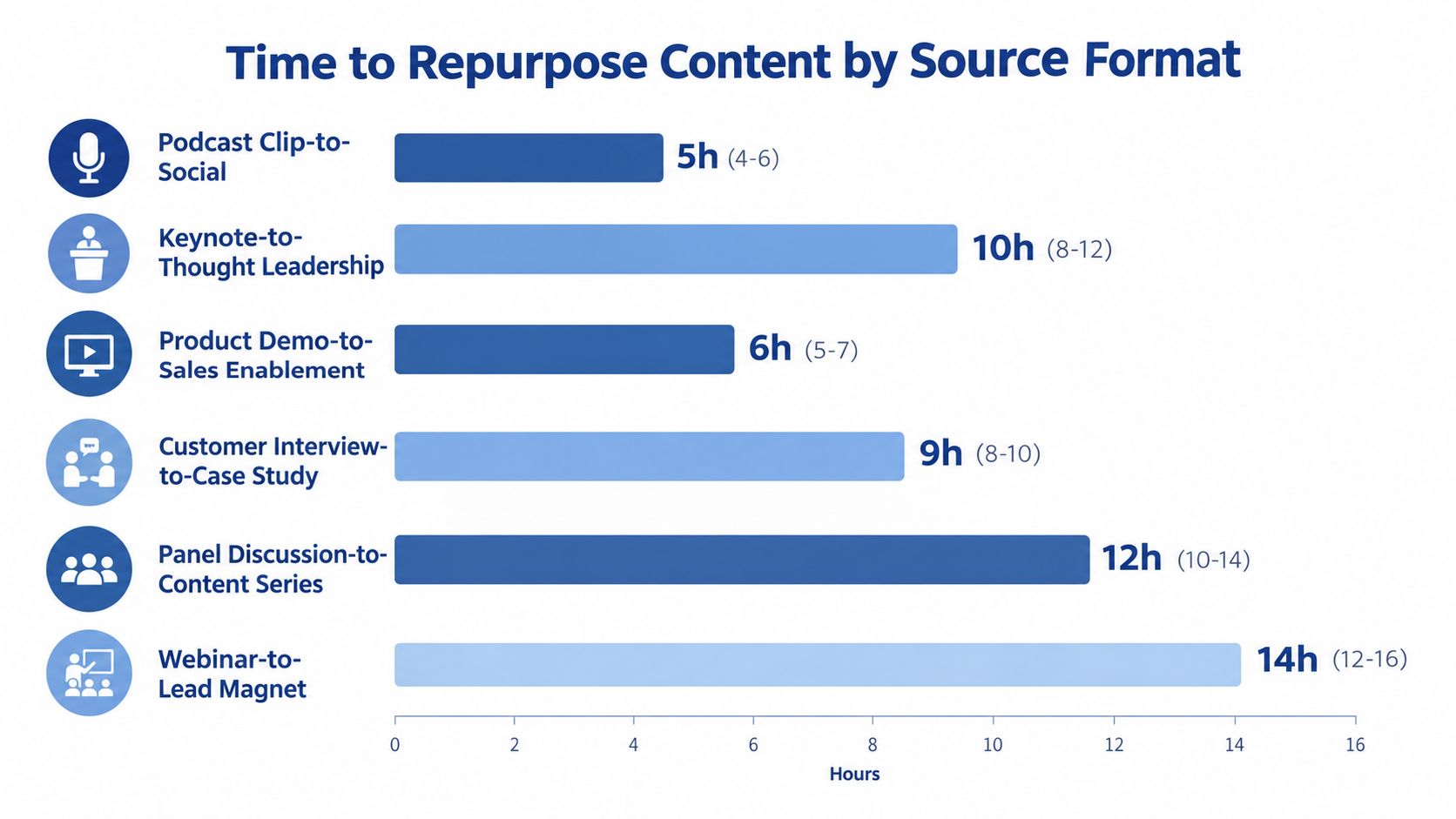
A detailed manual breakdown for one source asset includes 1 to 2 hours for reviewing and marking moments, 3 to 4 hours for video clipping and editing, 2 to 3 hours for posts and captions, 2 to 4 hours for graphics or carousels, and 2 to 3 hours for a search-led article. The workflow estimate is published by Repurpose Your Content.
Another guide estimates that manually repurposing one 60-minute podcast usually takes 8 to 12 hours across editing, writing, and design. A tool-assisted workflow may reduce operator time to roughly 30 minutes, plus tool credits, but that still assumes someone can judge quality, correct errors, and protect the brand voice. Kompozy's repurposing overview explains the difference between operator time and total production effort.
Plan capacity before choosing a model
- Small team: Prioritise clips, one written asset, and one conversion destination.
- Sales-led team: Produce demo snippets, objection answers, and follow-up copy first.
- Personal brand: Prioritise strong opinions, stories, and consistent visual identity.
- Demand generation team: Build one core asset, then connect every derivative to pipeline reporting.
- Agency: Standardise briefs, folders, naming, approvals, and brand kits before adding volume.
Repurposing also becomes less effective when teams publish without measurement. A later ZoomInfo summary reports that 71% of marketing executives identify attribution from social and content activity to revenue as their largest measurement challenge, while only 19% track AI-specific KPIs despite 67% using AI tools daily. The measurement summary is available from ZoomInfo.
The best operating model starts with one source, one audience, one outcome, and a limited asset set. After the team sees which formats support that outcome, it can expand production without creating content for its own sake.
For planning, teams can also use this social content planning guide to assign owners, dates, channels, and review status.
8 Marketing Playbooks Compared
| Playbook | Implementation Complexity | Resource Requirements | Expected Outcomes | Ideal Use Cases | Key Advantages |
|---|---|---|---|---|---|
| The Podcast Clip-to-Social Repurposing Playbook | Medium, ~4–6 hrs manual per episode (segmenting, editing, captions) | Clear audio, editing tools or vendor, brand kit, platform optimization skills | 8–12 short clips; clip views 3–5x vs episode; 8–15% CTR to full episode; 15–40% new listeners per platform | Podcasters wanting rapid discoverability and short-form distribution | High asset yield from one recording; low per-asset cost; fast publishing cadence |
| The Keynote-to-Thought Leadership Playbook | Medium–High, ~8–12 hrs manual (extract messages, long-form writing) | Keynote recording, writer/editor, design for lead magnet, speaker review | Month-long LinkedIn series, 40–60 qualified leads, LinkedIn articles 8–15K impressions | Speakers or executives converting talks into authority content and leads | Positions speaker as expert; multi-week content; attracts speaking opportunities |
| The Product Demo-to-Sales Enablement Playbook | Medium, ~5–7 hrs manual (clips, comparisons, templates) | Structured demo recording, product SME, designer for visuals, sales integration | 3–4 demo clips, competitor comparisons, FAQ, email templates; 15–20% shorter sales cycle | B2B sales teams improving demo consistency and AE onboarding | Reduces prep time; improves demo consistency; boosts prospect engagement |
| The Customer Interview-to-Case Study Playbook | High, ~8–10 hrs manual (interview editing, writing, design) | Willing customer, quantifiable metrics, writers, designers, video editing | Full written case study + 4–5 testimonial clips; ↑ case study traffic 200–300%; 20–30% faster closes | Companies seeking strong social proof and high-converting nurture assets | Produces durable social proof; multi-format assets; high conversion lift |
| The Panel Discussion-to-Content Series Playbook | High, ~10–14 hrs manual (isolate speakers, synthesize consensus) | Multi-speaker approvals, skilled moderator, editorial synthesis, co-marketing assets | 4 spotlight videos, 8-week series, consensus report; 3–5x reach vs single expert; tens of K impressions | Events or brands convening experts for co-marketing and lead gen | Amplified reach via panelists; co-marketing leverage; evergreen consensus content |
| The Webinar-to-Lead Magnet Playbook | High, ~12–16 hrs manual (extract frameworks, build funnel assets) | 60–90m recording, copywriter, landing page/ad creative, CRM & ad setup | 15–25 page gated guide, nurture flows, 20–40 leads/month; landing conv. 20–30%; CPL ~$8–12 | Webinar hosts converting live events into evergreen lead-generation funnels | Long-term lead stream; lowers CPL vs live ads; reusable sales enablement asset |
| Repurposing Done-For-You Service Overview | Low client complexity, ~15 minutes input; vendor delivers in 48 hrs | Vendor editing, platform-native formatting, brand kit application, QA | Rapid multi-asset delivery (clips, copy, graphics); standardized outputs and posting calendar | Teams lacking internal production capacity or needing fast scale | Eliminates production overhead; predictable turnaround; consistent quality |
| Execution Time & Resource Estimates (Aggregated) | Reference, ranges 4–16 hrs depending on source; common multi-step workflow | Transcription, editing tools, writers, designers, scheduling and review time | Benchmarks for planning; helps compare DIY vs outsourced cost/effort | Content planners budgeting internal effort or evaluating vendor ROI | Consolidated time estimates; highlights batching and priority strategies |
Choose the Playbook Your Recording Can Support
The right marketing playbook example depends on the job the recording needs to perform.
Choose the podcast model for reach and discovery. Choose the keynote model for authority and speaker visibility. Choose the demo model for sales enablement and buyer education. Choose the customer interview model for proof and trust. Choose the panel model for co-marketing and partner distribution. Choose the webinar model for lead capture and nurture.
The source format matters, but the commercial purpose matters more. A polished recording can still underperform when every channel receives the same cut, the same caption, and the same call to action.
The operating workflow
- Send one recording: The source can be a podcast, keynote, interview, product demo, panel, course, livestream, sales call, or meeting.
- Apply the brief: The production team extracts moments, follows the brand kit, and adapts each asset to its channel.
- Receive the package: The client receives 20 to 30 ready-to-publish assets within 72 hours, including video clips, LinkedIn posts, quote graphics, carousels, audiograms, and a blog post.
- Review the delivery: The client approves the assets or requests revisions. The service includes unlimited revisions.
- Publish from the playbook: The posting plan identifies what to publish, where to publish it, and when to schedule it.
That workflow gives busy teams a clear division of labour. The client supplies expertise and approval. The production team handles extraction, editing, design, copy, formatting, and packaging.
The service includes a 72-hour turnaround guarantee. If the deadline is missed, the client doesn't pay. Pricing starts from $14 per finished asset, with the final cost depending on the package and recording volume.
A strong system also tracks whether repurposing supports the business. The dashboard should connect publishing activity to qualified conversations, assisted conversions, pipeline, organic traffic, referral traffic, and reuse efficiency. The goal isn't to produce the largest asset library. The goal is to create useful content without forcing subject-matter experts to repeat the same work every week.
RepurposeYourContent is a relevant done-for-you option for teams that want to send a recording and receive finished, branded content. To assess the right playbook for a podcast, keynote, customer interview, demo, panel, or other recording, book a call or request a sample at RepurposeYourContent.com.
Tags: