Marketing with Podcasts: The B2B Playbook
Master marketing with podcasts to drive B2B growth. Learn how to launch, grow, and repurpose episodes into a full content engine with our 2026 playbook.
U.S. podcast ad spend is projected to pass $3.0 billion in 2026, while global podcast advertising is forecast to exceed $5.0 billion that year, with projected annual growth of 12.4%. (Digital Applied) Marketing with podcasts has moved beyond launching a show and hoping listeners arrive. The stronger B2B model treats every recording as a reusable content engine for LinkedIn, email, search, video, and sales enablement.
The commercial question is no longer whether podcasts can attract attention. It's whether a team can turn that attention into measurable demand without creating another production burden. A podcast can support awareness, trust, and mid-funnel action, but only when strategy, distribution, measurement, and repurposing work together.
Why Marketing With Podcasts Works in 2026
Podcasting now operates at a scale that supports serious media planning. One 2026 industry summary projects U.S. podcast advertising above $3.0 billion and global spend above $5.0 billion, with 12.4% year-over-year growth projected for 2026. (Digital Applied) That scale changes the conversation for B2B marketers. Sponsorships, host-read ads, and owned shows can sit inside a broader media plan instead of a small experimental budget.
Audience adoption supports that shift. A 2026 industry report estimates 158 million monthly podcast consumers in the United States, representing 55% of Americans regularly tuning in. (iHeartMedia) Another audience summary reports 58% monthly U.S. penetration and 45% weekly listening among Americans age 12 and older in 2026. Weekly listening rose from 15% in 2017, showing sustained adoption rather than a temporary spike. (iHeartMedia)
Trust creates more than reach
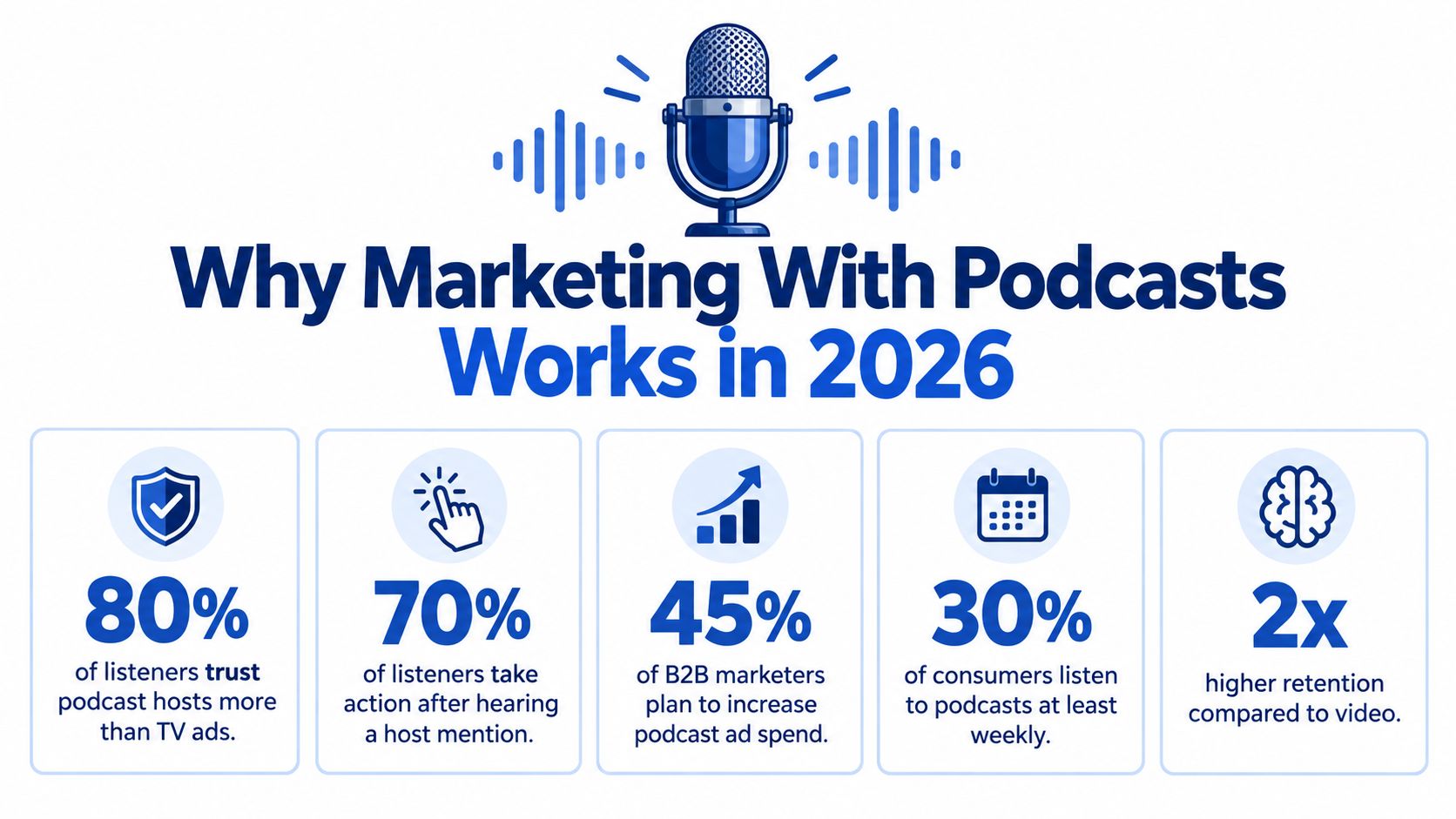
Podcast ads perform well when the creative respects the listening experience. A Nielsen meta-analysis commissioned by MAGNA combined 610 studies and 147,525 respondents. It found a 15% lift in aided awareness compared with control groups, while 35- to 60-second creative generally balanced performance and user experience. (MAGNA)
Host-read placements matter because the host already holds attention and context. Deloitte reports that nearly 40% of listeners are more influenced by podcast ads than advertising in other channels. That rises to about 50% among Gen Z and millennial listeners. A separate dentsu and Lumen study found podcast ads generated about twice the attention of social, digital video, and television formats, with host-read ads averaging 14.2 seconds of attention time. (Deloitte)
The implication is practical. A generic inserted ad may buy exposure, but a credible host can explain why a product matters. B2B buyers often need that explanation before they search, compare vendors, or contact sales.
Teams should pair those channel metrics with disciplined digital marketing analytics monitoring. Downloads indicate distribution, but they don't prove incremental demand. The useful question is whether a specific host, format, or audience segment creates action beyond existing audio habits.
Defining Your Podcast Strategy and Audience
A B2B podcast needs a business job before it needs a microphone. The show might create category awareness, support executive credibility, generate qualified conversations, or give sales teams useful customer-facing material. One show can contribute to several goals, but one should guide editorial decisions.
Start with the listener, not the format
Define one primary listener profile. Identify the role, buying responsibility, business pressure, and question that brings the person to the show. “B2B decision-makers” is too broad. “Revenue leaders evaluating attribution after a difficult quarter” gives the host a clear editorial direction.
Write a short listener statement:
This show helps [specific role] understand [specific problem] so they can [business outcome].
That sentence should influence episode ideas, guest selection, titles, calls to action, and distribution. If an episode doesn't serve the listener or the business objective, it belongs somewhere else.
Choose a format the team can sustain
Interview shows create authority through association and give guests a reason to share episodes. They also require outreach, scheduling, preparation, and guest management. Solo episodes offer more control and faster publishing, but they demand stronger scripting and consistent subject expertise.
Panels can create useful disagreement, though they multiply coordination risk. A practical strategy often combines one primary format with a lighter secondary format. For example, a company might publish expert interviews and use short solo episodes to answer recurring buyer questions.
A useful podcast content marketing strategy connects each format to a distribution plan. The recording shouldn't become an isolated audio file. It should produce material for channels where the target buyer already spends attention.
Build recognizable packaging
The title should tell the right listener what the show offers. Clever names can work, but a descriptive subtitle often removes confusion. Cover art needs strong contrast and legibility at small sizes. The show description should explain the audience, topic, format, and practical benefit without sounding like corporate boilerplate.
Create three to five messaging pillars. A cybersecurity show might use incident response, board communication, operational resilience, buyer education, and leadership. Each pillar should support multiple episodes and connect naturally to the company's offer.
Before launch, prepare a short trailer, a clear subscription path, and several finished episodes. The show needs enough material for a new listener to understand its value quickly. Every episode should include a specific next action, such as reading a related guide, joining an executive briefing, or requesting a conversation.
The Realistic Production and Launch Workflow
A polished podcast consumes more time than the recording itself. The work starts with guest selection and ends after promotion and follow-up. Teams that budget only for recording usually create a backlog of unfinished edits and inconsistent publishing.
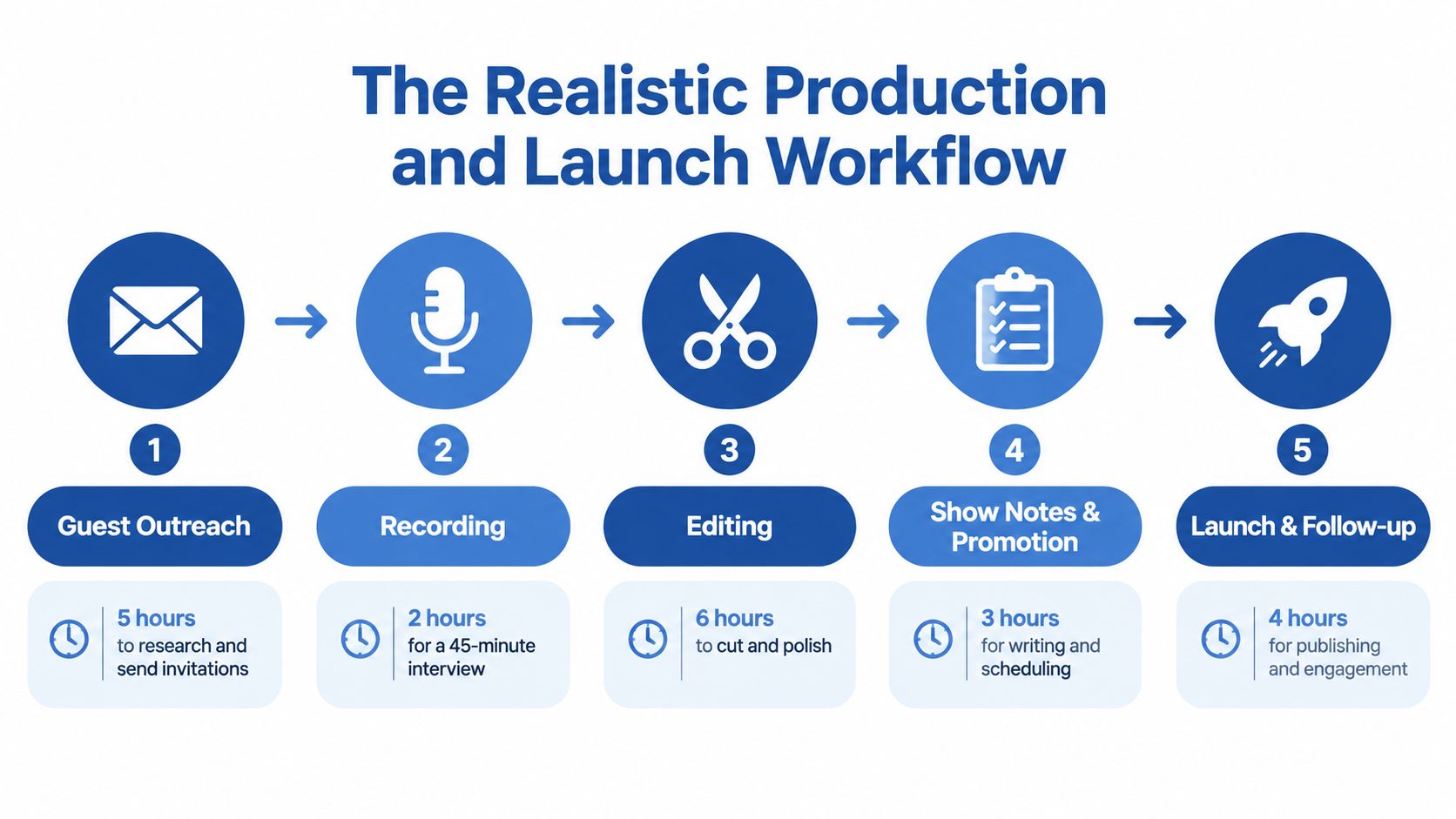
Consider a realistic 45-minute B2B interview. A workable process looks like this:
- Guest outreach, about 5 hours. Research relevant guests, identify a credible angle, write invitations, follow up, and schedule the conversation.
- Pre-interview research, about 2 hours. Review the guest's work, gather buyer questions, prepare an outline, and confirm talking points.
- Recording, about 2 hours. Allow time for setup, technical checks, introductions, retakes, and the actual 45-minute interview.
- Audio editing, about 6 hours. Remove errors, tighten pauses, balance sound, add music, and review the final cut.
- Show notes and promotion, about 3 hours. Write the description, chapters, guest summary, links, email copy, and social posts.
- Launch and follow-up, about 4 hours. Publish through the hosting workflow, check directories, respond to the guest, and monitor early engagement.
The exact workload varies, but the bottleneck is consistent. Editing and promotion require different skills, and both compete with the team's core marketing work.
A launch workflow that avoids the empty-feed problem
A practical launch sequence starts with the infrastructure. Create the hosting account, generate the RSS feed, prepare artwork and descriptions, and submit the show to the major listening directories. Then check every listing manually. Broken links, missing descriptions, and inconsistent branding reduce confidence before the first episode plays.
The first three episodes should serve different purposes:
- Episode one establishes the promise. Explain who the show serves and what listeners will learn.
- Episode two demonstrates depth. Address a meaningful problem with useful detail.
- Episode three expands credibility. Feature a guest, customer perspective, or strong point of view.
Publishing those episodes together gives early visitors a reason to continue listening. It also lets guests and partners promote more than one entry point.
Teams needing deeper operational detail can review this guide to full-service podcast production. The key decision is not whether every task can be done internally. It's whether the internal team can repeat the workflow at the required cadence without sacrificing higher-value work.
Distribution Tactics to Grow Your Listenership
Publishing the audio file is only the start. Discovery rarely comes from directory presence alone, especially for a new B2B show with no established audience. Distribution needs a repeatable system that puts each episode in front of relevant people several times.
Start with owned channels. Send the episode to the email list, feature it on the company website, add it to relevant resource pages, and give sales representatives a short sharing note. A guest should receive ready-to-use copy, a direct link, and selected moments that make sharing easy.
Turn guests into distribution partners
Guest promotion works when the episode gives the guest a clear professional benefit. A vague request to “share the episode” creates work for them. A better package includes a concise summary, a strong quote, a short clip, and suggested social copy.
Target guests with adjacent audiences, not merely impressive titles. A respected specialist whose audience matches the buyer may drive more qualified listening than a famous guest with little category overlap. Relationship quality also matters. A guest who understands the episode's value can become a repeat distribution partner.
Teams building a systematic guest strategy can use this resource on growing your podcast with guests. The principle is simple. Guests should expand reach into existing communities, not just decorate an episode page.
Treat video as a distribution layer
Video podcast consumption is becoming a major part of the format. Fifty-three percent of weekly podcast consumers actively watched video podcasts in 2026, and YouTube captured nearly two-thirds of video podcast impressions in large-scale campaign data. (Radio Ink)
That doesn't mean every podcast needs a full studio production. A clean interview recording can produce a long-form video, short clips, audiograms, quote graphics, and written posts. The format should match the channel. YouTube needs a searchable title and thumbnail. LinkedIn needs a sharp business observation. Email needs a useful reason to listen.
A detailed guide to promoting a podcast on social media can help teams map those assets to channels. Paid promotion can support a strong episode, but it shouldn't compensate for weak positioning or unclear audience fit.
The Done-For-You Content Repurposing Alternative
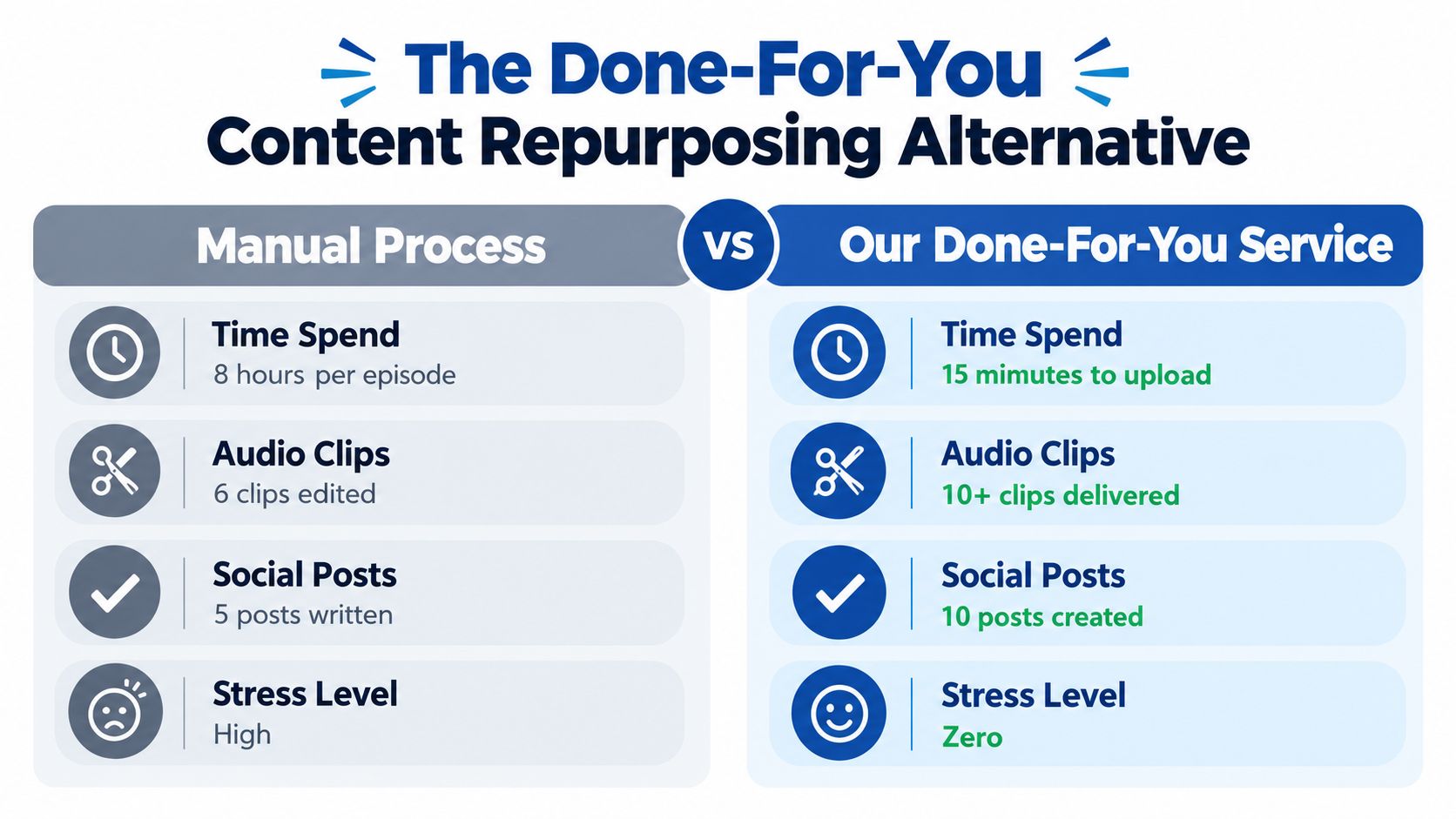
Manual repurposing turns a finished episode into another production project. Someone must find strong moments, edit clips, add captions, write posts, design graphics, build a carousel, draft an article, and review every asset. The work can consume about 8 hours per episode when a team handles it manually, including 6 edited clips and 5 written posts, as represented in the comparison visual below.
Compare the operating models
The DIY route offers control, but it also creates a hidden cost. The host or marketer becomes an editor, copywriter, designer, project manager, and quality reviewer. Those tasks may look manageable individually, yet they create a recurring queue after every recording.
A done-for-you service changes the handoff. The client sends one recording, such as a podcast, interview, keynote, sales call, livestream, course session, or meeting recording. The service returns 20 to 30 ready-to-publish assets within 72 hours, including video clips, LinkedIn posts, quote graphics, carousels, audiograms, and a blog post.
The client's time is about 15 minutes. The workflow is straightforward:
- Send the recording and brand guidance.
- Review the delivered content.
- Request revisions or approve the assets.
- Publish through the existing channels.
RepurposeYourContent delivers those finished assets in the client's brand voice, with unlimited revisions, and states a 72-hour turnaround guarantee, or the client doesn't pay. Pricing starts at $14 per finished asset, and one 45-minute recording can become 30 assets. Teams comparing production models can also consult this ClipCreator.ai repurposing guide for broader content multiplication ideas.
Calculate the value beyond editing
The strongest ROI comes from reuse, not from the recording alone. One conversation can support an episode, a search-focused article, several LinkedIn posts, short-form video, visual quotes, a sales follow-up, and an email. That creates repeated opportunities to reach buyers who missed the original publication.
The trade-off is straightforward. DIY production preserves maximum internal control but consumes specialist time. Outsourcing adds a service cost but gives the marketing team a dependable output without hiring separate editors, designers, and writers. A detailed done-for-you podcast content workflow helps teams evaluate what should remain internal and what should move outside.
Measuring Success and Proving Incremental Lift
Downloads are useful for understanding distribution. They don't prove that a podcast influenced pipeline. B2B teams need a measurement system that separates audience exposure from meaningful business movement.
Start with three layers:
- Awareness: Track aided awareness and recognition through brand studies, audience surveys, or controlled campaign measurement.
- Information seeking: Monitor branded searches, visits to episode-linked resources, and requests for product or category information.
- Intent and action: Track demo requests, sales conversations, opportunity influence, and purchase intent tied to podcast exposure.
Recent Nielsen reporting found average podcast campaign lifts of 10 points in brand awareness, 8 points in information-seeking behavior, and 6 points in purchase intent. (Radio Ink) Those figures show why marketers should measure more than downloads. Awareness and intent can move before a buyer fills out a form.
Build attribution into the episode
Give listeners a simple path to identify themselves. Use a dedicated landing page, a memorable offer code, or a short URL stated clearly in the introduction and outro. Ask new customers how they heard about the company during the sales process and post-purchase survey.
First-touch attribution can overstate the podcast's role. Last-touch attribution can erase it. A better approach records podcast exposure as an influence alongside search, email, events, sales outreach, and partner referrals.
Measurement rule: Compare podcast-exposed accounts with a sensible unexposed group whenever the data allows.
Account-based teams can tag contacts who engage with episode pages, clips, or podcast-specific landing pages. Sales can then review whether those accounts progress differently through qualification, opportunity creation, and close stages. Marketing should report both direct conversions and influenced pipeline, using consistent definitions.
Daily podcast listening accounts for nearly one-fifth of time spent with ad-supported audio, according to recent Nielsen reporting. (Radio Ink) That makes frequency relevant, but repeated exposure still needs controls. A buyer who already consumes podcasts heavily may respond differently from someone reached through a single campaign placement.
Teams looking for a broader framework can use this guide to measure content marketing ROI. Leadership doesn't need a download report. It needs a clear view of reach, response, influenced demand, and the cost of producing each useful asset.
Your Next Steps to Launch and Scale
A sustainable podcast engine has four parts. Choose a narrow audience and business objective. Record a format the team can repeat. Distribute every episode through owned, guest, search, video, and sales channels. Measure awareness, intent, and pipeline instead of treating downloads as revenue.
The recording should also feed the rest of the marketing system. A single interview can become an episode, clips, posts, graphics, a carousel, an article, an email, and sales material. That approach gives the team more publishing consistency without asking executives or subject-matter experts to create every asset separately.
Use this launch checklist:
- Audience: Name the role, problem, and buying context.
- Format: Choose interview, solo, panel, or a sustainable combination.
- Packaging: Prepare the title, artwork, description, and clear call to action.
- Production: Budget for outreach, research, recording, editing, notes, and promotion.
- Distribution: Prepare email, guest sharing, website, social, video, and sales support.
- Measurement: Create dedicated links, campaign tags, and pipeline reporting.
- Repurposing: Decide who will turn each recording into finished channel assets.
A podcast can become a durable B2B content source, but only when the team plans beyond publication. Book a strategy call or request a sample to see how one recording can become ready-to-publish content in the client's brand voice.
Tags: