Podcast Social Media Management Service: When to Hire One
Learn what a podcast social media management service does and when it's worth hiring one. Boost your show's reach and engagement in 2026.

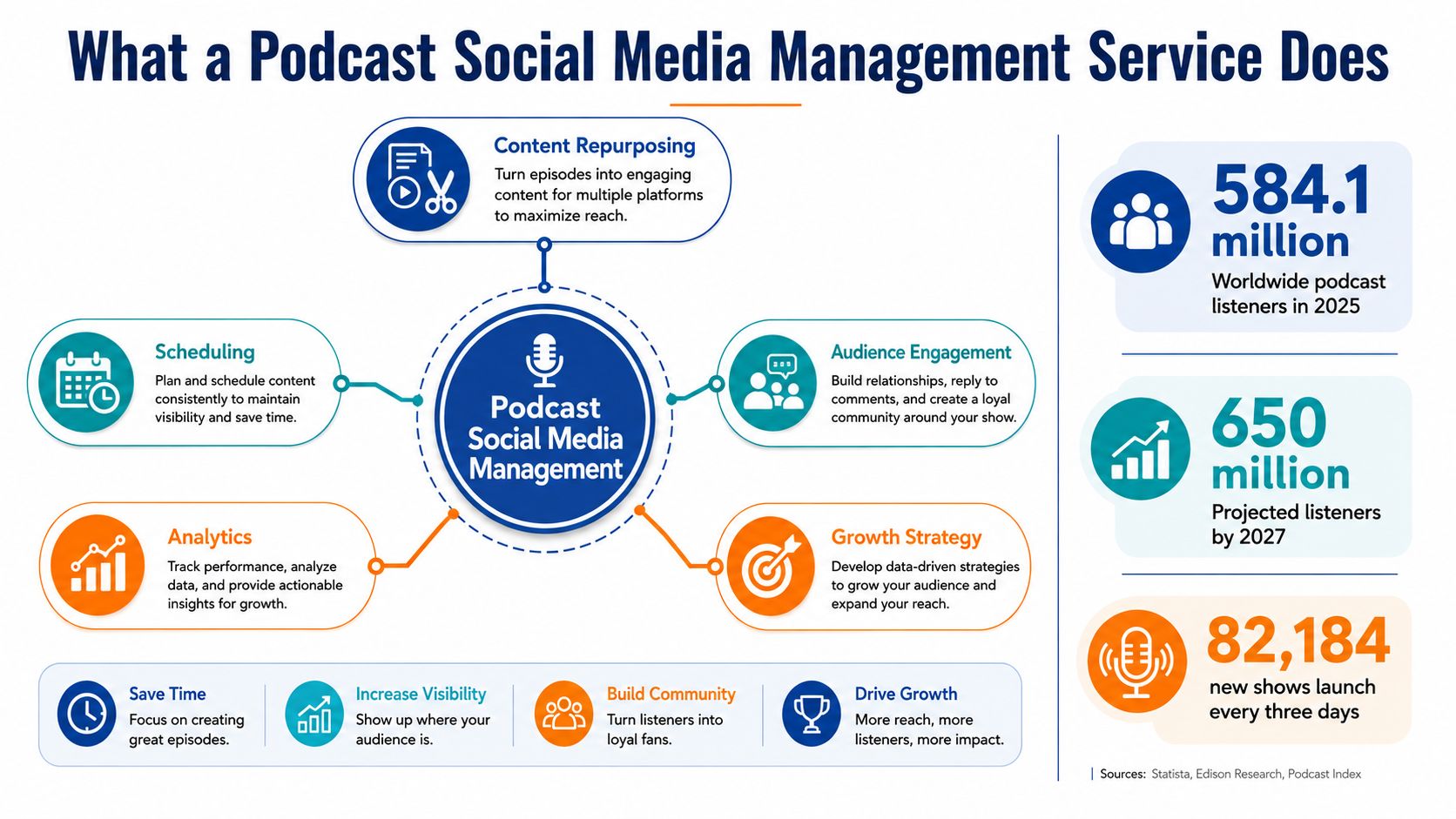
A podcast social media management service takes one recorded episode and turns it into 20 to 30 ready-to-publish assets in 72 hours, including clips, captions, graphics, scheduling, and platform strategy. That matters because podcasting is no longer a small niche, worldwide listeners reached 584.1 million in 2025, and projections climb to 651.7 million by 2027 (podcast marketing stats).
Competition is the key challenge. There are roughly 4.58 million to 4.70 million podcasts worldwide, and one report says 82,184 new shows launch every 3 days (podcast marketing stats). If you're still posting a random clip once in a while, you're not running promotion. You're hoping people notice.
What a Podcast Social Media Management Service Does
A podcast social media management service turns each episode into a repeatable distribution system. It is built for discovery, not just presence. That matters because the audience keeps growing while the catalog keeps expanding, so one off posts rarely keep up with how people find shows.
Episode-first, not post-first
A general social media manager usually starts with the calendar. A podcast-native service starts with the episode. That difference changes the whole workflow, because the recording is the source material, and every post comes from a specific moment, quote, or idea inside that episode.
Practical rule: if the episode does not drive the content, the content usually turns generic.
A podcast-specific service handles transcription, clipping, caption writing, visual formatting, and scheduling. The output is a system built from one recording, not a pile of unrelated posts. That is what lets podcast teams keep a feed active without trying to invent fresh ideas from scratch every day.
A high-quality podcast social media management service also understands platform behavior. YouTube matters for podcast discovery, Instagram matters for interaction, and X matters for volume. Metricool's 2025 Podcast Study found that YouTube posts generated a 3.13% engagement rate, while Instagram produced 5,517.51 interactions per post, and podcasts averaged 96.55 posts per month on X/Twitter (Metricool podcast study). That difference tells you each network is doing a different job, so the same asset should not be pushed everywhere in the same way.
For a closer look at how clips fit into that workflow, see podcast clips for social media. A strong service does not just post more. It uses the right format in the right place, based on how people consume podcast content.
What You Should Expect from a Podcast Social Media Service
A real service should give you a content mix, not a loose promise to “help with social.” The episode gets broken into pieces that fit how people consume content. That usually means clips for reach, text for context, graphics for saves, and a blog asset for search.
The structure below is what a serious podcast workflow should look like:
- 8 to 12 short vertical clips, usually for YouTube Shorts, Reels, or TikTok.
- 6 to 8 platform-specific posts, written in the host's voice.
- 4 to 6 quote graphics, built from the strongest lines.
- 1 to 3 carousels, especially useful for LinkedIn and Instagram.
- 1 SEO-ready blog article, pulled from the episode transcript.
A good team also builds around your brand kit. That means your logo, fonts, colors, and tone stay consistent. Copy shouldn't sound like a template. It should sound like the host, just cleaner and sharper.
Format-fit beats volume
The point isn't to flood every channel. The point is to match format to platform behavior. Vertical clips usually drive reach. Text posts, quote cards, and carousels are better at saving, commenting, and deepening the profile. That split is why a podcast social media service should include a posting playbook with each delivery.
A service also needs to know when to resurface old episodes. PodcastFastTrack's service page says its offer includes 4 text-based posts and 4 video shorts from each episode, plus 1 additional text post each month to revisit past episodes, along with scheduling, basic comment handling, and a monthly metrics snapshot (PodcastFastTrack social media management). That's the kind of operational detail that separates real service from random posting.
For show-notes repurposing ideas, see how to create podcast show notes from recordings. If the provider can't explain how every format supports a different outcome, they're probably selling activity, not growth.
The True Cost of DIY Podcast Social Media
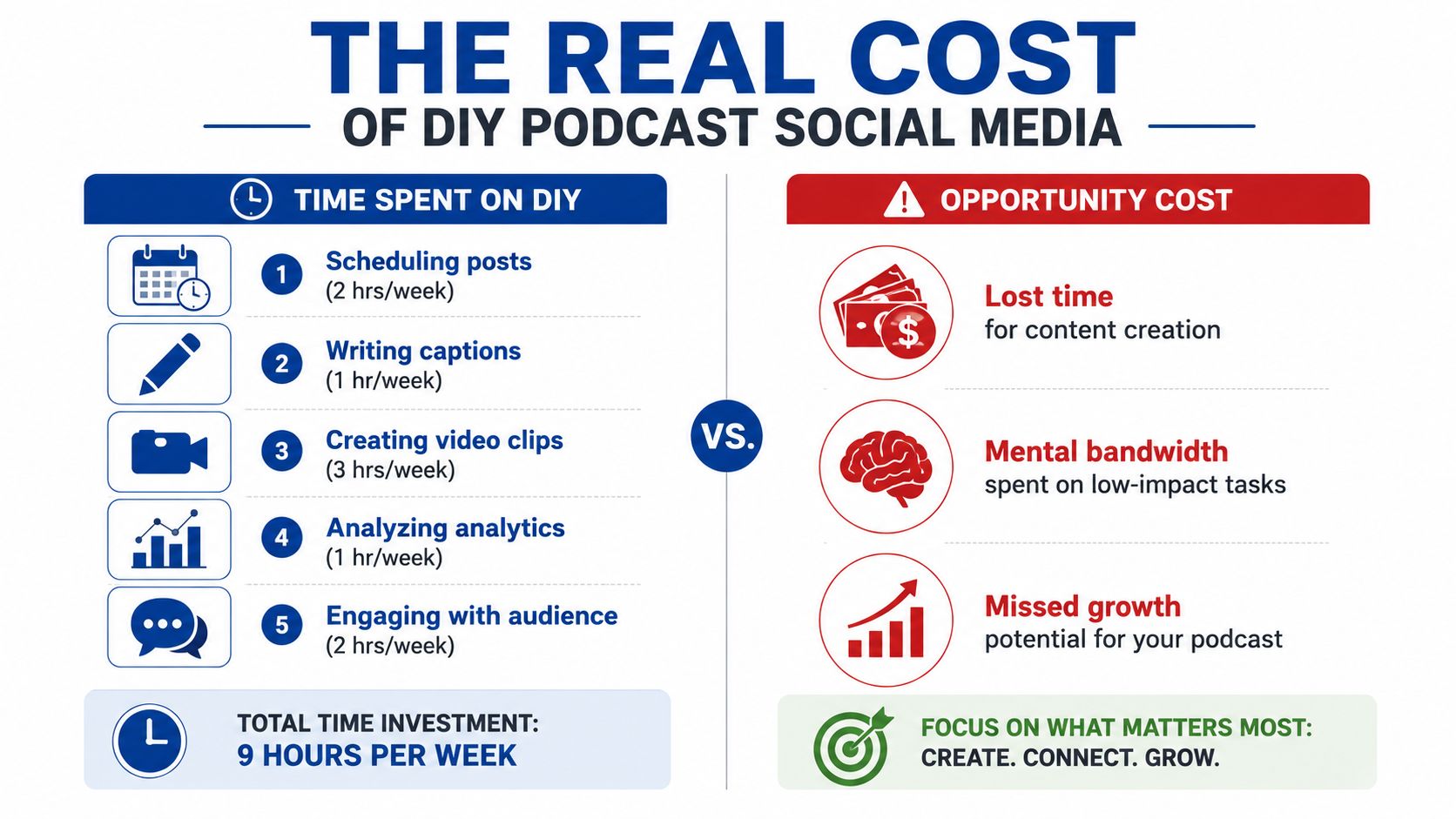
DIY social promotion looks inexpensive until someone counts the hours. A single episode can eat into a founder's week in pieces. The work is fragmented, so it rarely feels heavy while you are doing it, but it takes time from recording, guest outreach, episode planning, and the other work that keeps the show moving.
What the Week Looks Like
Writing captions usually takes 20 to 30 minutes per post. Designing quote graphics in Canva takes 10 to 15 minutes per asset. Clipping a 45-minute recording into platform-ready segments takes 2 to 3 hours. Uploading, formatting, and scheduling across three platforms adds another 1 to 2 hours.
One episode can easily take 6 to 10 hours of a podcaster's week. That does not include approval loops, guest follow-up, or fixing assets that miss the brand. If the show is weekly, the workload never really clears, it just returns in a new batch.
Practical rule: if social work takes more time than it returns in qualified listeners, the process is broken.
The harder truth is that podcast social media is not generic social media management. Episode-driven promotion has to start with the recording, pull the right clips, build the right post mix, and keep the message aligned across channels. A generalist manager can post for you, but a podcast-specific service is supposed to translate one episode into a repeatable content system. That difference matters when the feed needs to support the show instead of just staying active.
DIY also hides opportunity cost. While a host is clipping, resizing, and scheduling, they are not improving the next episode, preparing the next guest, or tightening the offer behind the show. A podcast-growth expert in 2026 argued that creators should total the time spent on clips, graphics, posting, and guest follow-up, then decide whether social is crowding out show quality. That is the right question. If the best hour of the week gets spent resizing assets, the show loses.
For a practical comparison, see how much content repurposing costs. The hidden expense is not software. It is attention.
Pricing Models and What They Should Return
Pricing says a lot about how a vendor structures the work. It also shows how much of the process is already built into the service. A lower-cost provider usually covers lighter execution. A stronger provider should bring structure, faster turnaround, and enough output to keep a show visible between episodes.
| Provider Type | Monthly Price | Typical Deliverables |
|---|---|---|
| Independent service provider | $400 to $800 | Defined deliverables, month-long management cycle, posting support, and basic strategy |
| Boutique agency | $999 to $2,499 | Multiple recordings, priority turnaround, planning, strategy calls, and fuller content systems |
Those ranges match real market offerings. Upwork lists podcast social media management tiers at $400, $600, and $800, each with a 30-day delivery time and 30-day management duration (Upwork podcast social media manager service). RepurposeYourContent's model starts at $999 per month for one recording and scales to $2,499 per month for a weekly content engine, with plans described as as little as $14 per finished asset and a 72-hour turnaround on deliveries. For a broader look at agency-style packaging, see content repurposing agency options.
What the money should buy
At the per-asset level, the math should be easy to track. If one recording becomes 20 to 30 assets, the service should cost less than hiring separate freelancers for editing, design, copy, and scheduling.
The return is not just more posts. It is better distribution. As noted earlier, Metricool's podcast study found that YouTube posts had the highest engagement rate at 3.13%, Instagram generated the most interactions, and X/Twitter handled the highest posting volume. That spread shows why ROI varies by show. B2B and expert-led podcasts often convert better on LinkedIn, while short-form video usually drives discovery elsewhere.
A useful benchmark is whether the service helps the show stay visible without eating the host's week. If it does that, the price is easier to justify.
How to Evaluate a Podcast Social Media Management Vendor
Start with format fit. A vendor that asks only how many posts you want usually isn't thinking about audience behavior. A better vendor asks where your listeners already are, then maps content to those channels instead of forcing a quota.
Questions that reveal the real process
Ask these before signing anything:
- Tone of voice: Do captions get written in your voice, or pulled from templates?
- Revision policy: How many rounds are included?
- Turnaround time: How fast do assets move from recording to delivery?
- Posting playbook: Does every delivery include what to publish, where, and when?
- Platform fit: Do they adapt clips, posts, and graphics for each channel?
- Ownership: Do you receive finished assets without watermarks or editing handoffs?
If the vendor wants you to handle design or rough cuts, that's not a full social service. That's shared labor with nicer packaging. The same goes for vague reporting. Monthly snapshots should show engagement, social performance, and practical improvements, not just a stack of screenshots.
A serious podcast vendor should be able to explain why a clip exists, why it goes on that platform, and what it should do next.
There's also a bigger strategic question. Some shows need audience growth. Others need listener quality and conversion. Spotify's research on underserved podcasts points to older shows with fewer listeners or fewer episodes, which means many shows need targeted distribution, not generic posting (Spotify research on less-streamed podcasts). That's the kind of nuance a real service should understand.
For vendor comparisons, see content repurposing services. If the provider can't show examples from podcasts like yours, keep looking.
The Done-for-You Workflow in Practice
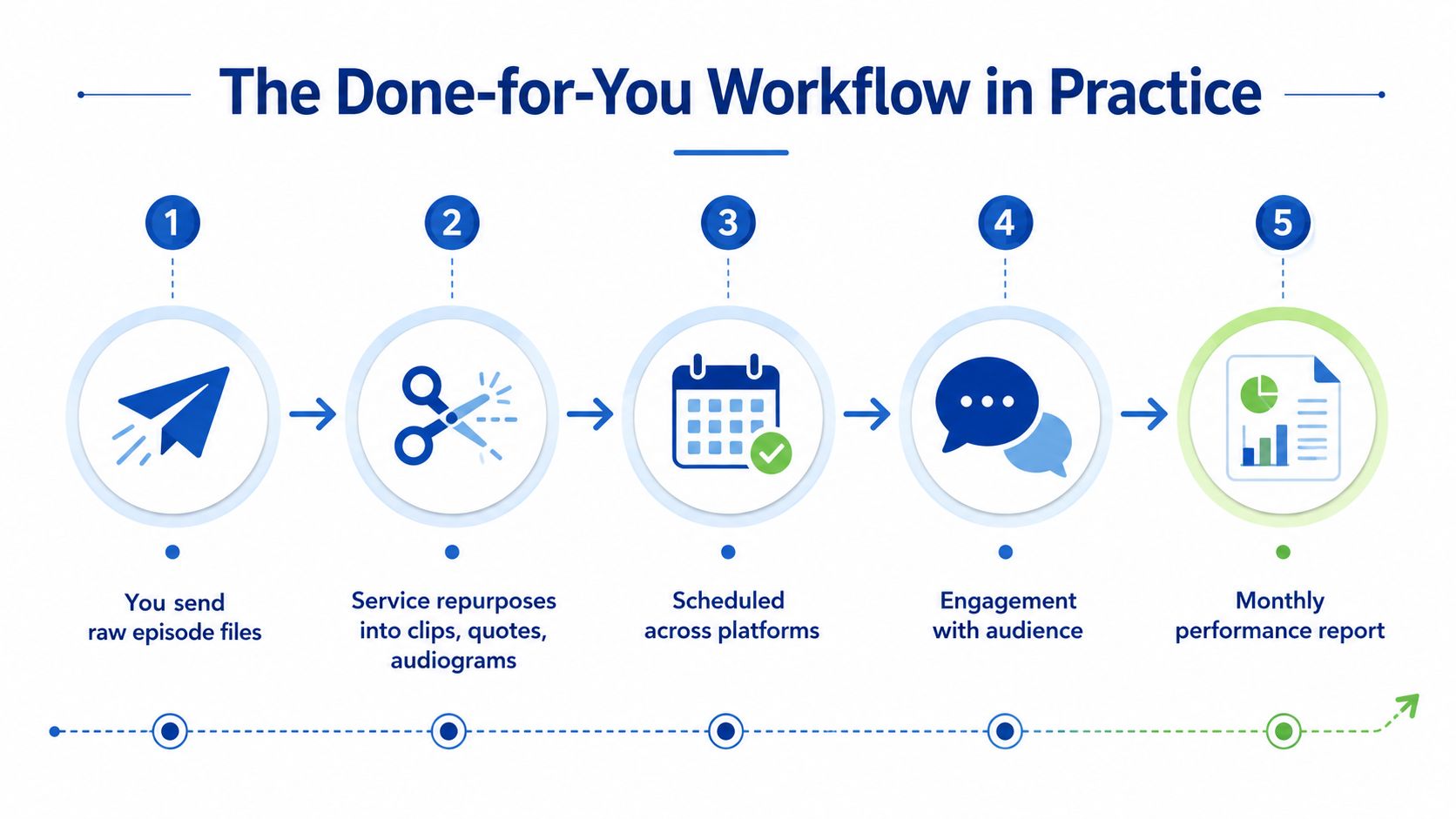
A proper workflow should feel boring in the best way. It should be simple for the client and structured on the back end. The less time the host spends managing the process, the more likely the whole system gets used every week.
A weekly show workflow that actually holds up
Step one is simple. You send one recording, a podcast episode, webinar, keynote, interview, or meeting recording. There's no need to chop it up first. The source file is enough.
Step two is analysis. The service transcribes the recording, finds the strongest moments, and maps them to formats that work on each channel. The best lines become clips, quote graphics, and posts. The less obvious but still useful moments become carousels or a blog article.
Step three is voice-matched writing. Captions should open with the episode's most specific claim, add a line of stakes or context, then end with a direct listen CTA tied to the episode. That formula beats vague copy every time because specificity earns attention.
Step four is brand alignment. Every asset should reflect the client's visual identity. No strange fonts. No off-brand colors. No recycled look that feels borrowed from another show.
Step five is delivery. A strong service sends 20 to 30 ready-to-publish assets in 72 hours, usually including 8 to 12 short-form clips, 6 to 8 posts, 4 to 6 quote graphics, 1 to 3 carousels, and a blog post. RepurposeYourContent uses that model as a done-for-you service, and the client's time is about 15 minutes for the upload and handoff.
The posting playbook matters too. For a weekly show, the assets should spread across the week so the feed doesn't go quiet. High-discovery days get clips. Midweek gets the carousel and article. Short posts and quote cards fill the gaps. That cadence follows the recording rhythm, not an arbitrary calendar rule.
What to Do Next as a Podcaster
The decision comes down to one question. Is your best use of time creating stronger episodes, or spending 6 to 10 hours a week on clipping, graphics, captions, and scheduling? If the answer is episodes, outsourcing social is the cleaner move.
A good next step is not a long sales process. It's a sample. Send one recording and ask for the full asset set back within 72 hours. Review the caption tone, the format fit, the platform mix, and whether the posting playbook makes your show easier to run.
A podcast social media management service should earn its keep by making episode promotion repeatable. The market is already large, and it keeps getting denser. Shows that rely on sporadic posting usually stay invisible. Shows that turn every episode into a full content engine build momentum over time.
For podcasters who want the episode to do the work, the practical move is straightforward. Book a call, request a sample, and compare the finished assets against the time you'd spend doing it yourself.
Tags: