Podcast Transcription to Blog Post Workflow
Turn one podcast episode into an SEO-ready blog post. This podcast transcription to blog post workflow covers cleanup, restructuring, voice editing

A 45-minute podcast episode can produce a strong blog post, but the transcript alone won't do it. A practical podcast transcription to blog post workflow uses transcription for source material, then applies editorial judgment, search-intent structure, voice editing, internal links, FAQs, and a final human review.
That distinction matters. 92% of podcasters repurpose transcribed content into blogs, social posts, or videos, according to podcast transcription industry statistics. Yet a cleaned transcript still reads like a conversation, not an article. The work begins after the audio becomes text.
The Real Cost of Turning Podcasts Into Blog Posts
A team records a thoughtful episode on Monday. By Wednesday, someone still needs to listen to it, find the thesis, rewrite the best sections, add search structure, and publish the result. The recording was only 45 minutes. The content operation can consume most of a workday.
Manual transcription alone typically takes 4 to 6 hours per hour of audio, while AI-assisted transcription takes roughly 5 to 10 minutes per hour, followed by 15 to 30 minutes of editing per hour for names, terms, and unclear passages, according to this AI versus manual transcription comparison. Transcription saves time, but it doesn't eliminate editorial work.
Where the hours actually go
For a 45-minute episode, a realistic DIY workflow looks like this:
- Transcript review: About 30 minutes to check speaker labels, names, technical terms, timestamps, and unclear audio.
- Thesis and structure: About 30 to 60 minutes to identify the main argument and create useful H2 headings.
- Prose rewriting: About 30 to 60 minutes to turn spoken passages into readable paragraphs.
- SEO optimization: About 15 to 30 minutes for keyword placement, metadata, FAQs, internal links, and formatting.
- Publishing: About 15 to 30 minutes for the CMS, images, links, quality checks, and scheduling.
A content workflow guide estimates that a 45-minute episode can become a 1,200- to 1,800-word post, with the full writing process taking about 1 to 2 hours, including transcription, editing, structure, SEO, and publishing. The podcast-to-blog conversion guide provides that breakdown.
The total varies by audio quality, topic complexity, and how prepared the editorial system is. A blank document creates more decisions. A standing template, brand voice guide, and fixed review checklist make the process faster because the team decides standards once.
Practical rule: A transcript reduces listening and typing. It doesn't replace an editor.
A broader content workflow can help teams assign those stages clearly. The Mallary.ai content workflow is useful context for mapping production tasks, owners, and review points across a recurring publishing operation.
The cost comparison becomes clearer when the article sits inside a larger content system. Teams assessing the cost of content repurposing should count review time, rewriting, design, publishing, and coordination, not just transcription minutes.
Generating and Evaluating Your Transcript
The first decision isn't which transcription service has the longest feature list. It's whether the recording gives automated speech recognition a clean enough signal to produce useful source material.
Clean, single-speaker studio audio can reach roughly 96% to 99% accuracy, while heavy accents, multilingual speech, and noisy field recordings may fall to about 80% to 90%, according to industry accuracy summaries covering AI podcast transcription tools. A benchmark-style source also places real-world English audio word error rates around 8% to 12% for meetings, podcasts, and phone calls. Those ranges aren't interchangeable, but they show why audio conditions matter.

Step 1 assess the recording before choosing the cleanup level
Check the source for:
- Speaker overlap: Crosstalk makes labels and sentence boundaries less reliable.
- Background noise: Cafes, conferences, traffic, and room echo obscure consonants.
- Specialist language: Product names, acronyms, people, and technical terms need manual verification.
- Language switching: Code-switching and multilingual sections require closer review.
- Compression damage: Remote recordings can contain clipped words and distorted voices.
Descript, Whisper-based services, and transcripts from Riverside or Zoom can all support the first pass. Speaker labels matter because they let an editor separate host commentary, guest answers, and usable quotations. The right choice depends less on brand loyalty than on audio quality, export options, and the amount of correction required.
For more detail on selecting an automated approach, consult this guide to automatic video transcription. The same evaluation logic applies to podcast audio.
Step 2 decide whether the transcript is a draft source or a rewrite source
A clean studio interview with distinct speakers may be reliable enough for direct outlining. A noisy panel with interruptions shouldn't move straight into article generation. It should support selective extraction, section-based summarization, and a human rewrite.
AI-assisted transcription generally takes 5 to 10 minutes per hour of audio, plus 15 to 30 minutes of editing per hour, as documented in the comparison cited above. That is the mechanical portion. The editor still verifies every name, number, product reference, and claim that could damage credibility.
The practical test is simple. Read a page without listening to the audio. If the meaning is clear and the terminology looks trustworthy, the transcript can support a first draft. If the page contains missing phrases, merged speakers, or uncertain names, treat it as raw material instead.
Restructuring Spoken Conversation Into Search-Intent Prose
A transcript follows the order in which people spoke. A blog post follows the order in which readers need answers. Those structures rarely match.
The editorial job starts by finding the episode's real thesis. The title may reflect the conversation, the guest, or the recording date. It may not reflect a search query. The final article needs one clear angle that connects the strongest insight to a specific reader problem.

Step 1 extract the thesis
Review the transcript for repeated ideas, strong explanations, useful examples, and moments where the guest answers a practical question. Then write the episode's core message in one sentence.
For example, an episode may cover AI editing, guest promotion, distribution, and analytics. The useful article angle might be how to turn a podcast transcript into an SEO blog post, not a broad recap of everything discussed. That narrower angle gives the article a reason to exist.
Step 2 map the thesis to search intent
A reader searching for a workflow expects a process. A reader searching for podcast SEO expects optimization guidance. A reader searching for transcription accuracy expects evaluation criteria. One episode can support several articles, but each article should answer one primary question.
The interview-based content marketing strategy approach is useful here because interviews often contain multiple possible themes. The editor must choose the theme that best serves the intended reader, not just preserve the recording's chronology.
Step 3 build the H2 hierarchy
Pull the strongest segments into a logical reading order:
- Define the problem and outcome.
- Explain the source-quality decision.
- Show the editorial transformation.
- Cover optimization and publishing.
- Answer objections or common questions.
- Give the reader a clear next action.
That outline may move a conclusion from the middle of the episode to the introduction. It may remove a long anecdote that worked in audio but adds no value on the page. It may combine three short answers into one stronger section.
Step 4 rewrite, don't polish line by line
Never publish a raw transcript and call it a blog post. Transcripts contain false starts, repeated clauses, conversational detours, and context that audio listeners understand but page visitors don't. They are source documents, not ranking artifacts.
Rewrite each passage as fresh prose. Keep a particularly sharp sentence as a pull quote when it carries the speaker's authority or personality. The surrounding explanation should still work for a reader who never hears the episode.
For a 45-minute episode, 30 to 60 minutes of editing and structure remains realistic, even with an established template, according to the workflow guidance supplied for podcast-to-blog production. AI can suggest an outline. It can't reliably decide what deserves emphasis, what belongs in an FAQ, or which anecdote should disappear.
Preserving Voice While Removing Filler
The best edited post sounds like the host on a clear, prepared day. It doesn't sound like a court transcript, and it doesn't sound like a generic content writer.
Start by removing verbal static:
- “Um” and “you know” when they add no meaning.
- False starts that never complete an idea.
- Repeated clauses caused by spontaneous speaking.
- Tangents that don't support the article's chosen intent.
- Filler transitions between otherwise strong points.
Then preserve the human signals that make the speaker recognizable. Keep contractions, direct address, rhetorical questions, unusual but meaningful phrasing, and signature expressions. Those details carry voice more effectively than copying every spoken pause.
A practical editing comparison
Spoken source:
“So, you know, what we found was, um, the transcript, it kind of gives you this starting point, and then you can, you know, turn that into the article.”
Edited prose:
“The transcript gives you a starting point. The article comes from the editorial decisions that follow.”
The second version removes static without changing the core meaning. It also creates a sentence structure readers can scan.
Fluency errors account for 48.55% to 71.12% of total transcription errors in ASR benchmark work, according to research on fluency errors in automatic speech recognition. That finding supports targeted cleanup. Editors should spend time first on disfluencies, punctuation, speaker labels, and domain terms in the weakest sections, rather than rewriting every line equally.
Use the read-aloud test
Read each finished paragraph aloud. If it sounds like a formal report, restore some looseness through contractions, shorter transitions, or a direct question. If it rambles, remove another clause or split the paragraph.
The target isn't a transcript with filler removed. It's the host's thinking presented with stronger organization and cleaner sentences. A polished blog can preserve warmth without preserving every detour.
Names and terminology deserve special care. Search the episode notes, guest website, company pages, and product documentation when available. A single incorrect name can undermine an otherwise useful article, especially when the post targets a technical audience.
The goal is the host on their best day, not a different writer.
SEO Optimization and Publishing Checklist
The final SEO pass should make the article easier to understand without forcing keywords into unnatural sentences. Start with one primary keyword. For this article, that phrase is podcast transcription to blog post workflow.
Place it in the H1, within the first 100 words, and in at least one H2. Use related variations naturally, such as podcast transcript to blog post, turning a podcast into an article, and how to create a blog from a podcast episode.

Run the final checklist
- Search intent: Confirm the introduction answers the reader's primary question immediately.
- Headings: Make each H2 describe a real reader need, not a vague topic.
- Meta description: Write a concise description under 160 characters that includes the primary keyword and gives a reason to click.
- Internal links: Link to relevant service pages and supporting articles in the existing content cluster.
- FAQs: Add questions that the episode answers clearly. Use FAQ schema only when the visible page includes the same questions and answers.
- Quotes: Attribute pull quotes accurately and verify the wording against the recording.
- Links: Test every internal and external link before publication.
- Formatting: Check paragraphs, lists, images, captions, and mobile readability.
- CTA: Give the reader one specific next step.
Internal linking works in both directions. Add links from the new article to older, relevant pages. Then update older pages to reference the new article when it genuinely expands the topic. That creates a connected content cluster instead of an isolated episode summary.
SEO reporting should also track more than rankings. A resource on how Oviond improves video reporting offers useful context for connecting content production with performance measurement. The blog team should review impressions, clicks, engaged visits, and assisted conversions where those metrics are available.
Publishing cadence depends on the recording's role. A timely interview, product announcement, or event discussion should publish while the subject remains relevant. An evergreen educational episode can enter a planned cadence, allowing the team to coordinate the blog, newsletter, social posts, and sales enablement links.
For a broader comparison of AI-assisted writing approaches, see this AI blog writing tools comparison. The important distinction remains editorial ownership. Automation can accelerate drafting, but a human should approve facts, structure, tone, and the final search experience.
The Done-for-You Alternative
DIY works when a team has reliable audio, a trained editor, and time reserved every week. It breaks down when the recording is only one task among client work, distribution, sales, and production.
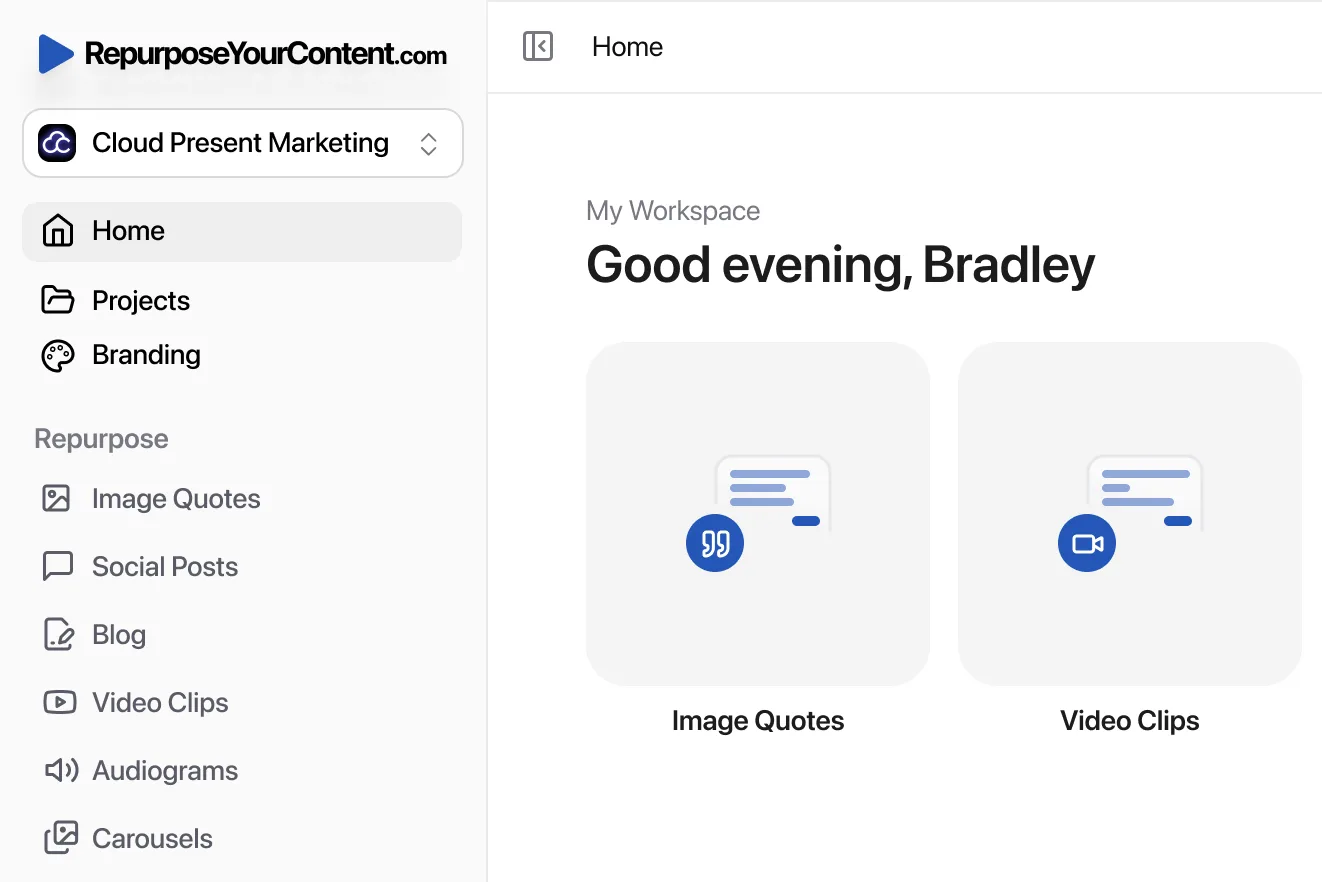
A done-for-you service applies the same workflow without asking the client to manage every stage. With RepurposeYourContent, clients send one podcast, interview, keynote, sales call, livestream, course, or meeting recording. The team delivers 20 to 30 ready-to-publish assets in 72 hours, including video clips, LinkedIn posts, quote graphics, carousels, audiograms, and an SEO-ready blog post in the client's brand voice.
One 45-minute recording becomes 30 assets. Client time is about 15 minutes, revisions are unlimited, and the 72-hour turnaround is guaranteed, or the client doesn't pay. Pricing starts at $14 per finished asset. The service model reflects the wider logic described in ViewsMax's content repurposing guide, where one long-form source supports multiple distribution formats.
Teams that want the podcast-specific workflow can review the podcast repurposing service. Book a call or request a sample to see how one recent recording could become a complete, on-brand content package.
Tags: